Origins & Early History of Yin-Yang Thought
阴阳观念的来历
The ideas of yin and yang are so deeply woven into Chinese thought that it is easy to assume they were always there, fully formed. In fact they had a long history, beginning as ordinary words about landscape and weather and only gradually becoming the abstract cosmological principles we know today. Tracing that development helps us see yin-yang not as a mystical doctrine handed down from antiquity, but as a way of thinking that Chinese thinkers built and refined over many centuries.
The oldest meaning: shaded and sunlit hillsides
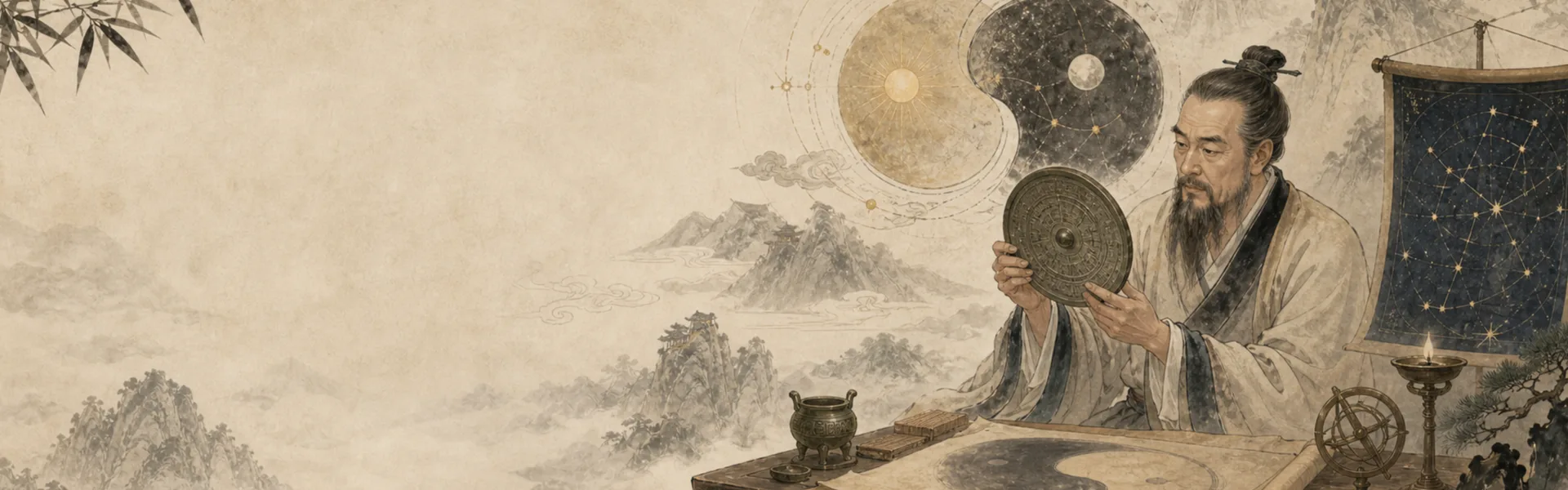
The oldest layer of meaning is strikingly concrete. In the earliest surviving texts, the characters for yin and yang refer simply to the shaded and sunlit sides of a hill or riverbank. Yang was the slope that caught the sun; yin was the slope that lay in shadow. The words also described the weather: a yang day was bright and clear, a yin day overcast. There was nothing metaphysical about this usage. It was the plain vocabulary of farmers and travellers describing the play of light across a landscape that changed with the hours and the seasons.
From a fixed pair to a relationship
From this everyday observation grew a more general insight. The same hillside was sunlit in the morning and shadowed in the afternoon; the shaded valley of winter became the warm field of summer. Light and shadow were not fixed properties of a place but conditions that shifted and exchanged with the turning of time. This simple recognition — that opposite conditions arise from one another and give way to one another — became the seed of the entire yin-yang idea.
The Yijing gives the idea a formal shape
The Book of Changes, or Yijing, played a central role in giving this intuition a more formal shape. Although the oldest core of the text is a manual of divination built on solid and broken lines, the philosophical commentaries that grew up around it, especially the material known as the Ten Wings, interpreted those lines in terms of alternating forces. The unbroken line came to represent the firm and active, the broken line the yielding and receptive. The endless recombination of these lines into trigrams and hexagrams offered a model of a universe in perpetual, patterned change. It is in these commentaries, traditionally but wrongly attributed to Confucius and now dated to the last few centuries BCE, that yin and yang begin to appear as cosmic principles rather than mere descriptions of terrain.
A separate tradition: the Five Phases
Meanwhile a parallel and originally separate tradition was developing around the Five Phases, or Wu Xing. The classic early reference appears in a chapter of the Book of Documents called the Great Plan, which lists Water, Fire, Wood, Metal and Earth together with their characteristic activities. At this stage the Five Phases and yin-yang were distinct schemes, each with its own history. Their fusion into a single system was largely the achievement of thinkers in the Warring States and early Han periods.
Zou Yan brings the strands together
The figure most often credited with bringing these strands together is Zou Yan, a scholar of the third century BCE associated with the state of Qi. Little of his own writing survives, and much of what we know comes from later reports, above all the account preserved by the historian Sima Qian. Zou Yan is remembered as the leading representative of what became known as the Yin-Yang School, one of the currents of thought that historians of the Han later classified among the major intellectual traditions. He is said to have developed elaborate theories linking the rise and fall of dynasties to the succession of the Five Phases, arguing that each ruling house governed under the sign of one phase and gave way to the next in a fixed order. Whether or not the details are accurate, Zou Yan stands as a symbol of the moment when yin-yang and Five Phase thinking became a comprehensive framework for understanding history, nature and politics together.
The Han synthesis
It was during the Han dynasty, from the second century BCE onward, that this combined system reached its mature form. The great synthesising works of the period wove yin-yang and the Five Phases into a single vision of a resonant, interconnected cosmos. The Huainanzi, a compendium produced at the court of a Han prince around 139 BCE, presents an elaborate account of how the world emerged from an undifferentiated origin, separating into the light and rising yang that formed the heavens and the heavy and sinking yin that formed the earth. The philosopher Dong Zhongshu, writing in the same era, applied the same principles to human affairs, arguing that the conduct of the ruler resonated with the patterns of Heaven and that harmony or disorder in the state would be mirrored in the natural world.
Correlative cosmology
This Han worldview is often described as correlative cosmology, and it represents the high point of early yin-yang and Five Phase thought. Everything in the universe was arranged into systems of correspondence: the seasons, the directions, the colours, the musical notes, the internal organs, the flavours and the planets were all mapped onto yin and yang and the five phases. A change in one part of this vast web was believed to resonate with the others, much as one string will sound when another tuned to the same pitch is plucked nearby. The purpose of knowledge, in this view, was to understand these correspondences well enough to act in harmony with them.
A contrast with Greek natural philosophy
It is worth pausing on how this differed from the direction taken by early Greek natural philosophy, which was developing in the same centuries. Greek thinkers tended to search for permanent underlying substances — the elements out of which things are ultimately made. Chinese thinkers, by contrast, were less interested in what things are made of and more interested in how they change and relate. The Five Phases were never quite elements in the Greek sense; they were phases of an ongoing process, stages in a cycle of transformation. This emphasis on relationship and change over fixed substance is one of the most distinctive features of Chinese thought, and yin-yang cosmology is its clearest expression.
Stability after the Han
By the end of the Han period the essential framework was complete, and it would remain remarkably stable for the next two thousand years. Later dynasties refined and elaborated it, and Song-dynasty Neo-Confucian philosophers gave it a new metaphysical depth, but the basic grammar established in the Warring States and Han eras was never overturned. The same concepts that Han scholars used to explain the succession of dynasties would later guide the physician taking a pulse, the geomancer siting a tomb, and the astrologer casting a chart.
Why this history matters
Understanding this history matters because it reminds us that yin-yang and the Five Phases were not revealed all at once as a finished doctrine. They grew from close observation of a changing world, were shaped by centuries of debate, and were assembled into a system by identifiable thinkers responding to the concerns of their age. This is why the ideas feel at once ancient and practical: they began in the plainest facts of sunlight and shadow, and they were built up, step by step, into one of the most enduring intellectual frameworks in human history.
How much of this history is secure
You should know how uneven the evidence is. The broad outline given above is accepted by most specialists, but several of its steps rest on thin ground. Zou Yan's own writings are entirely lost, so what he taught is reconstructed from later summaries written by people with their own arguments to make. Many texts traditionally assigned to the early period were compiled or heavily edited later, which makes it risky to date an idea by the text it appears in. The picture has also changed within living memory: manuscripts recovered from tombs at Mawangdui and Guodian since the 1970s have given scholars versions of familiar works that are centuries older than any previously available copy, and they show that some doctrines assumed to be late were already in circulation while others thought early are not there at all. The honest position is that the direction of development is clear while the dating of individual stages remains open, and you should treat any source that gives confident precise dates for these ideas with some caution.
Key points
Yin and yang began as ordinary words for the shaded and sunlit sides of a hill.
The same slope is sunlit at one hour and shaded at another, so the terms describe a relationship rather than fixed categories.
The Yijing gave the intuition a formal structure through its solid and broken lines.
The Five Phases (Wu Xing) developed separately before being combined with yin–yang.
Zou Yan, in the third century BCE, is credited with bringing the two strands together.
The Han dynasty produced the mature synthesis known as correlative cosmology.
Greek philosophy searched for permanent underlying substances; Chinese thought described patterns of change.
The framework was essentially complete by the end of the Han and stayed stable for two thousand years.
It grew from observation of a changing world rather than arriving as finished doctrine.
Sources drawn on for this article include Joseph Needham's Science and Civilisation in China, volume two, which remains the standard account of the development of yin-yang and Five Phase thought; the Stanford Encyclopedia of Philosophy entries on Chinese philosophy and the Yijing; and the historical writings of Sima Qian, which preserve the earliest surviving account of Zou Yan and the Yin-Yang School.