The Meaning of Yin and Yang
阴阳的含义
Two words carry an enormous amount of weight in Chinese thought, and most of the difficulty people have with them comes from treating them as nouns naming things rather than as terms describing relationships. This page sets out what yin and yang actually refer to, the four principles that govern how they behave, the misunderstandings that most often get in the way, and what the concept can and cannot do. It is worth going slowly here, because every later page in this section assumes this material.
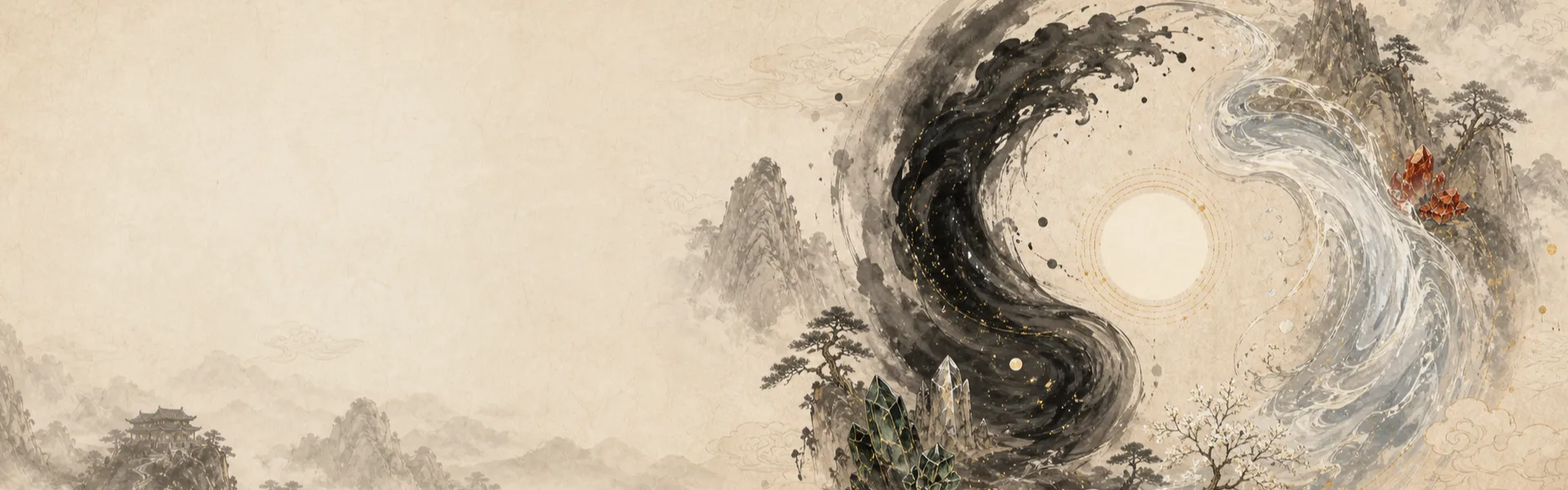
What the two words literally mean
The characters are concrete in origin. Yin refers to the shaded side of a hill or the north bank of a river, the side turned away from the sun. Yang refers to the sunlit side, the slope that catches the light. Both characters carry a component associated with hills or mounds, which fits this reading. You can still see the original sense in place names across China, where a town called something-yang usually sits on the sunny side of a feature and something-yin on the shaded side. Everything abstract that follows was built on this very ordinary observation: the same hill has two aspects at once, and which is which depends on where the sun is.
The first principle: they are relative
Nothing is yin in itself. A thing is yin only in relation to something specified. This is the single point that most popular accounts miss and the one that causes the most confusion when reading technical sources. Cool water is yin compared to hot water and yang compared to ice. Your torso is yang relative to your legs and yin relative to your head. A junior official is yin at court and yang at home. When a Chinese medical text seems to contradict itself by calling the same organ yin on one page and yang on the next, it is almost never an error; the comparison has changed. Train yourself to ask automatically: yin compared with what?
The second principle: they depend on each other
Neither term can exist alone, and not merely as a matter of logic. The tradition holds that each actively requires the other in order to function. Structure without activity is inert, and activity without structure disperses. The standard medical formulation is that yin is the substantial basis and yang the functional activity, so that damage to one eventually shows up as failure in the other. A patient whose material reserves are exhausted cannot sustain activity, and a patient whose activity has collapsed cannot build reserves. This is why treatment often addresses the apparently healthy side of the pair.
The third principle: they wax and wane against each other
The proportion between them is never fixed. As one increases the other decreases, and this constant adjustment is what the tradition calls balance. Balance here does not mean a static equal split, which would be a much less useful idea. It means an appropriate proportion for the situation, maintained through continual movement. Daytime activity is properly yang-dominant and night properly yin-dominant, and a person whose proportions do not shift with the situation is not balanced but stuck. When you read that some condition is a matter of imbalance, the claim is about a proportion that has stopped tracking circumstances, not about a departure from a fifty-fifty ideal.
The fourth principle: at the extreme, each becomes the other
When either reaches its limit it turns into its opposite. This is the most distinctive of the four and the least intuitive to readers trained on opposition. The winter solstice is the most yin point in the year, which is exactly why it is the moment yang begins to return. Extreme exertion produces collapse. A fever running its full course breaks into chills. The practical upshot is a general suspicion of extremes, not on moral grounds but on the grounds that anything pushed to its limit produces its own reversal. A good deal of Chinese strategic and medical thinking follows from this one observation.
Divisibility without end
Any yin or yang category can be divided again into yin and yang parts. Day is yang, but morning is the yang of yang and afternoon the yin of yang. This sounds like an idle move until you see it used, at which point it turns out to be the mechanism that makes the concept scale. It lets a practitioner zoom in to any level of detail while keeping the same vocabulary, which is how a single pair of terms can describe a season, a day, an organ, a tissue and a single moment in a movement. It also means that a yin-yang statement is meaningless unless you know at what level it is being made.
What the concept is not
Several things commonly attached to yin-yang are not part of it. It is not a moral distinction, and no classical source treats yin as evil; the pair describes how processes work, not what is right. It is not a fixed assignment of genders, though that correlation exists among many others and was later put to hierarchical use. It is not a claim about two substances or two forces, and looking for yin the way you might look for a particle or a field misunderstands the kind of term it is. And it is not a doctrine of conflict; the imagery of struggle between light and dark belongs to other traditions and does not fit this one.
Yin and yang in the body
Medicine is where the concept does its most detailed work. The surface of the body is yang and the interior yin. The back is yang and the front yin. Hollow organs that move things along are yang and solid organs that store are yin. Functional activity, warmth and rising are yang; substance, coolness and descending are yin. Symptoms sort accordingly, so that heat, restlessness and rapid pulse indicate yang excess or yin depletion, while cold, lethargy and a slow pulse indicate the reverse. The scheme is a sorting device that lets a practitioner assemble scattered signs into a pattern with a treatment direction attached.
Yin and yang in time
The cycle of day and year is the clearest natural illustration and the one the sources return to constantly. Yang rises from midnight, peaks at noon, declines through the afternoon and gives way at dusk; yin does the reverse. The same shape describes the year from winter solstice to summer solstice and back. This is why the concept is inseparable from the calendar, and why the fate and date-selection arts can treat a moment in time as having a determinate character. It is also the basis of practical advice about aligning activity with the phase of the cycle, which is among the more defensible recommendations in the tradition.
Why the idea proved so durable
Its usefulness lies in being a language for describing process and proportion at a time when no other was available. It handles change well, treats opposites as phases of one thing rather than separate categories, and scales from the cosmic to the momentary. For clinicians it provided a way to organise observations into patterns; for strategists a way to think about timing and reversal; for craftsmen a way to talk about the qualities of materials and processes. Ideas survive because they are workable, and this one was workable across an unusually wide range of activities.
How it connects to the other arts
Once you have this vocabulary, the rest of Chinese metaphysics becomes readable. Each of the ten heavenly stems and twelve earthly branches is classified as yin or yang, which is how a moment in time acquires polarity in fate calculation. Each of the eight trigrams is built from yin and yang lines, which is the basis of the Yijing and of compass feng shui. Directions, landforms and building orientations are assigned polarity. Internal martial arts describe opening and closing, substantial and insubstantial, in the same terms. The five phases are a separate system but were later fitted to this one, and every phase is further divided into yin and yang forms.
Yin, yang and qi
You will rarely meet yin and yang without also meeting qi, and the relationship between the three terms confuses many readers. The simplest workable account is that qi is the general term for whatever is active and in motion, while yin and yang are the two aspects under which any such activity can be described. On this reading yin and yang are not two different kinds of stuff but two characterisations of one thing, which is why the sources speak freely of yin qi and yang qi without implying two separate substances. This also explains a habit of phrasing that otherwise looks careless: a text may treat yang as a synonym for warmth, activity and function, and yin for coolness, substance and rest, without ever defining either, because in context these are aspects rather than definitions. When you find a passage hard to follow, try substituting the word aspect for the noun and see whether the sentence becomes clearer.
The limits, stated plainly
The concept's flexibility is also its weakness as an explanation. Because any situation can be described in these terms and because the terms are relative, no observation can ever count against the scheme. That makes it excellent as a descriptive and mnemonic language and poor as a testable theory. Where the tradition produced reliable results, as in parts of clinical practice, the credit generally belongs to accumulated observation that the yin-yang language organised rather than generated. Holding both halves of that judgment at once, taking the framework seriously without treating it as proven physics, is the most useful attitude to bring to the pages that follow.
Key points
- The words originally meant the shaded and sunlit sides of a hill, and the abstract concept grew from that observation.
- Nothing is yin in itself; the terms are always comparative, and the comparison must be specified.
- The four principles are relativity, mutual dependence, continual waxing and waning, and reversal at the extreme.
- Any category divides again into yin and yang parts, which is what lets one vocabulary work at every scale.
- The pair is not moral, not fixed to gender, not a pair of substances, and not a conflict between opposites.
- Its universal applicability makes it a strong descriptive language and a weak explanatory theory.