The Generating & Controlling Cycles
相生与相克
The five phases only become an analytic tool when you know how they act on one another. Two sequences of relation do almost all the work: one in which each phase supports the next, and one in which each phase restrains another. This page explains both, describes what happens when they malfunction, and shows how practitioners in medicine, martial arts and the calculation arts reason with them. If you learn only one thing from this section on the five phases, learn this page rather than the correspondence tables.
Why the relations matter more than the names
Beginners usually memorise the five phases and their correspondences and then find they cannot do anything with them. The reason is that a phase label on its own carries almost no information. Saying that a condition is Wood tells you very little. Saying that Wood is constrained and consequently overrunning Earth, while the Water that should nourish it is depleted, tells you what is happening and where to intervene. The system is relational, so its content lies in the connections rather than the nodes. Everything of practical use in five-phase reasoning is an application of the two cycles.
The generating cycle
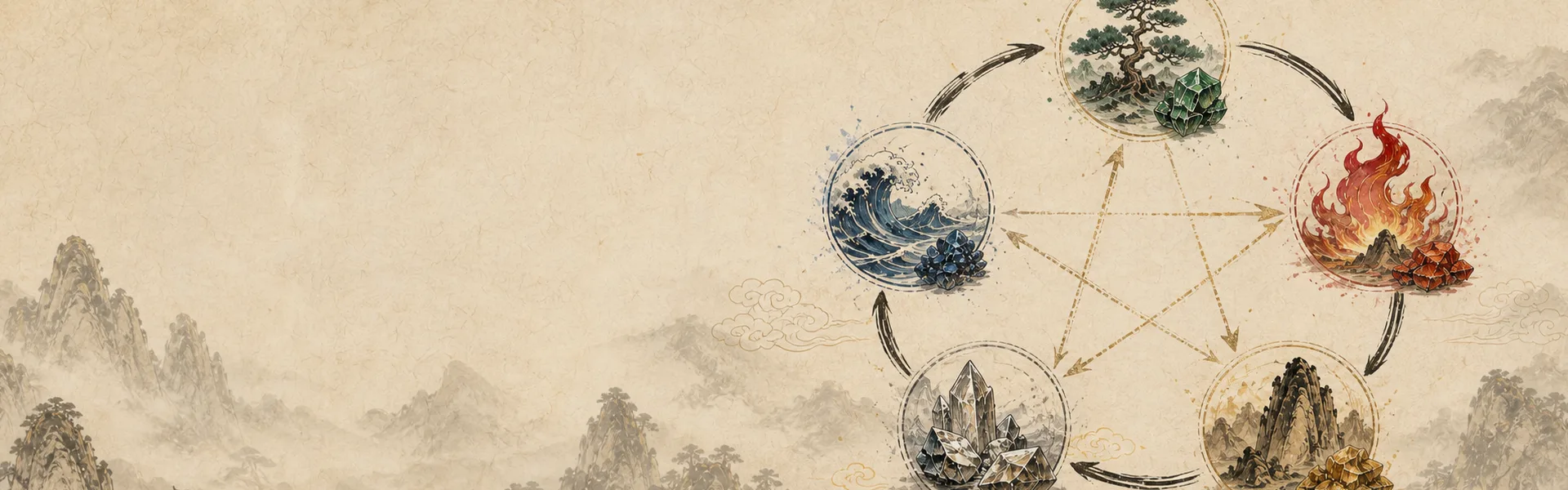
In the generating sequence each phase produces or supports the next. Wood feeds Fire, as fuel does a flame. Fire produces Earth, understood as the ash that remains. Earth bears Metal, since ores are found in the ground. Metal gathers Water, an association usually explained by condensation forming on cool metal or by the belief that mountain springs arise from mineral veins. Water nourishes Wood, as plants need moisture. Some of these links are obvious and others are clearly stretched, and it is more honest to acknowledge the unevenness than to defend every step as sound natural observation.
The language of mother and child
The generating relation is described in kinship terms. The phase that produces is the mother, the phase produced is the child. This is more than decoration; it structures how practitioners think about intervention. A depleted child may be treated by supplementing its mother, on the reasoning that the supply has failed rather than the phase itself. An overactive child may be reduced by draining its mother, cutting the supply rather than attacking the symptom. This indirect approach, treating the source rather than the site, is one of the most characteristic moves in the whole tradition, and the kinship vocabulary is what makes it easy to reason about.
The controlling cycle
In the controlling sequence each phase restrains the phase it can act upon, skipping one position in the generating order. Water quenches Fire. Fire melts Metal. Metal cuts Wood. Wood breaks up Earth, as roots split soil. Earth dams Water. Notice that this sequence is not the generating cycle reversed; it is a five-pointed star traced across the same circle, which is why the two cycles together form the familiar diagram of a circle with a pentagram inside it. The Chinese term is often translated as overcoming or conquering, which overstates the hostility of the idea.
Control is not hostility
The controlling relation is normally healthy and necessary. Restraint keeps a phase from running away with itself, and a phase that is not restrained becomes destructive. The proper reading is regulation, closer to a governor on an engine than to an enemy. Traditional sources are explicit that without restraint there is chaos, and that a well-functioning system has both adequate generation and adequate control. This matters for interpretation, because a reader who takes control as attack will misread clinical and strategic advice, treating a normal restraining relation as a problem to be removed rather than a function to be maintained.
When the relations malfunction
Two named disorders describe control gone wrong. In the first, a phase restrains its target excessively, overwhelming rather than regulating it, usually because the restraining phase is too strong or the restrained phase too weak. In the second, the relation reverses, and a phase that should be restrained bullies the one that ought to control it, which happens when the imbalance in strength is severe enough. Excess generation is also recognised as a fault: a mother that supplies too abundantly produces a child in excess. The general principle is that every one of these relations can fail either by being too weak or by being too strong.
Reading both cycles at once
Competent analysis never uses one cycle in isolation. Each phase stands in four relations simultaneously: it is generated by one phase, it generates another, it controls a third, and it is controlled by a fourth. To assess any phase you therefore ask four questions. Is what should feed it doing so? Is it able to feed what depends on it? Is it restraining what it should restrain? Is it being appropriately restrained? Most patterns in the literature are described as a specific answer to this set, which is why the same five names can generate a very large number of distinct configurations.
Why it works as a feedback model
Set out formally, the two cycles constitute a network in which every element both amplifies and dampens others, which is the general shape of a self-regulating system. This is a genuine formal virtue and probably explains much of the scheme's durability and appeal. The model captures something real about how interdependent processes behave: that intervening at one point produces effects elsewhere, that the effects run in both directions, and that a disturbance can propagate around a loop and return. Modern readers with a background in systems thinking often find this the most persuasive aspect of the tradition, and that recognition is fair as far as it goes.
Treating along the cycles in medicine
Clinical application is the clearest illustration. If Fire is deficient, a practitioner may supplement Wood, its mother, rather than only stimulating Fire. If Wood is constrained and invading Earth, the treatment eases Wood and supports Earth rather than attacking either alone. If Water is depleted and Fire consequently unchecked, the treatment supplements Water rather than only cooling Fire. Notice the shared logic: the site of the complaint is often not the site of the intervention. This is what practitioners mean when they say the scheme lets them treat the pattern rather than the symptom.
The cycles in martial arts
Xingyiquan is the clearest martial example, naming its five basic fists after the phases and using the two cycles to organise how they answer one another. In paired practice the relations supply a framework for which response counters which attack, so that the five fists are learned not as separate techniques but as a set of relationships. Taijiquan uses a related logic in its treatment of substantial and insubstantial and in the idea of answering force by redirecting rather than opposing. How literally any of this should be taken is debated among practitioners, and it is fair to say the scheme serves partly as a teaching structure and partly as a claim about combat.
The cycles in feng shui and fate calculation
In feng shui, phases are assigned to directions, forms, colours and materials, and the cycles are used to judge whether the assembled elements of a site support or undermine one another. A form read as Metal placed where Wood governs would be assessed as a controlling relation and considered unfavourable for what that direction represents. In fate calculation the eight characters of a birth chart carry phase values, and the analysis weighs which phases are strong, which are weak and which are absent, then considers how the cycles among them will play out over time as the calendar brings further phase influences into contact with the chart.
Where the two cycles came from
The historical picture is worth a paragraph, because it explains why the two sequences feel different in character. The controlling sequence appears to be the older of the two in its political use, since Warring States and early Han writers argued about dynastic succession in terms of one phase conquering another, and rival schemes existed in which the order ran differently. The generating sequence became dominant later and fitted better with the seasonal cycle, which is probably why it came to seem the more natural of the pair. The five-pointed diagram that shows both at once is a much later teaching aid rather than an ancient figure. What this history suggests is that the pairing of the two cycles was an achievement of systematisation rather than a single original insight, and that some of the awkwardness in the links reflects the effort of making two argumentative traditions agree.
What the model can and cannot show
The model is good at making you think about indirect effects and about balance across a whole system rather than a single point, and that habit has genuine value in clinical reasoning and in design. What it cannot do is settle disagreements, because the same situation can usually be described by more than one configuration, and different practitioners reading the same case may reach different and equally defensible conclusions. Nor can it be tested, since a failed prediction is readily explained by a relation that was not previously noticed. Use it as a way of organising thought about interdependence, and be sceptical of anyone who presents it as a mechanism.
Key points
- The five phases carry almost no information alone; the two cycles of relation do the analytic work.
- In generation each phase supports the next, described in the kinship terms of mother and child.
- In control each phase restrains a phase one step further round, tracing a star across the circle.
- Control is a normal regulating function, not hostility, and its absence is treated as a fault.
- Every phase stands in four relations at once, and analysis means asking whether each is functioning.
- The scheme is a useful feedback model but cannot be tested, since any outcome can be explained after the fact.