Taoism in Everyday Life
道家思想与日常生活
Taoism appears in everyday life through many channels: language and values, temple and festival culture, ways of caring for the body, relationships with place and season, artistic practice, and personal reflection. Some expressions belong to formal Taoist institutions; others are shared across the wider landscape of Chinese culture.
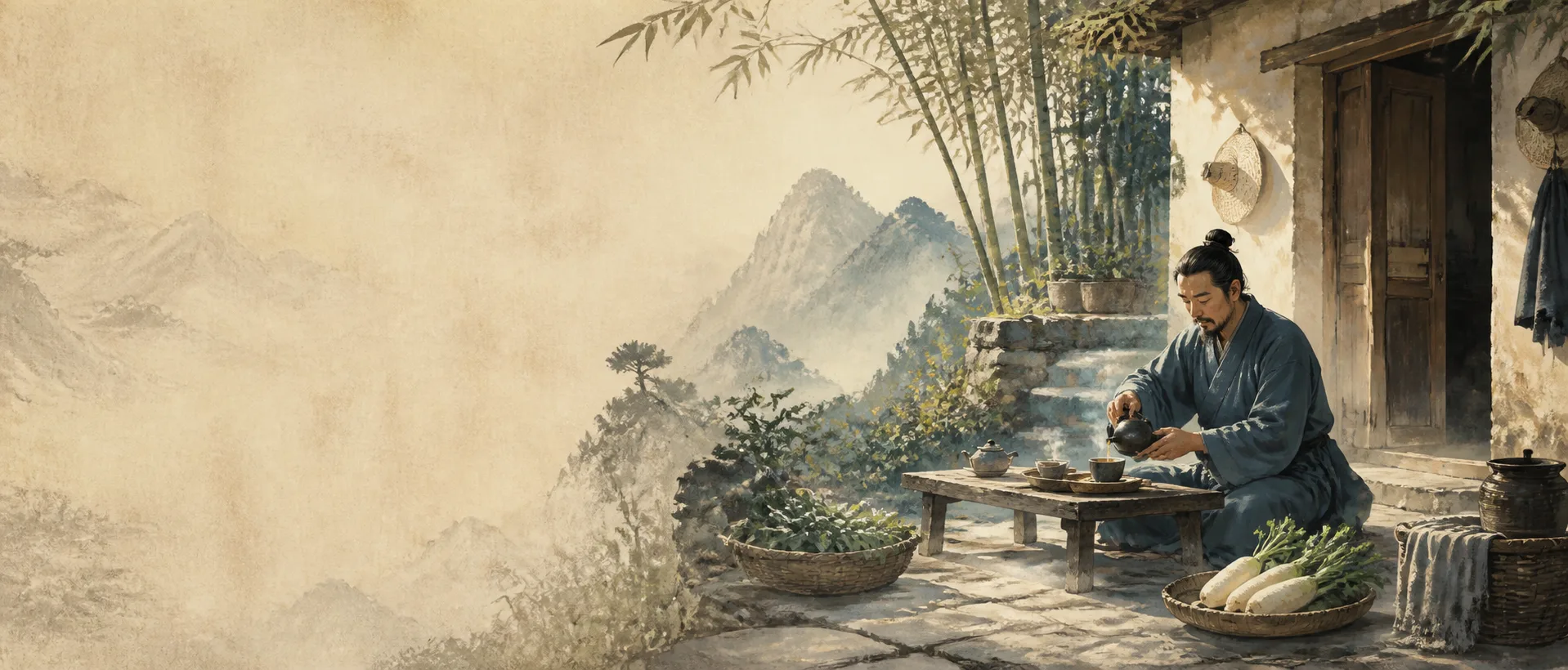
This diversity matters. Formal religious affiliation is only one way to understand participation. People may visit temples, honour local deities, observe festival customs, practise qigong, consult a traditional calendar or use Taoist-influenced ideas without describing every activity as a religious identity.
Temple, festival and community life
Taoist temples are places of worship, ritual, teaching and community memory. Visitors may offer incense, attend festival rites, seek blessings, remember ancestors or simply spend time in a sacred place. Ordained priests and monastics preserve liturgies, scriptures, music and lineages of practice, while local communities give each temple its own social history.
Participation varies by region, family and occasion. A festival gathering, a household observance and a monastic discipline are different expressions, yet each can connect daily life with a larger sacred and cultural world.
Cultivating body and attention
Taoist traditions have long explored the relationship between breath, posture, movement, attention and vitality. Practices associated with nourishing life (yangsheng), meditation and internal cultivation developed in varied historical and lineage settings.
Taijiquan, qigong, standing practice and gentle movement are now practised by people with many motivations, including health, martial study, cultural connection and personal discipline. Their benefits and demands depend on the practice, the teacher and the individual. Health information should be presented educationally and should not replace professional medical care.
Living with change
Ideas such as wu wei, ziran and yin-yang offer languages for observing relationship and change. In daily life, they can encourage a person to notice timing, unnecessary force, cycles of activity and rest, and the consequences of pushing a situation beyond its natural capacity.
These ideas are not formulas that produce one correct answer. They are ways of paying attention. Wu wei can invite skilful, proportionate action; ziran can encourage an uncontrived response; yin-yang can help us notice how apparently opposite qualities depend on and transform into one another.
Place, season and cultural rhythm
Seasonal festivals, the traditional calendar and attention to orientation or setting remain meaningful within many Chinese communities. Almanacs, date selection and feng shui belong to traditional interpretive systems with their own histories, methods and lineages. They are best understood through those cultural frameworks, with their claims and limits described clearly.
Not every seasonal or spatial custom is exclusively Taoist. Taoism developed in conversation with broader Chinese cosmology, local traditions, medicine, Confucian ritual and Buddhist practice. Shared ideas are evidence of cultural exchange, not a reason to collapse these traditions into one.
Arts as forms of attention
Calligraphy, painting, music, tea and incense culture can express qualities that also appear in Taoist thought: attentive presence, responsiveness, simplicity, spaciousness and respect for natural material. Each art has its own history and discipline. Their Taoist connections become most meaningful when explained through particular practitioners, texts, places and lineages rather than through general labels.
At Wudang, architecture, ritual, movement, mountain landscape and artistic culture meet in especially visible ways. The setting allows visitors to experience ideas not only as concepts, but also through paths, courtyards, sound, breath and movement.
Bringing the teachings into modern life
Readers around the world approach Taoist ideas through translation, practice, art and intercultural exchange. This continuing reception is part of the tradition’s modern life. A respectful approach keeps the Chinese historical setting visible while allowing sincere contemporary engagement.
Three habits make a thoughtful beginning:
Learn the original term and its range of meanings.
Notice which text, period, lineage or cultural practice is being discussed.
Let study, qualified teaching and lived experience deepen one another.
Taoism in everyday life is not one behaviour or identity. It is an evolving relationship between inherited traditions and the choices through which people continue to embody them.