Understanding Taoism in Context
认识道家与道教的文化脉络
Taoism has travelled through more than two thousand years of texts, communities, ritual, art and everyday practice. As it entered new languages and cultures, short explanations sometimes came to stand for a much richer tradition. Returning each idea to its context reveals a landscape that is more varied and more compelling.
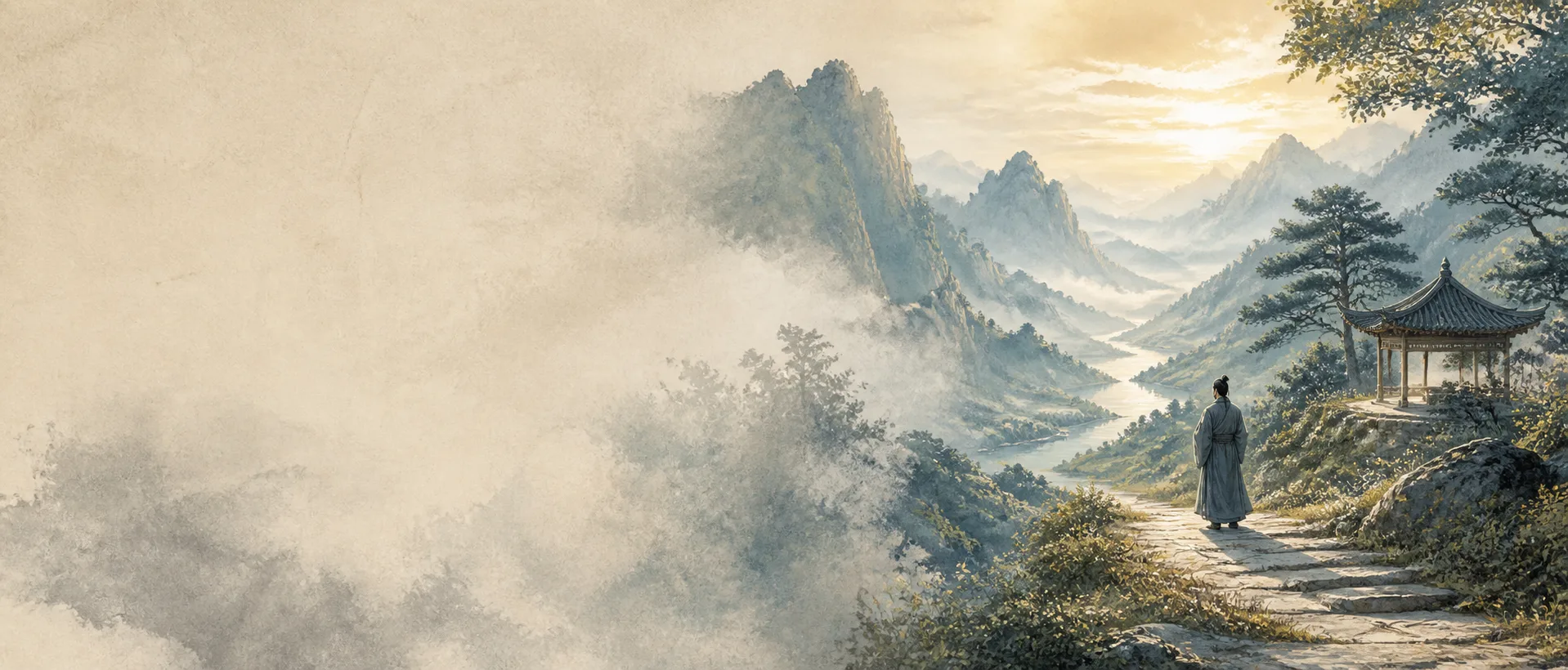
This article offers a constructive guide to that landscape. It places several familiar themes beside their classical, historical and living settings, allowing philosophy, religious practice, legend and cultural memory to be appreciated on their own terms.
The Tao beyond a creator-deity framework
In the Dao De Jing, dao can mean a way, a course or the underlying pattern through which the world unfolds. The text speaks of the Dao as nameless and not fully contained by language. It is not presented through the model of a personal creator who issues commands or intervenes according to preference.
Taoist religion also honours a rich sacred world of deities. These divine figures have histories, titles, responsibilities and devotional relationships, yet they exist within the larger cosmic order rather than simply serving as alternate names for the Dao.
Holding these two points together gives a fuller picture. The Dao provides a language for the generative course of things, while deities, ancestors and sacred officials give form to religious relationship, ritual and community life.
Wu wei as cultivated responsiveness
Wu wei (无为) is sometimes rendered literally as “non-action.” Classical examples show a more active meaning: the cook, craftsperson, swimmer or leader whose response is so well fitted that it appears effortless.
This ease is joined to attention and practice. A skilled person does not abandon effort at the beginning; practice gradually reduces unnecessary effort. In everyday life, wu wei may mean allowing a conversation room to settle, choosing the right moment to act, or simplifying a process so that people can participate naturally.
The concept therefore brings together preparation and openness. It values results achieved with clarity and proportion, without the strain of imposing one fixed plan upon every changing situation.
Yin and yang as relational patterns
Yin and yang are best understood as complementary tendencies in relationship. Quiet and movement, inward and outward, shaded and sunlit, receiving and expressing all change meaning according to their context. One side does not exist in isolation from the other.
The pair is also broader than any single correspondence. Although traditional systems can associate yin and yang with female and male, this is one strand within a wide network that includes seasons, directions, temperature, rhythm and phases of activity. The framework becomes most useful when it helps us observe relationship, transition and balance rather than assign permanent identities.
The taijitu gives this way of thinking a memorable visual form. Its flowing curve suggests alternation, while the two small circles recall that each tendency can contain the beginning of the other.
Laozi, tradition and textual history
Laozi occupies an honoured place in Chinese culture. Traditional narratives describe the Old Master meeting Confucius and composing the Dao De Jing before departing through a frontier pass. These stories have inspired literature, painting, temple culture and religious devotion for centuries.
Historical and manuscript research adds another dimension. Early versions of the Dao De Jing show differences in order and wording, and many scholars understand the received text as having taken shape over time. The earliest biography of Laozi also preserves several possibilities rather than one certain life story.
Legend and textual history can be presented together. Traditional accounts show how communities remembered Laozi and understood the authority of the teaching. Manuscripts show how a classic circulated and developed. Each reveals a different aspect of the work’s cultural life.
Taoism and Confucianism in dialogue
Taoist and Confucian thinkers often emphasise different approaches. Confucian traditions give sustained attention to learning, ethical cultivation, family relationships and ritual. Taoist texts frequently explore simplicity, flexible response and the limits of deliberate control.
Their relationship, however, has never been only opposition. They share terms such as dao and de, address many of the same questions, and influenced one another across centuries. Chinese scholars and families often drew from both traditions in different areas of life.
Reading them as a dialogue is more illuminating than treating them as mutually exclusive. Their contrasts sharpen important questions about education, social order, nature and freedom, while their long coexistence shows the inclusiveness of Chinese intellectual and cultural life.
Unity, difference and perspective
The Zhuangzi is celebrated for passages that shift perspective. A judgement that appears certain from one position may change when viewed from another creature, time or scale. This does not erase the particular qualities of things. On the contrary, the text is attentive to the unique grain of wood, the structure of an animal and the capacities of different beings.
Its invitation is to hold our categories with humility. Names and distinctions are useful, yet they may not exhaust the reality before us. Skill grows when perception remains responsive to particular circumstances instead of forcing every situation into the same scheme.
This interplay of unity and difference gives Taoist thought much of its depth. Things belong to a shared process of transformation while retaining their own forms, rhythms and possibilities.
Legend, lineage and the internal arts
Wudang martial culture is deeply shaped by Taoist ideas, sacred geography and generations of practitioners. Taijiquan and other internal arts use concepts such as yin-yang, softness, stillness, intention and qi to explain training and embodied skill.
Traditional accounts honour Zhang Sanfeng as a founding or inspirational figure. Historical documentation for named taijiquan systems becomes clearer in later periods, while Wudang’s wider Taoist and martial heritage has its own long and layered history.
These perspectives can stand together when their roles are clear. Founding narratives express identity, values and lineage memory. Historical study traces texts, communities and the development of practice. The practical value of an art rests in the quality of its teaching, training and transmission; appreciation of its legends adds cultural depth without requiring every narrative to function as a dated record.
Qi, the Five Phases and interpretive traditions
Qi has a wide range of meanings, including breath, vitality, atmosphere and material force. Traditional medicine, cultivation and martial arts use the term within their own theoretical and practical frameworks. Translating it only as modern physical “energy” narrows this range, so many writers retain the word qi and explain its meaning in context.
The Five Phases are wood, fire, earth, metal and water. They are dynamic phases and relationships, not simply five physical substances. Their generating and regulating cycles offer a traditional way of organising observations about change.
Feng Shui, BaZi, Zi Wei Dou Shu and date selection apply related correspondences through distinct methods and lineages. These are traditional interpretive systems with historical and cultural frameworks. Their claims, methods and limits should be described clearly and should not be presented as scientifically established certainty. A responsible introduction can respect their practitioners, explain their internal logic and help readers recognise the difference between cultural interpretation and empirical scientific conclusion.
Taoism as a broad living tradition
Stillness and calm are cherished in many Taoist practices, but they are part of a much broader tradition. Taoism also includes vivid ritual, music, ethical precepts, humour, community service, sacred journeys, bodily cultivation, ecological reflection and debate about governance and knowledge.
No single book, symbol or practice represents the whole. The Taoist Canon contains a vast range of scriptures and technical works. Local temples maintain distinctive customs. Lineages transmit specialised knowledge. Readers around the world continue to engage with the Dao De Jing and Zhuangzi in new settings.
This diversity is an invitation to explore. Context does not reduce wonder; it lets each expression of the tradition be understood with greater clarity and respect.
A helpful way to read
When encountering a new teaching or story, four questions can deepen understanding:
Does it come from a classical text, a religious scripture, a lineage, a local custom or a modern interpretation?
What role does it serve—philosophy, ritual, cultivation, art, identity or community life?
How does the tradition itself explain its meaning?
What can historical research establish, and where does interpretation begin?
These questions do not place tradition and scholarship in conflict. They allow different kinds of knowledge to contribute to a richer account.
Key points
The Dao is an impersonal, generative way or course; Taoist deities belong to a rich sacred order within religious tradition.
Wu wei joins practice, attentiveness and action without unnecessary force.
Yin and yang describe changing relationships and extend far beyond any single correspondence.
Traditional narratives and manuscript history illuminate different aspects of Laozi and the Dao De Jing.
Taoism and Confucianism have developed through both contrast and dialogue.
Wudang’s internal arts can be appreciated through practice, lineage memory and historical study.
Clear context allows traditional interpretive systems to be introduced respectfully and responsibly.