Where to Go Next
接下来读什么
You have completed the introductory pathway. From here, let your strongest question guide you. Taoism can be approached through philosophy, religion, movement, wellbeing, art, traditional systems of thought or the living landscape of Wudang Mountain. These are connected doorways rather than competing choices.
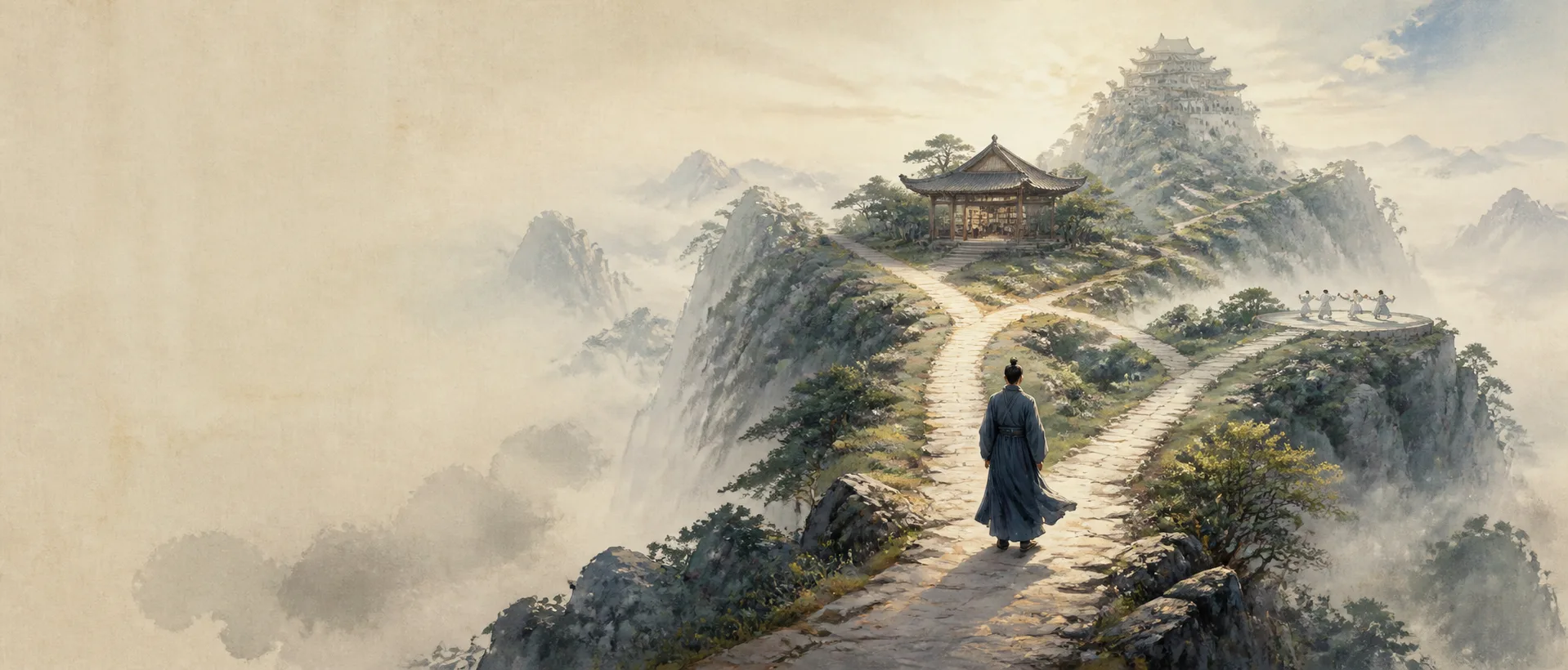
There is no single correct order. Begin with one area, then follow the ideas, people and practices that naturally lead you into another.
If you want to explore philosophy and the classics
Continue with the Tao Te Ching and the Zhuangzi. The Dao De Jing offers compact reflections on the Dao, de, naturalness, non-forcing and leadership. The Zhuangzi develops its insights through stories, humour, dialogue and shifts of perspective.
The I Ching opens a related path into change, timing and Chinese correlative thought. It is a shared classic with a long history of Confucian, Taoist and other interpretations.
If you want movement and regular practice
Visit Martial Arts for Taijiquan, internal arts, weapons traditions, training principles and Wudang martial culture. These pages help you understand what different arts value and what to look for in qualified teaching.
Visit Wellness for qigong, standing practice, nourishing-life traditions and gentle approaches to body awareness. Educational material can prepare you to ask better questions, while safe physical learning should reflect your condition and appropriate professional guidance.
If you are drawn to religion and living tradition
The Taoist Culture section introduces deities, temples, lineages, ritual, festivals, sacred music, scriptures and community life. It shows Taoism as a living religious tradition with many historical and regional expressions.
This pathway is especially helpful for understanding how classical ideas became embodied in institutions, sacred places, transmitted practices and relationships between communities and the divine.
If you love the arts
Explore Literati Arts through calligraphy, painting, guqin, tea, incense, gardens, flower arrangement and other cultural practices. Each art has its own techniques and history, while qualities such as attentiveness, naturalness, rhythm and spaciousness create meaningful conversations with Taoist thought.
Choose an art that already holds your attention. Close observation of one brushstroke, melody, tea practice or incense tradition can become a direct way of learning how cultural values take form.
If you are curious about traditional interpretive systems
Chinese Metaphysics introduces yin-yang, the Five Phases, the sexagenary cycle, feng shui, BaZi, Zi Wei Dou Shu, date selection, divination and related systems.
These are traditional interpretive systems with historical and cultural frameworks. Their methods, claims and limits should be described clearly and should not be presented as scientifically established certainty. A careful introduction can respect their practitioners, explain their internal logic and help readers understand their continuing cultural roles.
If you want to encounter Wudang as a place
Visit Experience Wudang to learn about the mountain’s history, temples, architecture, sacred geography, travel preparation and study opportunities. Reading about individual sites before a visit can make their spatial, religious and artistic relationships easier to recognise.
Wudang Mountain brings many parts of this website together. Philosophy, ritual, architecture, movement, music, health cultivation and the natural landscape meet there in a living cultural setting.
Choose a thoughtful beginning
If you are unsure, try one of these simple routes:
Read one short classical passage and one historical explanation beside it.
Explore one practice that suits your interests, body and available time.
Choose one art and learn how its materials, gestures and values developed.
Study one temple or mountain site before looking at the wider landscape.
Attend a clearly presented cultural programme and learn directly from an identified teacher or facilitator.
A good beginning does not need to cover everything. It needs to be clear enough to sustain curiosity and open enough to lead towards deeper study.