Philosophical and Religious Taoism: Distinct Paths, Shared Traditions
道家与道教:不同路径,共同传统
English often uses “Taoism” for a broad field that includes classical philosophy, organised religion, self-cultivation, ritual, art and everyday culture. Chinese offers two familiar terms: Daojia (道家), usually associated with a school or family of thought, and Daojiao (道教), the organised teaching and religious tradition.
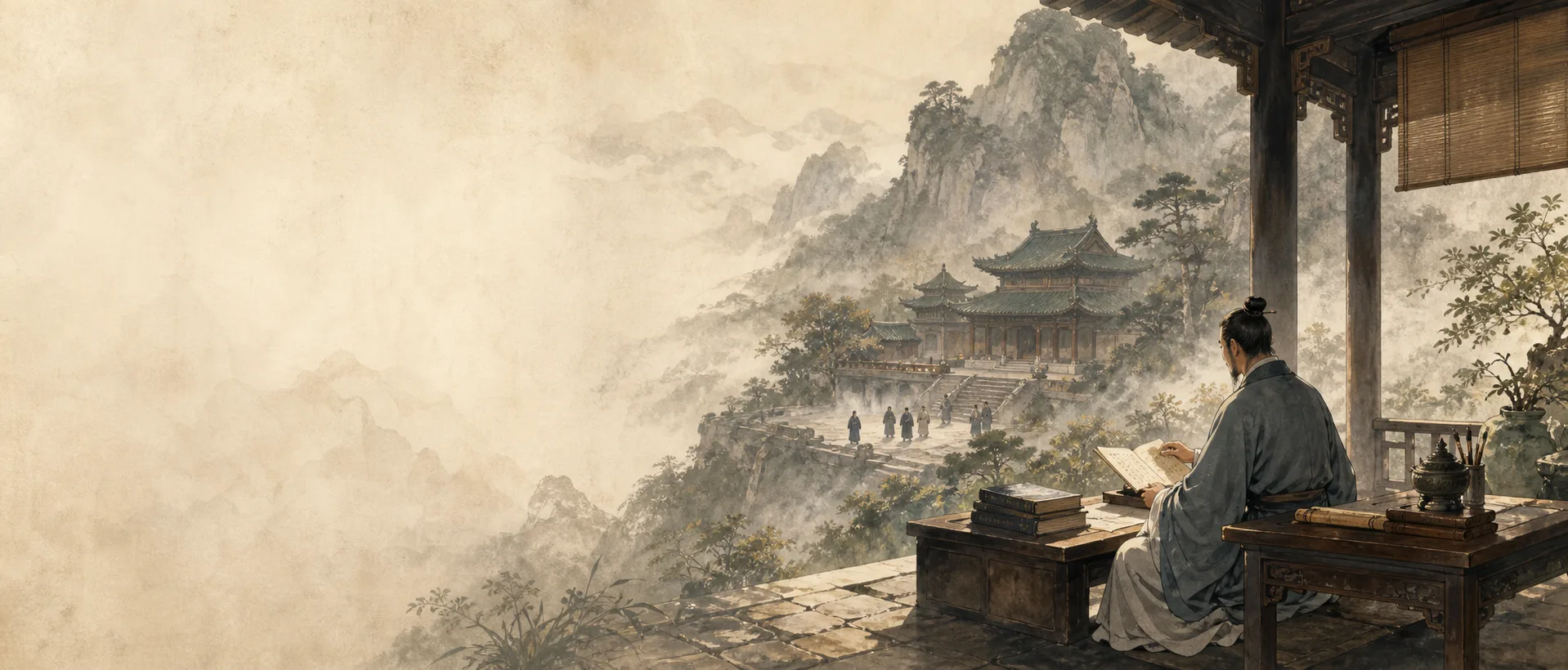
This distinction is helpful, but it is not a wall. Across Chinese history, texts, ideas, communities and practices have moved between these categories. Taoism is best understood as a diverse tradition in which philosophical inquiry and religious life have developed along distinct paths while continually sharing language and inspiration.
Why the distinction is familiar
Modern introductions often begin with “philosophical Taoism” and “religious Taoism.” The first usually centres on the Dao De Jing and the Zhuangzi, texts associated with the late Warring States and early imperial periods. The second refers to organised communities, ritual traditions, scriptures, temples, priests and lineages that became historically visible in later centuries.
The two-part description gives readers a useful starting map. It helps distinguish a philosophical passage about knowledge or government from a liturgical text used in a temple. It also reminds us that one English word covers materials produced in different periods and settings.
At the same time, modern categories can make the landscape appear more divided than it was. Classical texts became part of religious canons and practice. Religious teachers wrote philosophy and commentary. Scholars participated in ritual, cultivated health practices and drew upon Confucian, Buddhist and Taoist sources without needing to belong to only one intellectual identity.
Daojia: classical thought and enduring questions
Daojia is often translated as the “School of the Way.” The category was shaped by early Chinese historians and bibliographers who grouped certain thinkers and texts together. The writers we now associate with this field did not necessarily see themselves as members of one formally organised school.
The Dao De Jing explores the relationship between the nameless Dao, human conduct and governance. It values simplicity, humility, responsiveness and action without forcing. The Zhuangzi examines perspective, language, transformation, freedom and skill through dialogue, humour, story and paradox.
These texts do not present a single systematic doctrine. Their power lies partly in the questions they keep open: How can we act without imposing too much? What happens when fixed categories limit perception? How does skilled action become spontaneous? What does it mean to live well within continual change?
For more than two thousand years, readers have approached these works as philosophy, spiritual literature, guidance for leadership and resources for personal cultivation. Their interpretations have continued to evolve across Chinese and international contexts.
Daojiao: community, ritual and lineage
Daojiao refers to Taoism as an organised religious tradition. Recognisable communities emerged during the early imperial period, including the Way of the Celestial Masters in the second century CE. Over time, Taoist traditions developed extensive scriptures, ethical precepts, ritual systems, sacred geography, meditation, internal cultivation and forms of communal service.
Taoist ritual joins the human community with a sacred cosmos. Priests may conduct offerings, petitions, purification, memorials, blessings and rites of renewal according to their lineage and local tradition. Temples honour divine figures with distinct stories and responsibilities. Festivals connect families and neighbourhoods with seasonal and regional rhythms.
Lineage is important because ritual knowledge is embodied as well as textual. Music, movement, recitation, visualisation and the preparation of ritual documents are learned through guided practice. Major lineages such as Zhengyi and Quanzhen preserve different institutional forms while sharing a commitment to the Dao and to disciplined cultivation.
Shared texts and changing interpretations
The relationship between classical texts and organised Taoism is not simply one of origin followed by expansion. Later communities received the Dao De Jing, revered Laozi and read early ideas within new spiritual, ritual and cosmological frameworks. Commentaries connected passages with meditation, ethics, governance and internal cultivation.
This process is part of the vitality of a tradition. A classical work can preserve its early historical setting while also acquiring new roles through centuries of reading and practice. The Dao De Jing may be studied as philosophy, recited as scripture and used as a guide for cultivation. These approaches differ, yet each belongs to its reception history.
Shared vocabulary also provides continuity. Dao, de, qi, wu wei and ziran appear across philosophical and religious settings, though their emphasis may change. Ideas of harmony, transformation, simplicity and return likewise move through literature, ritual, medicine, visual culture and the arts.
Taoism within Chinese cultural life
Chinese traditions have long developed through dialogue. Taoism, Confucianism and Buddhism influenced one another in philosophy, institutions, art and everyday practice. A person might honour ancestors, study Confucian ethics, read the Zhuangzi, visit a Taoist temple and participate in local festivals without seeing these activities as mutually exclusive.
Taoist culture also includes connections with mountains, pilgrimage, martial traditions, calligraphy, music, medicine, tea and ideas of nourishing life. Each connection has its own history. Some are institutional and well documented; others are local, artistic or interpretive. Presenting them clearly allows both their cultural meaning and their historical development to be appreciated.
Living expressions of Taoism
Taoism today remains diverse. It is present in temples and ordained lineages, in household and community ritual, in scripture recitation, meditation and health cultivation, and in scholarly and personal engagement with classical texts. Its forms vary across mainland China, Taiwan, Hong Kong, Southeast Asia and global communities.
Wudang holds a distinctive place in this living landscape. Its sacred mountains, temples, Quanzhen heritage, martial arts and cultivation practices have made it an important centre of Taoist culture. Historical research and lineage memory each contribute to understanding that heritage. Treated with care, they enrich rather than compete with one another.
How to use the distinction responsibly
“Philosophical” and “religious” remain useful labels when they identify the kind of source or practice being discussed. They become limiting when one side is treated as the authentic form and the other as secondary.
A more complete approach asks:
Which period, text, community or lineage is being described?
Is the subject philosophy, ritual, cultivation, social history or a combination?
How did later practitioners receive and reinterpret earlier ideas?
What does historical documentation show, and how does the tradition understand its own inheritance?
These questions make room for precision without reducing Taoism to a single definition. They also show why the tradition has endured: its texts invite inquiry, its communities preserve practice, and its symbols continue to provide meaningful ways of relating human life to a larger order.
Key points
Daojia usually refers to a family of classical thought; Daojiao refers to organised Taoist teaching and religion.
The distinction helps identify different sources and settings, but the historical relationship is interconnected.
The Dao De Jing and Zhuangzi became both philosophical classics and important texts within religious tradition.
Taoist religion includes communities, scriptures, ethics, ritual, sacred places, cultivation and transmitted lineages.
Taoism has developed through dialogue with Confucianism, Buddhism and local culture.
Philosophical study and religious practice are distinct but equally meaningful dimensions of Taoist heritage.