Cao Guojiu and Li Tieguai: Privilege, Poverty and the Immortal Body
曹国舅与铁拐李:特权、贫困与身体身份
These two mark the outer limits of the Eight Immortals set. Cao Guojiu is an imperial relative, the highest-born member of the group. Li Tieguai is a filthy, lame beggar. Putting them in the same set of eight is the clearest statement the arrangement makes.
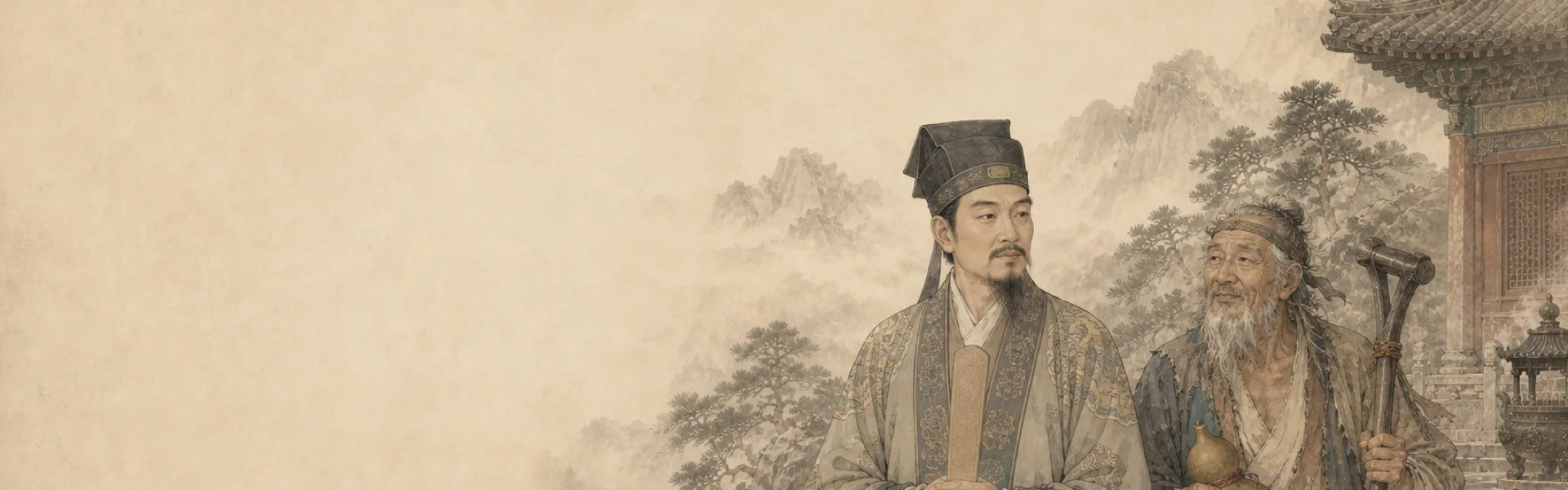
Their stories are also the two most interesting in the cycle from a doctrinal point of view. One is about the moral position of privilege; the other is about whether a person is their body.
Cao Guojiu: The Emperor’s Brother-in-Law
Guojiu is not a name. It is a title meaning the emperor's brother-in-law, so his designation is "Cao, the imperial brother-in-law" — identifying him purely by his relation to the throne, which is the point about him.
He is traditionally identified with a Song figure, the younger brother of the empress who was consort to Emperor Renzong in the eleventh century. That man was a real official who lived a long and unremarkable life at court, and the identification is traditional rather than demonstrable. As with most of the eight, the legend attached itself to a name that carried recognisable social weight.
The story told about him concerns the misconduct of a relative. In the usual version his younger brother used the family's imperial connection to commit crimes, in some tellings including killing, confident that the connection made him untouchable. Cao Guojiu, unable either to prevent this or to accept it, gave up his position, distributed his property and left. He was then encountered by Zhongli Quan and Lü Dongbin, who tested and instructed him.
What makes the story unusual is where it locates the moral problem. He has not done anything wrong himself. His difficulty is that he benefits from a structure that permits wrongdoing, and cannot correct it from inside. The renunciation is not penance for personal sin; it is a refusal of complicity. This is a fairly sophisticated moral position for a popular legend, and it explains why the figure was retained rather than being flattened into a generic pious official.
What Cao Guojiu Represents among the Eight Immortals
His attribute is a court tablet — the flat jade or wooden plaque held by officials at audience — and he is normally shown in official dress, sometimes with an official's cap. He is the only member of the set who looks like a member of the government, and in compositions he is often placed to make that contrast visible.
In some regional traditions he is regarded as a patron of the theatrical profession, on the basis that his tablet resembles the clappers used to beat time on stage. Attributions of this kind usually rest on a visual resemblance or a pun rather than on doctrine, and they vary from place to place.
The tablet also carries a general meaning within the set. It is the emblem of a man who had access to the highest authority in the empire and set it down. Where Lü Dongbin's sword is an instrument and Zhang Guolao's drum is a livelihood, Cao Guojiu's tablet is a credential, held loosely by someone who no longer wants it.
He is the least storied of the eight in popular narrative. There are fewer episodes about him, less opera, and almost no independent cult. His function in the set is structural: someone had to occupy the top of the social range.
Li Tieguai and the Story of the Borrowed Body
Li Tieguai is often placed first in listings of the eight and is among the most frequently depicted. He is shown as a beggar: unkempt hair, bare chest, ragged clothing, a lame leg, leaning on an iron crutch, with a gourd slung at his side.
The story explaining this appearance is the most philosophically pointed narrative in the cycle. In the standard version he was originally a man of ordinary or even handsome appearance who had mastered the practice of leaving the body in spirit travel. Before a long absence he instructed a disciple to watch over his body for seven days and to cremate it if he had not returned by then.
On the sixth day the disciple received word that his own mother was dying. Faced with a conflict between his duty to his teacher and his duty to his parent, he burned the body and left. When the traveller returned there was nothing to return to. Finding the corpse of a lame beggar who had just died, he entered it, and kept that form thereafter.
The economy of the story is worth admiring. Nobody in it behaves badly. The disciple's choice is between two of the strongest obligations in Chinese ethics and either choice is defensible; the tradition does not condemn him. And the outcome is not a punishment. Li simply continues in a different body, which is exactly the point.
What Li Tieguai’s Borrowed-Body Story Means
The body-swap narrative makes a claim that runs through the whole longevity tradition: that identity is not identical with the body.
This connects directly to the technical literature. Ge Hong in the fourth century graded transcendents into those who rise to the heavens, those who remain on earth, and those who depart by leaving the body behind — the last a recognised category with a name, not a euphemism for dying. The empty-coffin motif that recurs in Taoist hagiography, including in Zhang Guolao's story, belongs to the same framework.
It also reframes what "immortality" means in this tradition. The English word suggests endless duration in the body one has. The Chinese goal, becoming a xian, points to refinement and a changed condition. A story in which the attained practitioner ends up in a worse body than he started with would be incoherent if duration in a particular body were the aim. It is entirely coherent if the aim is a change of state.
And it does something for the set. The most spiritually advanced member of the group is the one who looks the worst. Li Tieguai's appearance is not a disguise adopted to test people, which is a common motif elsewhere; it is simply what happened, and he did not consider it worth fixing. The indifference is the demonstration.
This site describes these practices historically and structurally, provides no instructions, and does not present traditional physiological claims as fact.
Li Tieguai’s Crutch, Gourd and Healing Role
His two attributes are easy to read and both have content.
The iron crutch gives him his name — tieguai means iron crutch — and in some versions it was given to him by the Queen Mother of the West, which upgrades a beggar's stick into an instrument of transmission. It is the most immediately recognisable object in the whole set.
The gourd is more interesting. Gourds appear throughout Chinese religious imagery as containers of medicine, and Li Tieguai is widely invoked in connection with healing and by people in the pharmacy trade. The gourd is sometimes shown with smoke or a small figure emerging from it, indicating that what it contains is not simply liquid.
The gourd also has a cosmological reading: a small opening giving into a large interior is a standard Chinese image for a self-contained world, and it appears in that sense in a well-known phrase about a separate realm inside a gourd. Whether that reading was intended in his iconography or read into it later is not clear, but the association is old.
Together with his lameness the objects make him the most physically specific of the eight. He is the one you can identify from a great distance and from a bad angle, which is part of why he is so widely depicted.
Where Cao Guojiu and Li Tieguai Appear
Both figures are encountered overwhelmingly as images rather than in halls, and knowing where to look is more useful than knowing their stories.
Sets of the eight are carved on temple roof ridges and gable ends, on the wooden panels above doorways, on painted beams, on screens, furniture and export porcelain, on embroidered hangings and on New Year prints. In a set the eight are normally arranged in two groups of four, and identification proceeds by attribute — which is why the attributes are so rigidly standardised.
Li Tieguai does have some independent presence. Halls or side shrines connected with healing sometimes include him, and images of him appear in old pharmacies and in the decoration of medicine shops. This is a modest cult by comparison with a major deity, but it is a real one, and it is the only case among these two where a visitor might find a figure being petitioned rather than admired.
Cao Guojiu is almost purely compositional. He appears where the set appears and rarely otherwise. Where a regional tradition treats him as a patron of the theatrical profession, an image may be kept backstage or in a guild hall, which is a different kind of setting from a temple altar and worth distinguishing.
On stage the two are stock presences in the auspicious pieces in which the eight attend a celebration in the heavens, performed at birthdays, weddings and temple festivals. That genre, rather than any religious text, is how most people learned to identify them.
Why Cao Guojiu and Li Tieguai Belong Together
Placed side by side, these two figures state the argument of the set as economically as it can be stated.
One is an imperial relative in court dress holding a tablet of office. The other is a lame beggar with a crutch and a gourd. Neither is presented as better. If anything the beggar has the higher standing within the group, being frequently listed first, while the courtier is the least storied member. A set arranged to make that inversion visible is making a claim, and the claim survives in every carved beam and painted screen that carries the eight.
Both stories also turn on relinquishment rather than acquisition. Cao Guojiu gives up rank and property. Li Tieguai gives up, involuntarily but without complaint, the body he had. Neither obtains anything that a normal person would recognise as a gain, and both are presented as having succeeded.
For a visitor the practical point is the same as elsewhere in the set: these are figures of decoration and drama rather than principal objects of worship. You will meet them on beams, screens, porcelain and stages far more often than on altars. Li Tieguai has some independent following in connection with healing; Cao Guojiu has almost none. The exception among the eight remains Lü Dongbin, who has temples, scriptures and a lineage position that none of the others approach.
Sources and limits. This page draws on Song records of the family identified with Cao Guojiu, later hagiographic and dramatic collections, Ge Hong's classification of grades of transcendence, and studies of the Eight Immortals as a decorative and theatrical subject. The identification of Cao Guojiu with a specific historical official is traditional rather than established. Legendary material is labelled as such, and no practice instructions are given.
Key Points About Cao Guojiu and Li Tieguai
Cao Guojiu and Li Tieguai mark the social extremes of the Eight Immortals: an imperial relative and a lame beggar in the same set of eight.
Guojiu is a title, not a name — "the emperor's brother-in-law" — and identifies him purely by his relation to the throne.
His identification with a specific eleventh-century Song official is traditional rather than demonstrable.
His story locates the moral problem in complicity rather than personal sin: he benefits from a structure that permits wrongdoing and cannot correct it from inside, so he leaves.
His attribute is the court tablet, the emblem of a credential set down; he is the least storied of the eight and has almost no independent cult.
Li Tieguai's appearance is explained by the borrowed-body story: his own body was cremated a day early by a disciple facing a dying parent, and he entered a dead beggar's body instead.
Nobody in that story behaves badly and the outcome is not a punishment — which is precisely the argument that identity is not the body.
This connects to Ge Hong's recognised grade of transcendence by departing and leaving the body behind, and to the empty-coffin motif elsewhere in Taoist hagiography.
His iron crutch and medicine gourd make him the most recognisable of the eight, and he retains a following in connection with healing and the pharmacy trade.