Zhongli Quan: Teacher of Lü Dongbin and Patriarch of Internal Alchemy
钟离权:吕洞宾之师与内丹祖师
Zhongli Quan is the teacher of the group. Where the other seven are known for what happened to them, he is known for what he did to somebody else: he is the figure who converted Lü Dongbin, and through that transmission he became one of the founding authorities of internal alchemy.
He is also the member of the set whose name is most often garbled, in Chinese as well as in translation. Getting the name right is a small thing that opens onto a larger one, because the confusion reveals how these figures were actually transmitted.
How Zhongli Quan’s Name Is Commonly Misread
His surname is Zhongli, a genuine two-character Chinese surname, and his given name is Quan. He is often called Han Zhongli, where Han is a dynasty label meaning "Zhongli of the Han", because tradition makes him a Han dynasty figure.
The common error is to read that three-syllable form as surname plus given name, producing a man surnamed Han with the given name Zhongli. This mistake is made in Chinese popular usage too, not only in translation. Once it is made, the two-character surname disappears and the dynasty reference is lost.
The reason this matters is that it tells you the figure travelled orally and theatrically rather than textually. A name transmitted through documents keeps its parsing; a name transmitted through performance and conversation gets reanalysed. The Eight Immortals reached most people through opera, prints and storytelling, and their names bear the marks of that route.
He also carries the epithet Zhengyang, "correct yang" or "aligned yang". This is an alchemical term, not a personal name, and it stands in an obvious relation to Lü Dongbin's epithet Chunyang, "pure yang". The pair of epithets is doctrinal: teacher and disciple are named for two stages of the same process.
What Historical Sources Say About Zhongli Quan
Tradition makes him a general of the Han, defeated in battle, who fled into the mountains and there encountered a teacher who instructed him in the arts of transcendence. In some versions he had been the son of an official; in others there are portents at his birth. He is usually said to have received transmission from a figure identified as the first of the Quanzhen patriarchs.
None of this is attested in Han sources. The substantial written material about him is Song, and the texts attributed to him are Song or later. Modern scholarship treats the Han attribution as a traditional dating rather than a historical one, and treats the figure as a construction of the Tang-to-Song period, when internal alchemy was taking shape and needed authorities.
This site states such things plainly rather than presenting hagiography as record. The lack of a verifiable life does not diminish his importance, because his importance was never biographical. He functions as the origin point of a transmission, and what a transmission needs is a name at the head of the list, not a documented career.
The military background is worth noting for what it does rather than for whether it happened. A defeated general is a man whose worldly project has collapsed completely. Making him the first link in the chain places failure at the origin of the tradition's most technical body of practice.
Zhongli Quan as the Teacher of Lü Dongbin
His central role is the conversion of Lü Dongbin, which is the best narrative in the whole Eight Immortals cycle.
In the standard version he encounters Lü, an examination candidate pursuing office, at an inn. While millet cooks he lends the young man a pillow. Lü sleeps and dreams a complete successful life — examination success, high office, marriage, children, grandchildren, wealth — followed by slander, disgrace, the deaths of his family, poverty and death. He wakes and the millet is not yet done.
The teaching method is worth noticing. He does not argue. He arranges for the other man to undergo the experience and draw the conclusion himself, and the conclusion is about scale rather than morality: the whole arc of success and ruin takes less time than cooking grain. This is a demonstration, not a sermon, and it set the pattern for a great many later Taoist conversion narratives.
He then sets Lü a series of trials, conventionally ten, testing character under ordinary provocation — false accusation, financial loss, insult, threat, bereavement, the appearance of having been cheated. There is no austerity contest and no test of occult skill. Lü passes by responding without resentment or calculation, and receives transmission.
The pair became a fixed unit in Taoist writing. The compound formed from their two surnames is the standard way of referring to the lineage of internal alchemy that traces itself to them, and a substantial Song text presents their teaching as a dialogue between master and disciple.
How to Recognise Zhongli Quan
His appearance is distinctive and reliable.
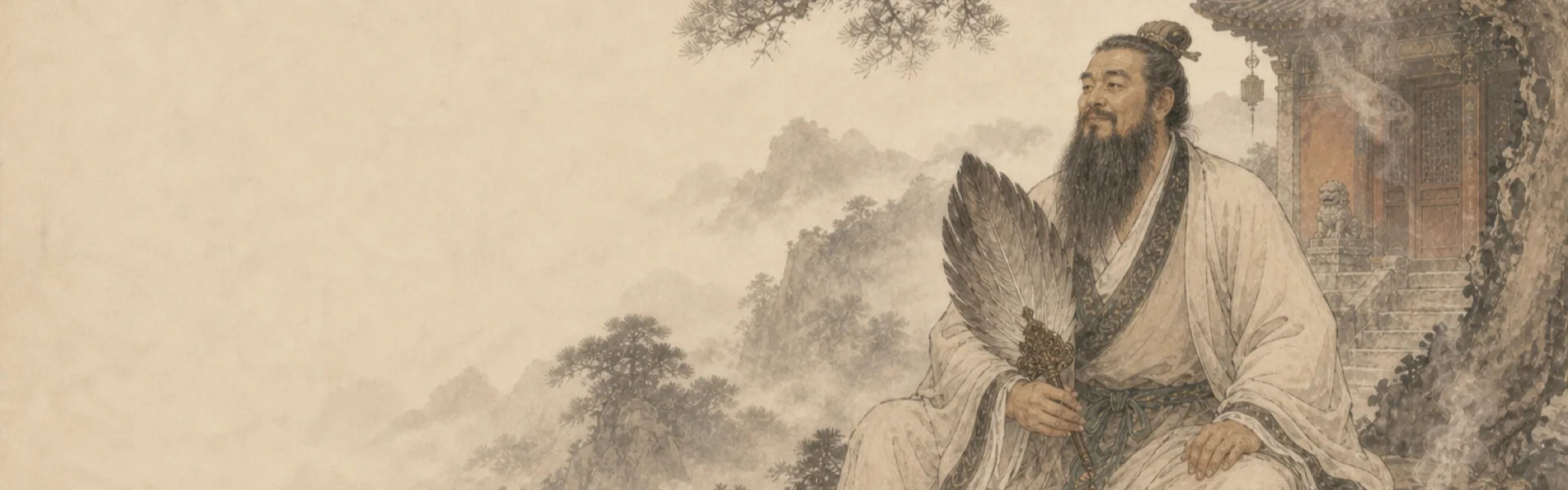
He is shown as a large, bare-chested man with an exposed belly, which is his most immediate identifier. The hair is usually gathered into two topknots or side buns, sometimes loose and unkempt. He often has a full beard. The body type and the informality of dress mark him as the martial member of the group, and they contrast deliberately with Cao Guojiu's official robes and Lü Dongbin's scholar's cap.
He carries a fan, generally a large palm-leaf or plantain-leaf fan rather than a folding one. In legend the fan revives the dead and can raise wind and cloud; in the composition it is the object that identifies him at a glance. Sometimes he also holds a peach, which is the standard Chinese emblem of long life.
In sets he is normally placed among the seniors, frequently near Zhang Guolao, and in arrangements that imply a hierarchy he and Lü Dongbin often occupy the most prominent positions — Lü because of his cult, Zhongli because of his seniority as teacher.
In the frequently painted subject of the eight crossing the sea, he uses the fan.
Zhongli Quan as a Patriarch of Internal Alchemy
His institutional position rests on internal alchemy and on Quanzhen.
Internal alchemy relocated the operation of the older external alchemy inside the body and reread the mineral vocabulary as metaphor. External alchemy had taken mineral ingestion entirely seriously for centuries and had killed people, including emperors; the internal turn in the Tang and Song was driven partly by that record. A tradition making so large a reinterpretation needed authorities to stand behind it, and Zhongli Quan with Lü Dongbin became the standard pair to which transmission was traced.
Texts attributed to him include a work setting out the stages of practice in an ordered sequence and the dialogue text mentioned above. Attribution in this literature is traditional and is generally later than the figure to whom it is assigned; the point of attributing a text to Zhongli Quan was to place it in a line, not to make a claim about authorship in the modern sense.
The Quanzhen school, founded in the twelfth century, formalised all of this by naming a set of northern patriarchs in which he occupies the second position, preceded by the figure said to have taught him and followed by Lü Dongbin, then a further transmitter, then Wang Chongyang. This list is the reason his name appears in monastery halls across China.
This site describes internal alchemy historically and structurally. It provides no instructions, does not present traditional physiological claims as fact, and endorses no teacher or school.
Where Zhongli Quan Appears
Zhongli Quan occupies two quite different kinds of place, and distinguishing them is useful.
The first is decorative. Sets of the eight appear on temple roof ridges and gable ends, on carved panels above doorways, on painted beams, on screens, furniture and porcelain, on embroidered hangings and New Year prints. In these he is one of eight, identified by the fan and the bare belly, and the set as a whole functions as an auspicious motif rather than as an object of worship.
The second is institutional. As a named patriarch of Quanzhen he appears in halls dedicated to the lineage, in the tablets and portrait sets that record transmission, and in the ordination and precept documents that name the line. This is a different order of presence: it is not ornament, it is record.
Very few figures occupy both registers. Lü Dongbin does, more fully than anyone. Zhongli Quan does, though his institutional presence is stronger than his popular one — the reverse of the usual pattern, and a direct consequence of his position as teacher rather than as a recipient of petitions.
On stage he is a stock character in the auspicious pieces where the eight attend a celebration in the heavens, and he is the deliverer in the plays about Lü Dongbin's conversion and about Lan Caihe. Where a play needs a figure to arrive, test somebody and depart, he is the conventional choice.
Why Zhongli Quan’s Role as Teacher Matters
Zhongli Quan's prominence illustrates something structural about Taoism that is easy to miss.
Taoism has no pope, no synod and no central body that can certify a teaching as orthodox. Legitimacy therefore runs through lineage: a documented line of transmission from master to disciple. In such a system the most valuable thing a tradition can possess is a credible name at the head of its list, and the most valuable thing a figure can do is teach someone whose own line survived.
This inverts the usual relationship between fame and achievement. Lü Dongbin is far more widely worshipped, has more temples and generated a far larger body of text. But Zhongli Quan holds the senior position, because transmission runs downward and the earlier name outranks the later one regardless of popular following.
It also explains the shape of Taoist biography generally. Accounts of practitioners are preoccupied with naming teachers, and generation poems exist so that a monk's religious name encodes his position in a line. Office comes first and biography is added later. Zhongli Quan is a clear case: the office is that of first teacher of internal alchemy, and the biography — the Han general, the defeat, the mountain encounter — was supplied afterwards to fill it.
Sources and limits. This page draws on Song narrative and alchemical material attributed to or concerning Zhongli Quan, Quanzhen lineage documents naming the northern patriarchs, studies of the formation of internal alchemy, and surveys of the Eight Immortals as a decorative and dramatic subject. The Han dynasty dating is traditional rather than historical, and textual attributions are reported as traditional. No practice instructions are given and no teacher or school is endorsed.
Key Points About Zhongli Quan
Zhongli is a genuine two-character surname and Quan is the given name; Han Zhongli means "Zhongli of the Han", and reading Han as a surname is a common error in Chinese as well as in translation.
That misparsing shows the figure travelled through performance and speech rather than through documents, which is how most people met the Eight Immortals.
His epithet Zhengyang, "aligned yang", pairs doctrinally with Lü Dongbin's Chunyang, "pure yang": teacher and disciple named for two stages of one process.
Tradition makes him a defeated Han general, but the substantial material is Song and the figure is a construction of the period when internal alchemy was taking shape.
Placing a defeated general at the head of the line puts failure at the origin of the tradition's most technical practice.
He converts Lü Dongbin by lending him a pillow rather than by arguing — a demonstration about scale, not a sermon about morality — then sets ten trials of ordinary character.
He is shown large and bare-chested with an exposed belly, hair in two topknots, carrying a large palm-leaf fan and sometimes a peach.
Quanzhen names him second among its northern patriarchs, which is why his name appears in monastery halls across China.
He outranks the far more widely worshipped Lü Dongbin because transmission runs downward: the earlier name is senior regardless of popular following. Office comes first, biography is added later.