Zhang Guolao: Tang Recluse and Backward-Riding Immortal
张果老:唐代隐士与倒骑驴的仙人
Zhang Guolao is the one member of the Eight Immortals for whom there is respectable documentary evidence of a real person. A man named Zhang Guo appears in the official Tang histories, was summoned to court, was given a title, and declined further honours. Almost everything else attached to him is legend, but the starting point is a record rather than a story.
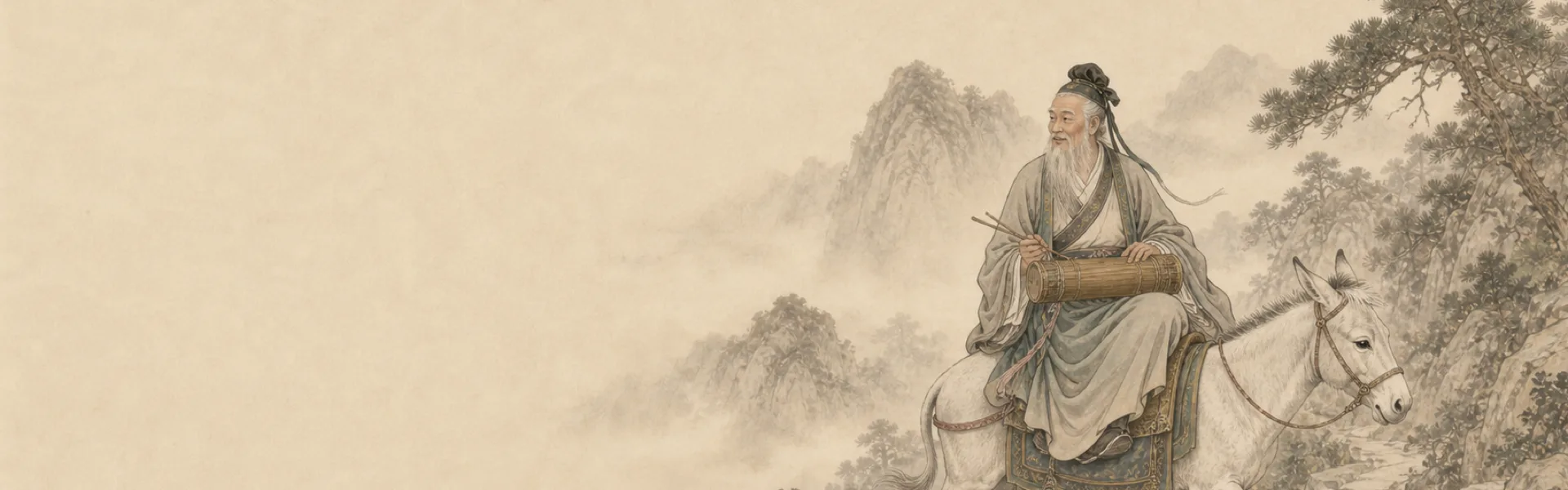
He is also the member of the group most likely to make a foreign visitor laugh, since he is normally shown as a very old man riding a donkey backwards. The joke is deliberate, and like most Chinese religious jokes it is carrying an argument.
The Historical Zhang Guo in Tang Records
Zhang Guo appears in the Tang official histories as a recluse living in the Zhongtiao mountains in southern Shanxi, credited with extreme age and with techniques of longevity. He was summoned to the capital by Emperor Xuanzong in the 730s, a period when the court was actively interested in Taoist practitioners.
The histories record that he was received at court, was awarded an honorific title as a master of the arcane, declined offers of further preferment including a marriage connection with the imperial house, and returned to the mountains, where he died. This is the kind of material that survives because a court archive recorded it, and it is unusually solid ground for a figure of this type.
What the histories do not do is endorse the claims about him. They report that he asserted a great age — figures given range into the hundreds of years — and they report the court's interest without settling whether the claims were true. Tang historians were often content to record that something was said.
The "lao" in his usual name is simply "old". He is Zhang Guo the Elder, and the epithet stuck because age was the whole point of his reputation.
Zhang Guolao’s Donkey and Later Legends
The legendary material accumulated after the Tang and follows a consistent line: this is a figure whose miracles are all about compressing or reversing ordinary expectations.
His donkey — sometimes a white mule — could be folded like paper and carried in a bag or a sleeve, then unfolded and sprinkled with water to become a live animal again. The image is a good example of the kind of miracle Chinese hagiography likes: not a display of power over nature so much as a demonstration that the categories one relies on are less fixed than they appear.
Another cycle concerns his death. In some accounts he died and was buried, and when the coffin was later opened it was empty. This motif recurs throughout Taoist hagiography and has a technical name in the tradition: departure by leaving the body behind, which Ge Hong in the fourth century listed as one of the recognised grades of transcendence. The empty coffin is not a claim that the death was faked; it is a claim about what kind of event the death was.
A further set of stories makes him extremely ancient, in some versions predating the dynasties and having witnessed the alternation of sea and land. These belong to the general vocabulary of longevity legend rather than to anything specific about him.
Why Zhang Guolao Rides Backwards
The detail that defines him iconographically is that he sits facing the animal's tail. Several explanations circulate in the tradition, and it is worth taking them as a set rather than choosing one.
The most common is that facing backwards is a comment on ordinary human direction: everyone else is looking where they are going, and he is looking at where they have all been. The reading fits a tradition much occupied with the value of reversal, of going against the current, of returning rather than advancing.
A second explanation makes it a demonstration of indifference to appearances. A dignified old man of recognised attainment adopts a posture that guarantees he will be laughed at. This is a recurring Taoist strategy — Lan Caihe's disorder and Li Tieguai's beggar's body do the same work — and its point is that the tradition's authorities are not to be identified by dignity.
A third, more technical, connects reversal to internal alchemy, in which the ordinary downward and outward flow of the body's energies is described as being turned back. Whether this reading is original or was applied later is unclear, but it is common in Ming and Qing material.
None of these is the official meaning, because there is no body with the authority to declare one. The image works precisely because it invites the question.
How to Recognise Zhang Guolao
His attributes are among the easiest to identify in a set of the eight.
He carries a fish drum: a length of bamboo, open at one end, covered with a membrane and struck or tapped, often paired with two small iron rods. It is a real instrument, used by street storytellers and itinerant performers, and it associates him with popular narrative rather than with scripture.
He is shown as visibly old: white beard, sometimes bald, sometimes stooped. Where the other immortals vary in apparent age, his age is fixed and is his defining quality.
He is accompanied by the donkey or mule, and where the composition allows, he is riding it backwards. In carved and painted sets on temple beams, screens and porcelain, this is usually the quickest way to locate him.
He is normally placed among the seniors of the group. In arrangements that suggest a hierarchy, he and Zhongli Quan tend to occupy positions of respect.
What Zhang Guolao Represents in Popular Religion
Popular use of the figure runs in two directions that look contradictory and are not.
The first is longevity and old age, which follows directly from his reputation. He appears in birthday imagery, in gifts to the elderly, and in the general decorative repertoire of long life alongside peaches, cranes and pines.
The second is fertility and children. Prints and paintings showing Zhang Guolao with an infant were traditionally given to newly married couples in parts of north China, and he is invoked for the birth of sons. The logic is that a figure who commands time can also grant continuation, and in a system where the worst outcome is to die without descendants, longevity and progeny are the same concern approached from two sides.
That connection deserves a moment, because it explains a good deal about Chinese religion. Having descendants is not merely a social preference. In the religious logic, the dead depend on descendants for provision and for petitions; to die without them is to fall into the category the seventh-month festivals exist to relieve. A deity of long life and a deity of children are addressing one problem.
Where Zhang Guolao Appears in Chinese Culture
Because his weight is visual rather than institutional, the places to look for Zhang Guolao are not temples dedicated to him but the surfaces of ordinary buildings and objects.
Sets of the Eight Immortals appear on temple roof ridges and gable ends, on the carved wooden panels above doorways, on the painted beams of halls, on screens and furniture, on export porcelain, on embroidered hangings, on New Year prints and on the plaster relief of village houses. In a set the eight are usually arranged in two groups of four, and the immediate task for a viewer is identification by attribute — which is why the attributes are so standardised.
He also appears in a distinct genre in which the eight are shown crossing the sea, each using their attribute as a vessel or a support. This is the source of a common Chinese saying about each person exercising their own particular ability, and it is one of the most frequently painted subjects in the whole repertoire.
Sites in Shanxi associated with his supposed residence in the Zhongtiao range carry local traditions, and a hill in southern Hebei is popularly named after him. These are local attachments of the kind that accumulate around any well-known figure, and their historical value is as evidence of where the legend was strong rather than of where the man lived.
On stage he is a stock character: the comic elderly sage. Temple opera, which is where most people learned the Eight Immortals in the first place, gave him a fixed appearance, a fixed instrument and a fixed manner, and the visual tradition followed the stage rather than the other way round.
How to Read Zhang Guolao as History and Legend
It is worth being clear about what kind of importance Zhang Guolao has.
He is not a major object of worship. There are few temples dedicated to him alone, no substantial body of scripture in his name, and no lineage that traces transmission through him. Compared with Lü Dongbin, who has all three, his religious weight is slight.
What he has instead is very wide currency as an image. He is everywhere in decorative art, in opera, in prints, in carving. Most Chinese people can identify him; far fewer have ever petitioned him. This is the normal condition of most of the Eight Immortals, and it is a distinction outsiders often miss, because a figure's visual ubiquity is easily mistaken for religious centrality.
The fact that the historical Zhang Guo is better documented than most of his companions and yet accumulated less institutional weight is instructive. Documentation is not what makes a figure religiously important in this tradition. Adoption by an institution is. A well-attested recluse who founded nothing remains a story; a possibly composite figure who was made a patriarch of a school becomes a deity.
Sources and limits. This page draws on the accounts of Zhang Guo in the Tang official histories, later hagiographic and narrative collections, Ge Hong's classification of grades of transcendence, and studies of the Eight Immortals as a decorative and dramatic subject. Legendary material is labelled as such. Claims about extreme longevity are reported as claims, not as fact.
Key Points About Zhang Guolao
Zhang Guolao is the one of the Eight Immortals with solid documentary basis: Zhang Guo appears in the Tang official histories.
He was summoned to court by Emperor Xuanzong in the 730s, given an honorific title, declined further preferment and returned to the mountains.
The histories record his claim to extreme age without endorsing it; "lao" in his name simply means old, which was the whole basis of his reputation.
His donkey could be folded like paper — a miracle about the instability of categories rather than a display of power.
The empty coffin motif corresponds to a recognised technical grade of transcendence: departure by leaving the body behind.
Riding backwards has several readings — a comment on human direction, a refusal of dignity, and a link to reversal in internal alchemy. No authority declares one official.
His attributes are the bamboo fish drum, visible old age, and the donkey; the drum links him to street storytelling rather than scripture.
He is invoked both for long life and for children, because in this system dying without descendants is the outcome both concerns are aimed at.
He is visually ubiquitous but religiously slight — no temples of his own, no scripture, no lineage. Institutional adoption, not documentation, is what creates religious weight.