Lü Dongbin: Scholar Immortal, Quanzhen Patriarch and Sword Bearer
吕洞宾:士人仙真、全真祖师与佩剑象征
Lü Dongbin is the exception among the Eight Immortals. The other seven are, for the most part, figures of decoration and drama: you meet them on porcelain, on carved beams and on stage rather than on an altar. Lü has his own temples, his own scriptures, a place among the patriarchs of a major school, and a cult that was still generating new texts in the twentieth century.
Understanding why he is different is a useful way into how Taoism actually assigns importance. It has little to do with how good the story is, and a great deal to do with whether an institution took the figure up.
Why Lü Dongbin Is the Exception among the Eight Immortals
The Eight Immortals as a set are a Ming assembly. Individual members are older, but the group of eight was standardised late and largely through drama rather than scripture. Eight is a structurally complete number in Chinese thought, and the set is deliberately varied — spanning age, sex, class, education and respectability — which is part of its appeal as a decorative and dramatic subject.
Lü was absorbed into that group but he did not need it. By the Song he already had a substantial independent cult, and by the Yuan he had been installed as one of the patriarchs of the Quanzhen school. Temples dedicated to him exist across China, some of them major institutions, and texts attributed to him form a small library.
He is also the member of the group most often actually worshipped. The others receive incense as part of a set; Lü receives petitions in his own right, particularly concerning examinations, healing, and the transmission of internal alchemy.
The lesson generalises. In Chinese religion, a figure's importance is a function of institutional adoption. Office comes first and biography is added later; a deity with a temple, a scripture and a lineage claim will outlast a more charming figure who has none of these.
What Historical Sources Say About Lü Dongbin
The historical basis is thin and should be described as such.
Tradition makes him a Tang figure, usually placed in the eighth or ninth century, with a surname Lü and the given name Yan, styled Dongbin. Various accounts give him an examination career — sometimes successful, more often repeatedly failed — an official post, or a life as a wandering scholar. Places in Shanxi, Hunan and Jiangxi all claim connections.
The earliest substantial narrative material is Song rather than Tang. From the eleventh century onward, stories about him proliferate: encounters with him in disguise, tests set for prospective disciples, poems left on tavern walls, appearances at drinking establishments and marketplaces. The volume of material grows continuously through the Song and Yuan.
Modern scholarship generally treats the figure as a composite: possibly built around a real person, but assembled from local legend, poetry attributed to him, and the needs of successive institutions. There is no contemporary Tang documentation of the kind that would settle the question.
This site states such matters plainly rather than presenting hagiography as record. The uncertainty does not make the figure unimportant; it locates the importance in what the tradition did with him rather than in what he did.
Lü Dongbin’s Yellow Millet Dream and Ten Trials
The central story is his conversion by Zhongli Quan, and it is the most interesting narrative in the whole Eight Immortals cycle.
In the standard version, Lü is a scholar pursuing office. He meets an old man at an inn who, while millet cooks, gives him a pillow. He sleeps and dreams an entire successful life: examination success, high office, marriage, children, grandchildren, wealth, then slander, disgrace, ruin, the deaths of his family, poverty and death. He wakes; the millet is not yet done.
The point being made is precise. It is not that worldly success is unpleasant — the dream includes decades of genuine success. It is that the whole arc, success and ruin together, occupies less time than cooking a pot of grain. The argument is about scale, not about morality, and it is delivered as a demonstration rather than a sermon.
Zhongli then sets him a series of trials, conventionally numbered ten, which test not asceticism but character under ordinary provocation: false accusation, financial loss, insult, threat, temptation, bereavement, the appearance of having been cheated. Lü passes by responding without resentment or calculation. The trials are worth noticing because of what they are not: there is no austerity contest and no test of occult skill.
After this he receives transmission and in due course becomes a teacher himself. The pattern — a hidden master, an unpromising candidate, a demonstration, a series of tests, then transmission — became the template for a great many later Taoist narratives.
How to Recognise Lü Dongbin
His attributes are consistent and easy to read.
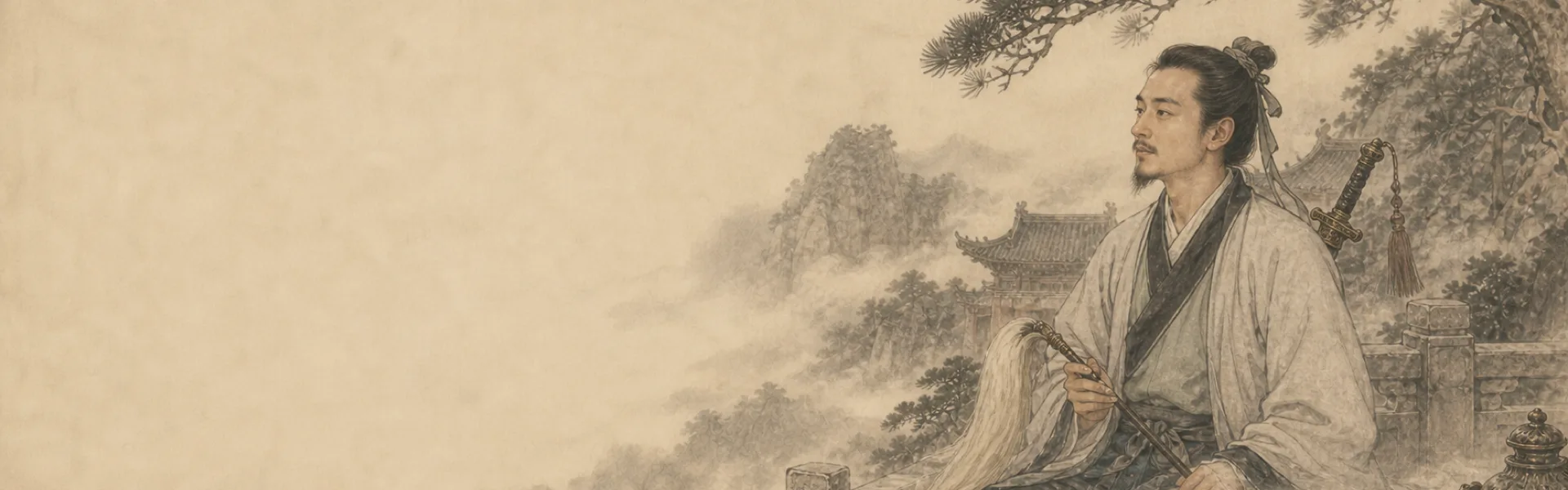
He carries a sword, usually slung across the back. This is the detail most often misunderstood. The sword in Taoist iconography is an instrument against demons and disorder, not against people; it belongs with the written talisman and the seal rather than with the battlefield. Zhenwu's martial character works the same way — he subdues demons, not opponents.
He wears scholar's dress: a literate man's robe and cap, sometimes with the appearance of a minor official. This marks his social position within the group and explains part of his appeal, since he is the immortal an educated man could imagine having been.
He often carries a fly whisk and sometimes a gourd. In sets of the eight, he is normally placed prominently, and in some arrangements he is treated as the group's leader, though the sources do not agree on this.
He is also known by the epithet Chunyang, "pure yang", which is an alchemical term rather than a name. Temples called Chunyang Palace or Chunyang Temple are dedicated to him, and the epithet signals the doctrinal role described below.
Lü Dongbin as a Patriarch of Internal Alchemy
Lü's most consequential role is as a founding authority for internal alchemy.
Internal alchemy relocated the operation of the older external alchemy inside the body and reread the mineral vocabulary as metaphor. It needed authorities, and Lü — together with Zhongli Quan as his teacher — became the standard pair to which transmission was traced. His epithet "pure yang" names the goal of the process in its own technical language.
A substantial body of text is attributed to him. Some is verse; some is instructional. The best known internationally is a work on inner practice that was translated into a European language in the early twentieth century, circulated among psychologists, and became one of the main channels by which Chinese internal practice entered Western awareness. Its attribution to Lü is traditional rather than demonstrable, and its actual composition is much later.
A great deal of the material attributed to him arrived through spirit writing — a practice in which a text is produced by a medium holding a suspended stylus over sand or ash, and attributed to the deity communicating through it. Spirit-writing altars produced Lü Dongbin texts in large quantities from the Ming through the twentieth century, particularly in Guangdong, Hong Kong and Southeast Asia. This is a genuine and historically important mode of Chinese religious authorship and it explains why the corpus kept growing centuries after the supposed author.
This site describes internal alchemy historically and structurally. It provides no instructions, does not present traditional physiological claims as fact, and endorses no teacher or school.
Lü Dongbin in Quanzhen Lineage Claims
Lü's institutional position was fixed by the Quanzhen school, founded in the twelfth century by Wang Zhe, known as Wang Chongyang.
Quanzhen traced its transmission through a set of patriarchs in which Lü occupies a central place, with Zhongli Quan before him and Wang Chongyang after. Wang's own conversion is traditionally attributed to an encounter with Lü at a place in Shaanxi, and the site became a Quanzhen holy place.
What matters here is the function of the claim rather than its historicity. Taoism has no central doctrinal authority, so legitimacy runs through lineage. A new school needs a line reaching back to a recognised authority, and Lü — already widely worshipped, already credited with alchemical teaching, already the subject of a large story cycle — was the obvious candidate. The claim gave Quanzhen a genealogy, and Quanzhen gave Lü an institution. Both benefited.
This is how traditions are made, and it is not a criticism. Editors and organisers shape a tradition as much as visionaries do; the case of Lü Dongbin simply makes the process unusually visible.
The Worship of Lü Dongbin Today
Lü remains widely worshipped, and the reasons are practical.
He is petitioned in connection with examinations, which in modern terms means school and university entrance, and this alone guarantees a steady constituency. He is associated with healing, and in some regions with specific trades — barbers and ink makers among them, on the strength of stories rather than doctrine. He is a common recipient of divination requests, and sets of oracle slips in his name are used in temples in southern China and Hong Kong.
Major temples associated with him include the Chunyang Palace at Ruicheng in Shanxi, best known for its Yuan dynasty wall paintings, which are among the most important surviving works of Chinese religious painting; Chunyang Palace in Taiyuan; and numerous halls within larger Quanzhen monasteries. Temples in Hong Kong and Southeast Asia with spirit-writing traditions often centre on him.
For a visitor, the practical point is that a hall dedicated to Lü Dongbin is functionally different from a decorative set of the Eight Immortals on a beam or a screen. The set is ornament and opera. The hall is a place where people submit requests. The same figure occupies both, which is a fair summary of how Chinese religion handles the boundary between story and worship.
Sources and limits. This page draws on Song and Yuan narrative collections about Lü, Quanzhen lineage documents, studies of internal alchemy and of spirit-writing cults, and surveys of the Eight Immortals as a decorative and dramatic subject. Where material is hagiographic it is labelled as such. No practice instructions are given and no teacher or school is endorsed.
Key Points About Lü Dongbin
Lü Dongbin is the exception among the Eight Immortals: he has his own temples, scriptures, lineage position and active cult, where the others are largely decoration and drama.
Importance in Chinese religion follows institutional adoption. Office comes first and biography is added later.
The historical basis is thin: tradition places him in the Tang, but the substantial narrative material is Song and later, and the figure is probably composite.
The millet dream argues about scale, not morality: an entire successful and then ruined life passes in less time than cooking a pot of grain.
The ten trials test character under ordinary provocation — false accusation, loss, insult — not asceticism or occult skill.
His sword is an instrument against demons and disorder, not against people; his scholar's dress marks his social position in the set.
His epithet Chunyang, "pure yang", is an alchemical term naming the goal of internal alchemy, for which he is a founding authority.
Much of the corpus attributed to him arrived through spirit writing, which is why it kept growing for centuries after his supposed lifetime.
Quanzhen installed him among its patriarchs; the claim gave the school a genealogy and gave Lü an institution. Traditions are made by organisers as much as by visionaries.