Han Xiangzi and Lan Caihe: Music, Flowers and Ambiguous Identity
韩湘子与蓝采和:音乐、花与身份边界
These two are treated together because they occupy the same corner of the set: both are young, both are associated with music and flowers, and both are arguments about category rather than figures with much narrative substance.
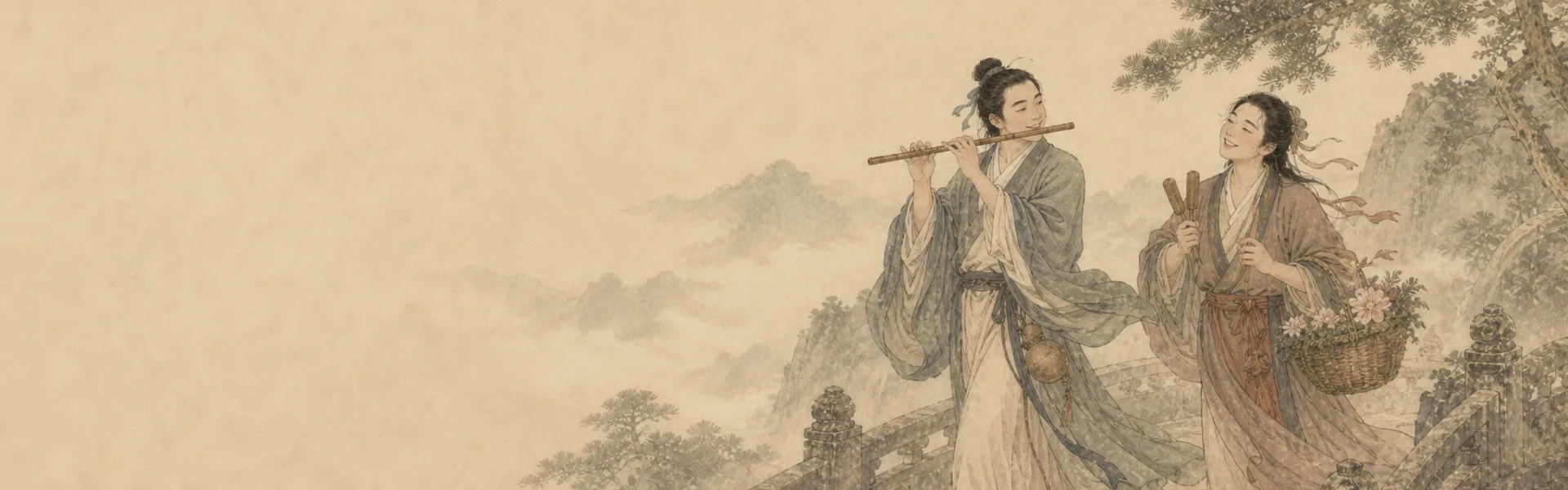
Han Xiangzi is the one with a documented family connection to a major historical figure. Lan Caihe is the one who cannot be classified at all — not by age, not by class, not reliably by sex. Between them they mark out the edges of what the Eight Immortals set was designed to include.
Han Xiangzi and His Great-Uncle Han Yu
Han Xiangzi is traditionally the grandnephew of Han Yu, the Tang writer and official who lived from 768 to 824 and who is one of the central figures of Chinese literary and intellectual history. Han Yu was a vigorous critic of Buddhism and of Taoist court favour, and he argued for a return to classical Confucian models.
The connection is not invented out of nothing. Han Yu had a grandnephew named Han Xiang, and one of Han Yu's best-known poems is addressed to him. The poem was written when Han Yu was exiled to Chaozhou in the far south in 819, after submitting a memorial objecting to the court's veneration of a Buddhist relic. In it he is at a mountain pass in the snow, expects to die on the road, and instructs the young man to collect his bones.
What legend did with this is worth watching closely. In the developed story, Han Xiang is already a Taoist adept. He has previously demonstrated his powers to his sceptical great-uncle — most often by causing flowers to bloom out of season, with a prophetic couplet appearing on the petals. Han Yu dismisses it. Then, exiled and freezing at the pass, he meets his nephew again, and the couplet turns out to have named the place.
The story is a deliberate reversal. China's most famous opponent of religious enthusiasm is made the uncomprehending relative of an immortal, and is proved wrong by the events of his own most celebrated poem. This is a polemical construction, and it survived because it is a good one.
What Han Xiangzi Represents among the Eight Immortals
His attribute is a flute, and he is the immortal associated with music. In sets of the eight he is the young man with the transverse flute, sometimes shown playing it.
Music is not decorative in Taoism. Liturgy is sung and structured by percussion, regional ritual repertoires are sharply distinct — Wudang, Beijing, Suzhou, southern Fujian and Taiwanese traditions differ markedly — and several are registered as intangible cultural heritage. A figure who represents music is representing one of the tradition's actual technical specialisms.
He is invoked by musicians, and in some regions by florists and gardeners on the strength of the flower miracle. Like most of the eight, he receives incense as part of a set rather than as an independent object of worship.
The flower episode also connects him to a theme that runs through Chinese immortal lore: the transcendent demonstrates by rearranging the seasons. Causing a plant to flower out of its time is a claim about not being bound by the ordinary calendar, which is the same claim the longevity tradition makes about the body.
Lan Caihe: The Immortal Who Resists Classification
Lan Caihe is the oldest-attested member of the group in a substantial written account, and the account is startling.
A collection of immortals' lives compiled in the tenth century describes a figure who went about in a tattered blue gown, wore a belt hung with wooden tablets, had one foot shod and the other bare, wore padded clothing in summer and lay in the snow in winter with steam rising from the body, and begged in marketplaces while singing to the beat of large wooden clappers. The songs were improvised and were said to have an unsettling sense of the passage of time. Money received was strung on a cord and dragged along the ground, and when it fell it was not picked up. The account ends with an ascent from a tavern, leaving behind the gown, the belt, the single shoe and the clappers.
Almost every element of this is a refusal of a category. Clothing that contradicts the season. One foot shod. Money treated as litter. A begging performer who cannot be placed as either destitute or holy. Nothing about the description allows the observer to assign a social position.
The sense of time in the songs is the part that gives the figure its weight. This is not a comic vagrant; it is a figure who sings, in a marketplace, about how quickly everyone present will be gone. The disreputable exterior is what makes the message hearable.
Lan Caihe’s Ambiguous Gender
Lan Caihe's sex is not fixed, and this is a genuine feature of the tradition rather than a modern reading.
The earliest account gives a male figure in ambiguous dress. Later iconography frequently shows a youth of indeterminate appearance, and in some paintings and porcelain the figure reads as female. On stage the role has been played both ways, and in some regional opera traditions Lan Caihe is straightforwardly a young woman. Sets of the eight sometimes contain two apparently female figures as a result, which occasionally causes confusion about which one is He Xiangu — the lotus is the reliable distinguishing attribute.
The ambiguity is consistent with everything else about the figure. A character defined by refusing classification would be diminished by having a settled sex. It is also worth noting that the tradition never resolved the question, despite having centuries in which to do so and no shortage of editors willing to standardise other things.
This should not be over-interpreted in modern terms. The material does not present a theory of gender; it presents a figure who is outside categories, of which sex is one. But it does mean that a strand of Chinese religious imagery has carried an unclassifiable figure, in plain view, on temple beams and household porcelain, for a thousand years.
Lan Caihe’s Flower Basket and Other Attributes
Lan Caihe's standard attribute in the developed iconography is a flower basket, usually held in the hand or slung on a hoe over the shoulder. This is later than the tenth-century account, which mentions clappers rather than flowers, and the shift is a good illustration of how attributes get tidied.
The clappers survive in some depictions, and in southern traditions the figure is sometimes shown with them alongside or instead of the basket. The single shoe occasionally survives as a detail for viewers who know to look.
Together with Han Xiangzi's flute and He Xiangu's lotus, the basket gives the set a cluster of young figures with flowers and music, usually placed together in the composition. Where the eight are arranged in two groups of four, these three plus one senior figure commonly form a group.
In the very common subject of the eight crossing the sea, Lan Caihe rides the basket. The saying about each person exercising their own particular ability comes from this image, and it is among the most frequently painted scenes in Chinese decorative art.
Han Xiangzi and Lan Caihe on the Opera Stage
Both figures reached most people through theatre rather than through scripture, and in Lan Caihe's case the theatrical connection goes further than transmission.
A surviving Yuan dynasty play takes Lan Caihe as its subject and makes him a professional actor, deliverance from an acting troupe being the plot. This is unusual and revealing. Theatre people in imperial China occupied a low and legally restricted social position, and a play in which an actor is the one selected for transcendence is doing the same work as the beggar and the unclassifiable vagrant elsewhere in the set. It is also, presumably, a play that actors enjoyed performing.
The play is one of the earliest substantial dramatic treatments of any of the eight, and it predates the fixing of the standard group. It shows the set being assembled in real time, in the medium that did most of the assembling.
Han Xiangzi's material also became a dramatic staple, and later a novel, in which the confrontation with his sceptical great-uncle is expanded at length. The story's appeal to dramatists is obvious: it has a famous name, a family conflict, a prophecy, a reversal and a snowstorm.
A further genre shows the eight together attending a birthday celebration in the heavens, which became the standard auspicious piece performed at birthdays, weddings and temple festivals. Most Chinese people who can identify the Eight Immortals learned to do so from performances of this kind rather than from any religious text, which is worth remembering when the set is described as Taoist iconography.
What Han Xiangzi and Lan Caihe Represent Together
Taken together, these two make explicit what the whole set is for.
The Eight Immortals are not a pantheon and were never intended as one. They are a demonstration, and the thing demonstrated is that transcendence is not distributed according to social value. The set contains a court official and a beggar, a scholar and an illiterate, an old man and a youth, a woman of no standing and a figure of no fixed sex at all. Whatever else the arrangement says, it says that the criterion is not respectability.
This is why the set became so popular as decoration. A household could display it as a wish for good fortune, a temple could carve it on a beam, a theatre could stage it, and everyone involved understood the implicit claim without needing it explained. Few religious images in any tradition combine that level of ubiquity with that much content.
It is also why the individual biographies matter so little. Han Xiangzi's story is a polemic against a famous sceptic; Lan Caihe's is a study in unclassifiability. Neither is a life. The fact that Lan Caihe almost certainly never existed does not make the figure unimportant; it locates the importance in a different place.
Sources and limits. This page draws on Han Yu's poem addressed to his grandnephew and the historical record of his exile, the tenth-century collection of immortals' lives that describes Lan Caihe, later hagiographic and dramatic material, and studies of the Eight Immortals as a decorative and theatrical subject. Legendary material is labelled as such, and where the tradition never settled a question — including Lan Caihe's sex — that is reported rather than resolved.
Key Points About Han Xiangzi and Lan Caihe
Han Xiangzi is traditionally the grandnephew of Han Yu, the Tang writer who attacked Buddhism and Taoist court favour; Han Yu did have a grandnephew of that name and addressed a famous poem to him.
Legend turns that poem into proof: the flowers Han Yu dismissed had prophesied the very pass at which he later met his nephew in exile. The story is a deliberate polemical reversal.
Han Xiangzi's attribute is the flute, and music is a real technical specialism in Taoism, with sharply distinct regional liturgical repertoires.
Lan Caihe is described in a tenth-century collection as a ragged singer with one foot shod, padded clothes in summer, snow in winter, and money dragged on a cord and left where it fell.
Nearly every element of that description refuses a social category, and the songs were said to concern the passage of time.
The figure's sex was never fixed: male in the earliest account, indeterminate in much iconography, female in some regional opera. The lotus, not appearance, identifies He Xiangu.
The flower basket is a later attribute; the original account gives wooden clappers, and the shift shows how attributes get tidied over time.
The set is a demonstration rather than a pantheon: it includes an official and a beggar, a woman of no standing and a figure of no fixed sex, and its claim is that the criterion is not respectability.
The individual biographies matter little. That Lan Caihe almost certainly never existed does not make the figure unimportant; it locates the importance elsewhere.