Baguazhang and the Yijing: History, Diagrams and Practice
八卦掌与《易》:历史、卦图与练法解释
Baguazhang takes its name from the eight trigrams, but that fact raises several different questions. Did trigram theory produce the art’s movements? When did it organise printed curricula? How do teachers use it now? Historical origin, curriculum design and present-day interpretation require different evidence. This guide connects the Baguazhang overview, the history of the art and the practical guide to circle walking and palm changes.
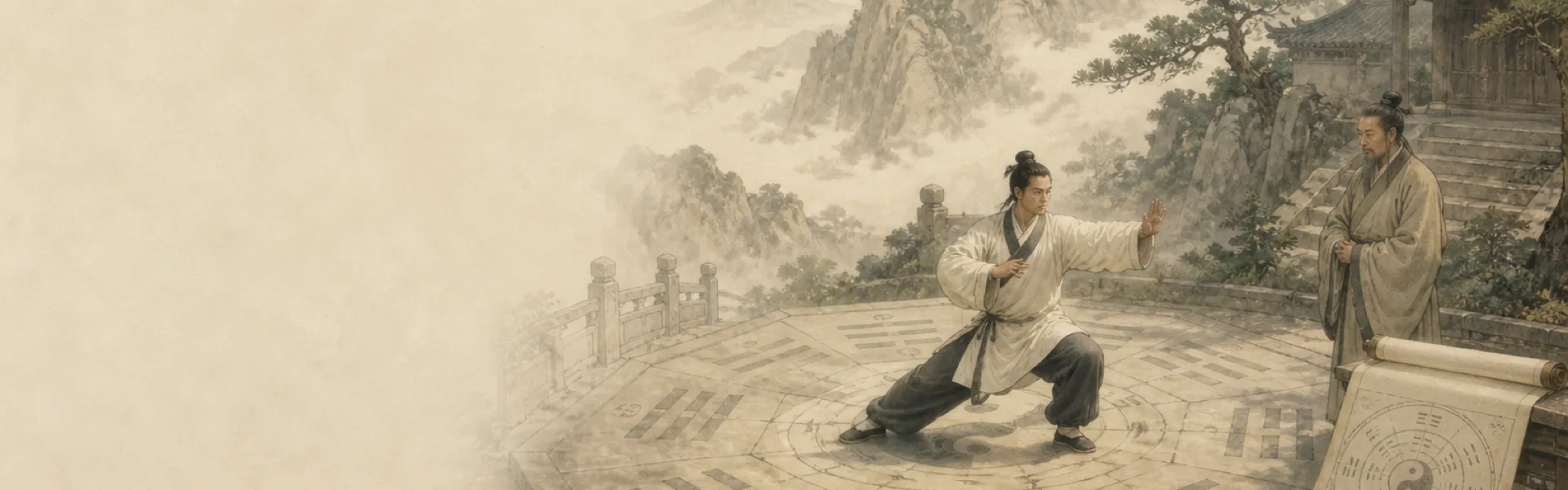
Begin with three different questions
A name can point to a cultural framework without proving that the framework generated every technique. A curriculum can use trigrams to arrange existing material. A teacher can also use the language of change, direction or paired qualities to illuminate a task today. These are not rival answers to one question; they are three kinds of relationship.
Keeping them separate prevents two easy errors. One is to treat every correspondence as ancient technical engineering. The other is to dismiss any later interpretation as worthless ornament. A framework may be historically later than a movement and still become a meaningful part of how a community teaches it.
What the Yijing contributes
The Yijing, or Scripture of Change, is not a single unchanging theory handbook. Its received tradition includes sixty-four hexagrams and layers of explanation and commentary. A modern scholarly edition from Columbia University Press describes its development from a divination manual into wisdom literature and shows how later interpreters, including Zhu Xi, gave the text new philosophical settings.
For martial-arts readers, the eight trigrams offer a compact vocabulary of lines, positions, relations and transformations. The sixty-four hexagrams enlarge the combinatorial field. These structures can prompt comparison, but the classical text does not supply a Baguazhang footwork sequence or a complete set of palm changes.
What the late-Qing memorials establish
The memorial inscriptions discussed in the history guide place Dong Haichuan and his community in the documented late-Qing story of the art. They preserve lineage memory, names and accounts of transmission. They do not set out a trigram-by-trigram technical system from which the art can be reconstructed.
That silence does not prove that Dong or early students never used ideas from the Yijing. It does set a limit: an early origin claim needs early evidence, while a later printed explanation is evidence for its own date and setting. The responsible answer may remain “not established.”
Sun Fuquan’s 1921 printed synthesis
A clearer documentary point appears in Sun Fuquan’s Baguáquán xué, in an accessible National Library of China edition dated 1921. Its contents move through wuji, taiji, the two modes and four images before presenting animal forms associated with the trigrams. Later chapters explicitly discuss a combined Earlier-Heaven/Later-Heaven form, diagram and explanation.
This is strong evidence that one important early Republican curriculum articulated Baguazhang through a developed cosmological structure. It does not show that every branch used the same map, that every correspondence began with Dong, or that a reader could derive the movements from the Yijing alone.
Identify the diagram before interpreting it
The trigrams can be arranged in more than one circular order. The commonly named Earlier-Heaven and Later-Heaven arrangements place them differently and accumulated different interpretive associations. A circle marked with eight trigrams is therefore not self-explanatory.
Before linking a direction, palm or body quality to a trigram, ask which arrangement is being used, which text or teacher supplies it, and what the mapping is meant to do. Switching diagrams is not automatically an error, but the reason for the switch should be stated rather than hidden.
Compare mappings without forcing agreement
Lineages may name, count and pair palm changes differently. Variation does not prove that every correspondence is arbitrary, nor does one elegant system bind all other branches. It shows that claims must be attached to a specified curriculum.
A useful comparison table records the source, date, branch, movement name, trigram and stated purpose. It should leave an empty cell when a source gives no match. That is more honest than silently harmonising different lists or using one modern chart as the standard for the whole art.
Three ways a correspondence can work
A trigram link may serve at least three functions. As a mnemonic, it helps order and remember a set. As an analytical lens, it prompts comparison between qualities such as opening and closing, advance and withdrawal, or stability and mobility. As a practice cue, it directs attention to a specific action in a specific exercise.
The same label can function differently in two schools. Ask the teacher which role is intended. A mnemonic need not be a historical origin story, and a useful practice cue need not be a universal law of movement.
Test an explanation through an observable task
If a trigram is said to clarify a palm change, translate the explanation into something that can be practised. Does it alter the chosen direction, timing, pressure, shape or relationship with a partner? Keep the task, speed and resistance defined, then compare the result with and without the cue.
This does not reduce tradition to laboratory proof. It distinguishes several kinds of statement: a historical claim needs dated sources; a teaching cue needs to guide attention; a tactical claim needs an appropriate partner task; and a symbolic reflection may be valuable without pretending to be any of the other three.
Read historically without reducing living value
Baguazhang’s relationship with the Yijing is best understood as a history of interpretation as well as a question of origins. The 1921 witness shows that cosmological organisation was already part of an influential printed presentation. Later lineages continued to select, revise and embody such correspondences.
Readers can respect that inheritance while naming the limits of the record. Ask what a source dates, what a diagram organises and what a cue changes in practice. This approach neither claims that the classic mechanically generated the art nor strips the art of a framework through which generations have understood it.