Circle Walking and Palm Changes in Baguazhang
八卦掌走圈与换掌:变量、转向与练习进阶
Circle walking is one of Baguazhang’s most recognisable practices, but there is no single circle, step or palm-change sequence shared unchanged by every branch. This guide treats the practice as a set of adjustable tasks. It complements the Baguazhang overview and the separate history guide.
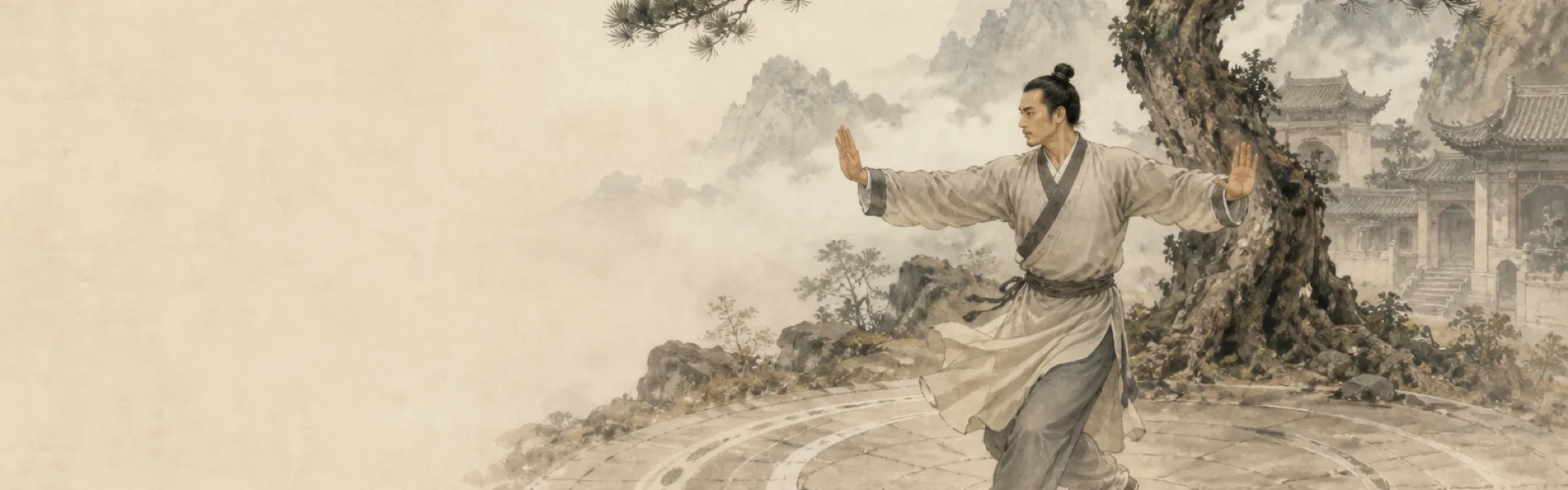
Circle walking is a family of drills
Walking around a centre can train orientation, continuous stepping, coordinated turning and the ability to change direction without first returning to a square stance. Different schools use it for different purposes: basic footwork, posture work, palm shapes, linked changes, conditioning or preparation for partner practice.
Those purposes should not be collapsed into one promise. Walking a smooth circle does not by itself prove fighting skill, historical authenticity or a particular internal mechanism. A useful drill names what is being trained and gives the student something observable to check.
Set the variables before you begin
Choose an even, unobstructed surface and a radius that allows unhurried steps. Then set a direction, pace, stance height, hand position and visual focus. A larger circle usually makes the turn gentler; a smaller one asks for more frequent redirection. Neither is automatically more advanced.
- Radius: can the feet follow the curve without forced twisting?
- Pace: can you keep the chosen rhythm while breathing normally?
- Stance: can you maintain the height without bracing or collapsing?
- Gaze: can you stay aware of the centre and the wider space?
Change one variable at a time. That makes the result easier to interpret than changing the circle, speed and posture together.
Posture serves the task
Many teachers ask for an upright head, a settled chest, organised hips and a body that turns as a connected whole. The visible shape still varies with the school, the palm posture and the purpose of the drill. Some methods orient the torso strongly toward the centre; others use less winding or change it during the step.
Use the cue your method gives you, then test it: can you step, turn and stop without losing balance or holding your breath? A posture that looks impressive but prevents an easy change of direction is not yet serving the exercise.
“Mud-wading step” names more than one method
Tangnibu, often translated as “mud-wading step,” is a common teaching term, not one universal footfall. Depending on the branch and exercise, the foot may travel close to the ground or lift more clearly; contact may be described through the heel, the whole foot or another sequence. Step length and the amount of inward curve also differ.
Start with the version your teacher can demonstrate and correct. Keep each placement quiet and deliberate, and avoid forcing a planted foot to twist simply to preserve the circle. The practical question is whether the step supports stable travel and the next change.
Koubu and baibu are turning tools
Koubu and baibu commonly describe inward-closing and outward-opening placements used to redirect the body. Their angle, order and tactical meaning vary. They are useful vocabulary, but they are not a complete explanation of every palm change, evasion or application.
Practise the entry, the turn and the exit as distinct phases. Check that the feet create enough room for the body to follow, that balance remains available between steps and that the hands do not arrive independently of the base.
The single palm change studies direction
Many Baguazhang curricula use a single palm change as an early way to reverse direction while keeping movement continuous. The exact hand path and footwork are lineage-specific. Its shared value is the question it poses: can you recognise the moment to turn, reorganise without a dead stop and leave along a clear new line?
Learn the choreography slowly first. Then vary the starting point on the circle, the direction and the pause between phases. Accuracy matters more than treating the change as a mystical container for the whole art.
“Eight changes” is not one universal catalogue
Some branches organise major changes in sets of eight and relate them to the trigrams; others name, count or combine material differently. Sun Fuquan’s 1921 Baguáquán xué is valuable evidence for one early printed curriculum with cosmological organisation. It is not a rulebook for every branch or proof that all present sequences were identical.
Ask what a school’s list is designed to teach: changes of direction, body organisation, palm methods, tactical entries or a progression through several of these. Understanding the organising purpose is more useful than forcing different lists into artificial agreement.
Bridge solo changes to partner tasks
A solo change can develop coordination, but its martial meaning has to be tested in a defined interaction. Begin with a cooperative partner who provides a known line or contact. Decide whether the task is to find an angle, maintain contact, leave a line of force or place a controlled touch.
Increase only one demand at a time: uncertainty, speed or resistance. Agree on contact level and stopping signals before starting. Success in a drill shows success under those conditions; it does not guarantee self-defence ability or justify uncontrolled practice.
Build volume gradually and measure quality
Find a short amount of walking that you can repeat with stable steps and attention. Add time, a lower stance, a smaller circle or more complex changes separately rather than all at once. General orthopaedic guidance notes that sudden increases in activity and insufficient recovery can contribute to overload; it does not establish a Baguazhang-specific injury rate. See the AAOS overview of bone stress injuries.
Record the direction, radius, duration and one quality cue after practice. A gradual-activity approach starts from a manageable baseline and progresses in small steps; the South Tees NHS guide explains that principle in a persistent-pain context. It should not be treated as a personalised training prescription.
Adapt the drill and review what happened
Effort, warmth and temporary muscular fatigue are different from sharp, worsening, persistent or function-limiting pain. If a variation provokes the latter, stop that variation and seek advice from an appropriately qualified clinician. Existing injuries or health conditions may require individual adaptation.
At the end of a session, ask four questions: Were the steps quiet and deliberate? Could I change direction without rushing? Did the hands and base arrive together? Did quality remain stable at the chosen volume? These answers give the next session a clear purpose without pretending that one posture, circle size or repetition count suits everyone.