Baguazhang Sources and Reading Paths
八卦掌资料与阅读路径
Baguazhang sources become clearer when the question comes before the reading list. A memorial inscription, a printed training manual, a lineage interview, an academic study and a heritage record do not provide the same kind of evidence. Each can be valuable, but none can answer every question.
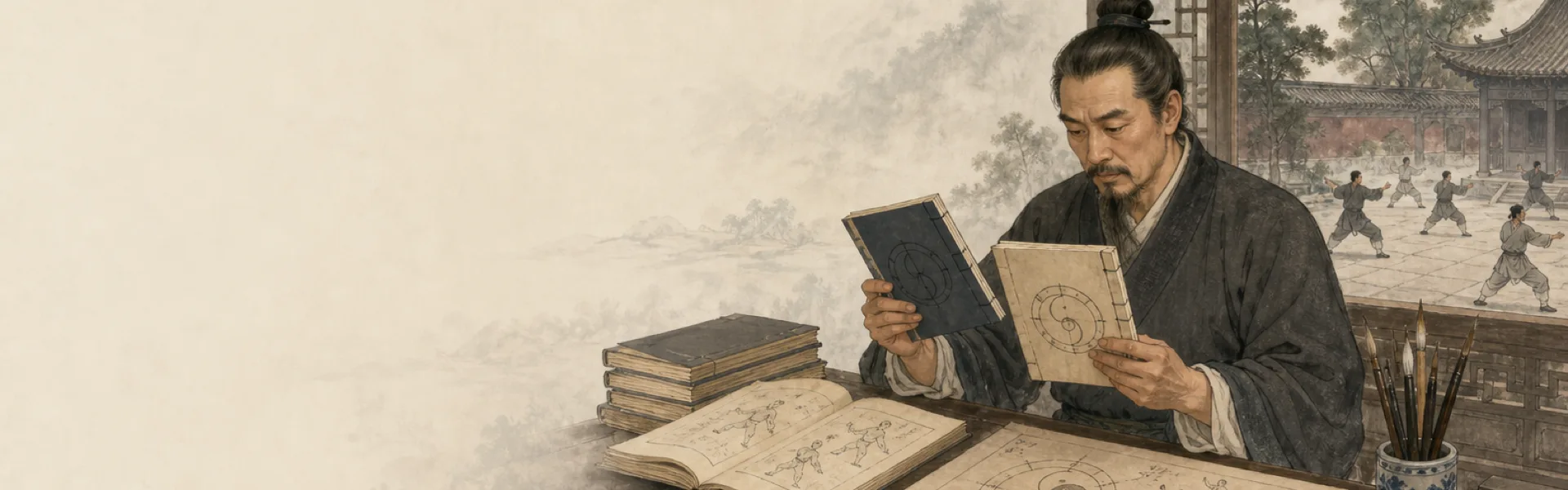
This guide offers three reading paths and a method for comparing sources. It complements the broader guide to sources on the internal arts; here the examples and cautions are specific to Baguazhang.
Begin with the question
Ask what you want to know. A question about Dong Haichuan’s documented circle requires sources close to his lifetime. A question about an early public curriculum requires a dated edition. A question about what one branch practises now requires identified teachers, locations and dates. A question about training still needs observation and instruction.
Write the question beside every note. Then separate three layers: what the source directly says or shows; what its author argues; and what you infer. This small habit prevents a plausible interpretation from quietly becoming a fact.
Memorials are dated community records
The memorials associated with Dong Haichuan are unusually important because they preserve names, relationships and community memory near the first generations of transmission. They are commemorative records made by disciples, however, not neutral transcripts of Dong’s teaching.
Keep the reported 1883, 1904 and 1930 witnesses separate. A later inscription can preserve a meaningful tradition without proving that its fuller story appeared in the earlier one. The history guide sets out that sequence without merging the inscriptions.
Also record which object you are reading: an original or relocated stone, a rubbing, a modern transcription, a photograph or a translation. These are related witnesses, not interchangeable copies. When provenance is uncertain, paraphrase cautiously and state the limit.
The inspectable 1921 manual
The National Library of China’s 1921 copy of Sun Fuquan’s Baguáquán xué is a strong starting point because readers can inspect the edition itself. Its catalogue describes 23 chapters, including the beginner’s “Three Harms,” “Eight Gates and Nine Requirements,” turning and piercing palms, and sections organised through taiji, four images and the eight trigrams.
This establishes what one influential early Republican publication presented by 1921. It does not reproduce Dong Haichuan’s lessons word for word, settle the date when every formula began, or prove that every branch used the same sequence. The Baguazhang and the Yijing guide explains the same boundary for cosmological mappings.
Later manuals need edition-level labels
Later Republican-era manuals can reveal how different authors selected, named and arranged their material. Compare them only after recording author, exact title, publisher or printer, edition date, and the copy actually consulted. A modern reprint may silently repunctuate, abridge or combine earlier texts.
Do not build a single “classical Baguazhang curriculum” by collecting attractive phrases from several books. Agreement may indicate shared transmission or later borrowing; disagreement may reveal branch priorities, editorial choices or different audiences. Both are historical information.
Verses and requirement lists are compressed tools
Rhymed verses, posture lists and short formulas are designed to be remembered. Their compression is useful in a taught curriculum and risky when detached from one. The same character can cue direction, quality, timing or a correction to a particular posture.
Record the exact Chinese wording, source, edition, teacher or branch, and the exercise being discussed. Sun’s 1921 chapter explicitly says “nine requirements”; other curricula group and name requirements differently. The principles guide therefore treats formulas as prompts to test, not as universal biomechanics.
Lineage testimony preserves practice and memory
Interviews, biographies, school publications and specialist periodicals can preserve names, exercises, teaching sequences and personal recollections unavailable elsewhere. They are especially useful when the speaker, interviewer, date, place and branch are identified.
They also participate in lineage life. Jeff Takacs’s 2003 article, “A Case of Contagious Legitimacy”, studies kinship, ritual and legitimacy in Chinese martial-arts societies. It helps readers understand what lineage acts and memorial activity do socially; it does not decide whether a movement is mechanically correct or verify every ancestral story.
Broader history supplies context
Peter A. Lorge’s Chinese Martial Arts: From Antiquity to the Twenty-First Century places martial practice in military, social and political history. It is useful for testing whether a Baguazhang narrative fits the institutions and language of its claimed period.
Regional histories and studies of popular religion can illuminate the world around nineteenth-century martial practice. Context is not a missing transmission link: similarity in geography, terminology or symbolism does not by itself prove that one movement produced a particular boxing method.
Heritage records describe present recognition
China’s intangible-cultural-heritage database lists Baguazhang as national project VI-25, published in the third batch in 2011, and records associated regions, protection bodies and recognised transmitters. The current project page is useful evidence for official recognition and living plurality.
A heritage description also presents an authorised public account. Read its origin narrative as part of contemporary heritage-making, then compare it with dated memorials and scholarship. Current recognition cannot by itself prove every nineteenth-century event.
Read across editions, languages and media
Search with variant names as well as “Baguazhang”: early sources may use forms such as zhuanzhang or longer curriculum titles. Keep the Chinese title beside any translation so another reader can recover the same work. If a translation smooths a technical term, return to the photographed page or scan.
Books, photographs and video support different observations. A manual can show an author’s sequence; photographs can preserve positions; video can show timing and transitions. None reveals every pressure, intention or correction. Use them to prepare questions for practice, not to claim hidden qualities that the medium cannot demonstrate.
Three practical reading paths
For history: begin with the dated memorial sequence, then read Takacs on lineage and legitimacy, Lorge for broader context, and the heritage record as a present-day layer. Keep tradition, documentary witness, scholarly argument and official recognition in separate columns.
For practice: begin with the 1921 manual, compare its terms with your identified curriculum, and use the circle-walking guide and principles guide to turn phrases into observable tasks. A book can support instruction; it cannot watch your balance, load or partner.
For source method: choose one claim and build a short table: exact witness and date; words or image on the page; author’s conclusion; your inference; and what would change your mind. That process is more useful than accumulating a long list of titles without knowing what each one can establish.