Baguazhang Principles: Turning, Angling and Continuous Change
八卦掌法则:转身、走斜与连续变化
Baguazhang teachers often use compact formulas—turn, wrap, change, take the angle—to organise a great deal of practice. A formula becomes useful when it directs attention to something a learner can observe. It becomes misleading when one branch’s wording is presented as the only body shape or tactical answer. This guide turns familiar principles into questions, drills and review points while preserving the language through which different lineages teach them.
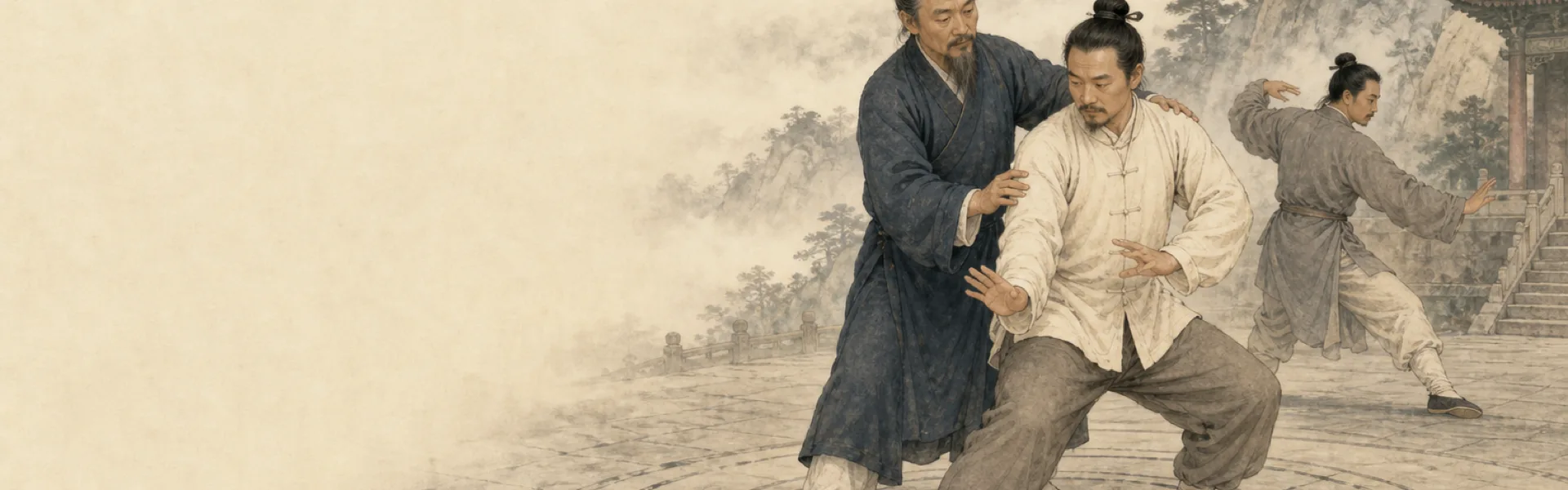
Principles are questions, not fixed shapes
A principle is broader than a technique. “Change the angle,” for example, does not prescribe one step. It asks whether a movement altered the relationship between you and a partner while keeping balance, sight and options. The answer may look different at another distance, on the other side or in another branch.
Begin by recording the exact instruction, who teaches it and what exercise it belongs to. Then ask what should be visible when it works. This keeps a traditional phrase connected to a curriculum instead of turning it into a universal claim.
Coordinate turning without staying permanently wound
Many Baguazhang exercises coordinate changes through the feet, legs, pelvis, torso and hands. In circle walking, the direction of travel and the orientation of the upper body can differ; in a palm change, those relationships reorganise. “Spiralling” is a useful description of linked rotation, but it does not require every joint to rotate as far as possible or the waist to remain twisted all the time.
Try one variable at a time. Reduce the circle, shorten the step or lessen the torso turn while keeping the head comfortably upright and the breath unforced. The useful range is the one in which you can step quietly, change direction without a corrective hop and finish able to move again. More rotation is not automatically better.
Read twisting, wrapping, drilling and overturning in context
The four terms often rendered as twisting, wrapping, drilling and overturning—ning, guo, zuan, fan (拧、裹、钻、翻)—appear in modern Baguazhang teaching, but their grouping and explanation vary. One teacher may use them to describe changes of the forearm and palm; another may apply them to the whole body or to the relationship between defence and counterattack.
Do not assume they form one mandatory sequence. Ask the teacher to demonstrate one contrast: twisted and untwisted, wrapped and open, drilling and merely reaching, overturned and withdrawn. Repeat the contrast slowly, then change only the step or contact. The phrase is doing real teaching work when it helps you notice and reproduce a difference.
Requirement lists belong to named curricula
Lists are memory devices, and their number is not always stable. Sun Fuquan’s public-domain 1921 Baguazhang xue includes chapters on “three harms” and “eight gates and nine requirements.” Its nine-part formula names sinking, closing, lifting, rising, wrapping, relaxing, dropping, contracting, and clearly rising-drilling/falling-overturning. That dated witness is important; it is not a licence to call every later list identical.
When a class uses “eight requirements,” note the Chinese words, the posture being corrected and the teacher’s explanation. Instructions concerning the chest, pelvis, head, tongue or breath should not be forced to their extreme. A useful requirement improves the current task without pain, breath-holding or loss of balance.
Angling and evasion are conditional choices
Changing position can alter the line through which a partner reaches or pushes. It may create an exit, bring one hand into a better place to cover, or make the partner turn before continuing. None of those results is guaranteed simply because a step travels sideways. Distance, timing, obstacles and the partner’s ability to follow all matter.
Set a modest drill: one person reaches along an agreed line while the other steps to a marked angle and keeps both hands available. Success means remaining balanced, seeing the partner and preserving space to move—not reaching an imaginary “safe” point. Later, vary the side, speed or starting distance. Receiving, redirecting, covering and leaving the line can coexist; they are not exclusive labels for different arts.
Front, side and rear keep moving
Some teachers divide the space around a partner into front, side and rear “doors.” The map is useful if it reminds learners that access and risk change with orientation. It becomes false when the rear is described as a place where an opponent cannot see, strike or brace. A moving person turns, steps, reaches and uses the environment.
Practise with both partners active. One seeks an outside angle while the other turns to recover the front. Pause after each exchange and check: whose hands have a clear path, who can leave, and whose stance can support the next step? The aim is not to win a race to the back; it is to recognise how quickly a useful angle appears and disappears.
Continuous change includes stable moments and resets
Continuity does not mean compulsory nonstop motion. A practitioner can pause without becoming inert, and can move constantly while losing structure and choice. A better test is whether one action leaves a workable route into the next: the feet are not crossed without purpose, the gaze is not lost, and the hands can cover, touch or disengage.
The circle-walking and palm-change guide treats radius, pace, posture and direction as adjustable variables. Add deliberate freezes to a familiar change. If the position cannot support a breath, a turn or an exit, find where organisation was lost. Resetting is part of learning, not evidence of failure.
Build partner work one variable at a time
Partner practice needs a defined role and boundary. Agree on the attacking line, contact level, target area, speed, protective equipment and stopping signal. Begin cooperatively so both people understand the task. Add resistance only after deciding what may vary; “uncooperative” is too vague to guide safe progression.
A useful sequence might keep the line fixed while allowing the feeder to change timing, then keep timing steady while allowing one follow-up step. At each stage, the learner should be able to stop without falling into the partner. Consent can be withdrawn at any time. Success in this drill shows success under these conditions, not proof of general fighting ability.
Test space, surface, fatigue and uncertainty
Movement has costs. A wide circle may not fit near a wall; a quick turn may be unsuitable on a slippery surface; fatigue can reduce step quality and attention. Rather than claiming that Baguazhang always solves these problems, use constraints to reveal which parts of a method remain available.
Mark a smaller area, change the surface only when it is safe, or shorten a round before technique deteriorates. Do not train through sharp, worsening or persistent symptoms. Modify the range or load and seek qualified healthcare when needed. Practice can develop a skill; it cannot remove the uncertainty of an uncontrolled encounter.
Review what changed and under which conditions
After a session, replace “Was my movement internal?” with concrete questions. Could you change direction without an extra step? Did your hands remain available while turning? Could you see the partner? Did the angle create a real route to touch, cover or exit? Could you repeat it on both sides and at a slightly different distance?
Also record failure. A cue may work in solo walking but disappear on contact; an angle may work against one line but expose another. The Yijing guide explains how symbolic frameworks can organise comparison, while the history guide separates dated evidence from later teaching. In practice, the same discipline applies: name the source, state the task and say what you actually observed.