Internal vs. External: Neijia and Waijia
内家与外家
Neijia (内家, “internal school”) and waijia (外家, “external school”) are familiar terms in Chinese martial arts. They can refer to a historical account, a school's identity or a teaching emphasis. Trouble begins when those different uses are treated as one universal division.
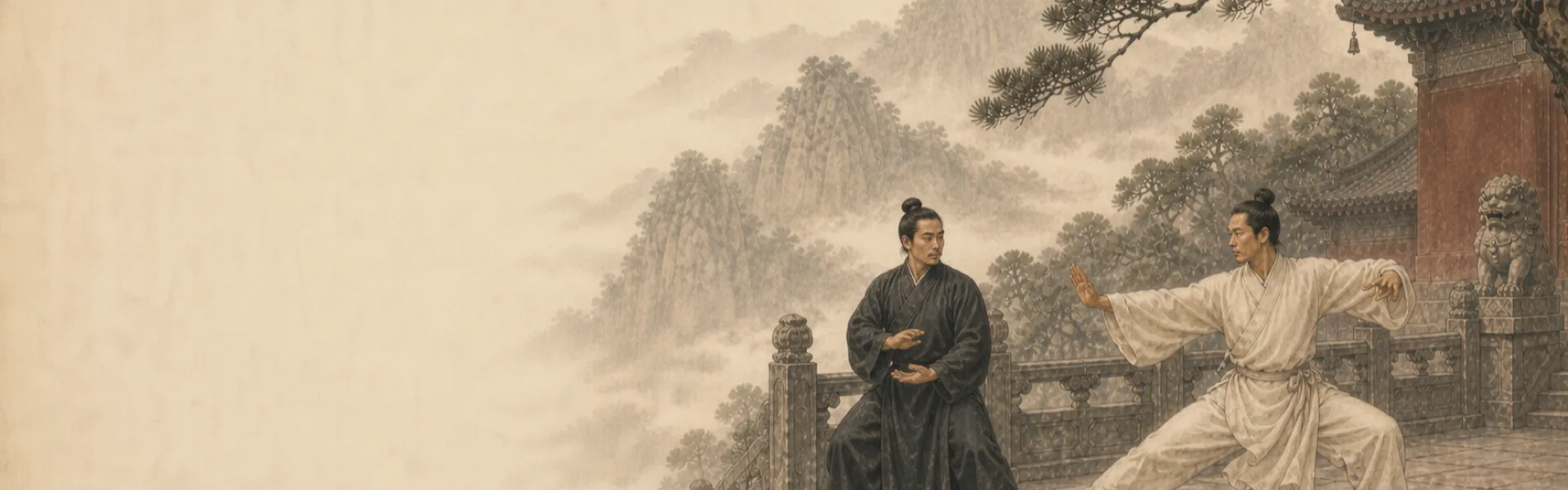
This guide explains how to read the distinction without dismissing its cultural importance or assuming that a label tells you everything about a method. For a student, the most useful questions concern the actual training, its progression, its history and its limits.
First ask what the speaker means
In a course description, “internal” might emphasize attention, coordination, reduced unnecessary tension or a particular lineage. In a historical text it may name a specific group. In a discussion of religion it may carry an association with Taoist cultivation. These meanings are related in some contexts, but they are not identical.
Nor do the words simply divide the inside and outside of the human body. A movement has visible form, physical effort and an attentional task. Describing one aspect as internal does not make the other aspects disappear.
A good explanation therefore starts with a concrete definition: what does this school mean by the term, and how does that definition change what a beginner actually practises?
An important historical source: Wang Zhengnan’s epitaph
Huang Zongxi’s seventeenth-century Epitaph for Wang Zhengnan is an important source for the distinction. Its opening contrasts Shaolin boxing with an “internal school,” characterized by the expression yi jing zhi dong (以静制动), using stillness to respond to movement. The text also sets out a genealogy and recounts Wang’s conduct and martial reputation.
Read it as a commemorative historical text, not as a modern training syllabus or a controlled test. It provides evidence of how its author described and valued an art. Establishing the transmission of a particular modern method requires additional evidence about that method and its teachers.
The epitaph does not, by itself, settle the relationship between every art now called internal. Equally, the presence of a literary or commemorative purpose does not make the source worthless. Its terminology, named people and ethical concerns deserve careful attention.
Zhang Sanfeng and Wudang: distinguish the questions respectfully
Zhang Sanfeng is a Ming-dynasty Taoist figure of enduring importance to Wudang. The Ming History, volume 299, records his connection with the mountain and imperial efforts to find him. This historical and cultural presence should not be reduced to a dismissive aside about whether he existed.
Different texts also attach martial genealogies and sacred narratives to the name. The epitaph’s opening, for example, invokes a Wudang adept named Zhang Sanfeng within a Song-period account; the Ming History gives a different chronological setting. These passages should be identified accurately, not quietly merged into one biography.
Recognizing Zhang Sanfeng’s importance, examining a source’s account and establishing the transmission of a specific boxing method are distinct tasks. A careful page can respect the first while being precise about the evidence needed for the others.
Do not make one label carry five different claims
- Soft and hard: ask whether these describe contact, tempo, posture, effort or a tactical choice.
- Slow and fast: a teaching speed does not necessarily describe every stage of practice.
- Attention and strength: attention to coordination is not an exemption from physical effort or appropriate conditioning.
- Taoist and Buddhist: a religious or institutional relationship does not specify an entire technical syllabus.
- Lineage and quality: identifying a lineage does not automatically establish a particular teacher’s competence or a student's suitability for the class.
These are questions to separate, not a new chart assigning every art to a box. An apparently elegant contrast becomes misleading when it is used to infer details that the provider has not actually explained.
Compare teaching methods through observable tasks
A student can ask about stance height, stepping, turning, held positions, coordination, solo forms, partner exercises and conditioning. Ask how the teacher introduces each element, what corrections look like and how demands change over time.
For example, “relax the shoulders” can be clarified as reducing an unnecessary effort while maintaining an organized position. It should not mean becoming unsupported or ignoring discomfort. “Whole-body movement” should be accompanied by a task and feedback, not only an impressive phrase.
The aim is not to translate every traditional word into one anatomical formula. It is to make instruction understandable enough that a student can ask what they are doing and how the teacher knows it is improving.
Respect the language of qi without making unsupported promises
Qi is significant in Chinese cultural and practice vocabularies. A teacher may use it within a particular framework of posture, breathing, attention or cultivation. Ask how the term is being used in that setting.
A sensation of warmth or heaviness is an experience, not by itself a measurement of a special force or proof of medical benefit. Likewise, a calm appearance does not establish martial effectiveness. Historical explanation, personal experience and an outcome claim need different kinds of support.
For health questions, use condition-specific evidence. NCCIH’s Tai Chi overview discusses studied programmes and their limitations; it does not certify every class described as internal. A cultural term is not a substitute for appropriate healthcare advice.
Partner demonstrations need context
A cooperative exercise can teach a defined response. A performance can illustrate a principle. Neither automatically tells you how the same action behaves under different conditions. Ask what the demonstration is intended to show, what the partner is asked to do and what its limits are.
If a school claims to teach martial application, ask how it develops timing, judgment and progressively appropriate practice. This is not an invitation to surprise-test someone or attempt an unsupervised challenge. Contact work needs consent, suitable supervision and a clear way to stop.
A wellbeing class can be worthwhile without combat training. The important point is that its description should match what it offers.
What Wudang and Shaolin names can tell you
These names can identify places, institutions, traditions and martial identities. They should not be treated as two complete and opposite systems that explain every Chinese martial art or every class offered today.
Ask which actual teacher, method or institution is being named. A relationship to a place may be cultural, organizational, biographical or technical; each should be described for what it is. A school should not have to disparage another tradition to explain its own work.
Similarly, a modern adaptation need not be concealed to be worthwhile. Identifying what has been adapted helps students understand the relationship between inherited material and present teaching.
A practical checklist for students
- What does “internal” or “external” mean in this programme?
- Which named method and teachers does it refer to?
- What will a beginner actually do, and how will that change?
- How are physical effort, rest and adaptations managed?
- What claims concern culture, health, performance or martial application?
- Can the teacher explain the supporting sources and the limits of each claim?
No label guarantees a risk-free class. If a health condition affects participation, ask an appropriate healthcare professional about your needs and the instructor about modifications. You should be free to decline contact, ask questions or stop an exercise.
Use the distinction as a starting point
On Wudang.org, these terms are useful when their meaning is made clear. They are not a ranking of people, a guarantee of superior health or a reason to dismiss the historical depth of a tradition.
Return to Foundations of Internal Martial Arts or the Martial Arts overview. For the boundary between traditional explanations and clinical claims, read Taoist traditions and modern healthcare.