Martial Arts as Taoist Cultivation
以武入道:武术与道家修养的关系
Martial practice can be part of a Taoist path of cultivation when it belongs to a meaningful relationship between teaching, conduct and religious life. It can also be studied as movement or martial skill without becoming a religious commitment. Understanding that difference helps visitors approach Wudang with respect and ask what a particular school actually offers.
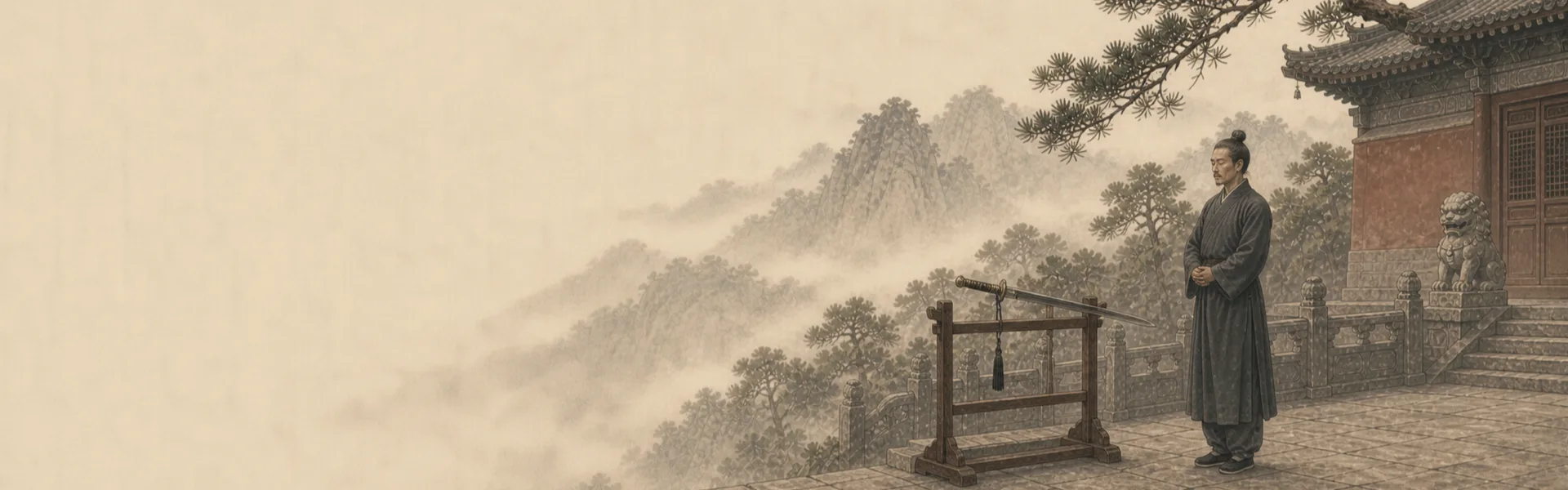
This guide does not decide the spiritual value of someone else’s practice. It distinguishes a tradition’s account of its purpose, evidence about its history, the tasks taught in a class and the changes a student hopes to make. These questions belong together, but one answer does not settle all of them.
Cultivation means more than becoming calm
Taoist cultivation cannot be reduced to a modern stress-management programme. The Stanford Encyclopedia’s account of religious Daoism discusses nourishing life, meditation and alchemy, with ethical conduct as a foundation. Different traditions give these activities distinct religious purposes.
When a school describes its martial teaching as cultivation, ask how it uses the word. Does it mean attending carefully to movement, developing conduct towards others, undertaking a devotional commitment, or following a specific transmitted discipline? These meanings can coexist. Naming them helps students understand the invitation without reducing religious practice to fitness or making a movement class promise spiritual attainment.
Wudang is a religious place, not simply a backdrop
The UNESCO account of Wudang’s buildings documents a major Taoist religious landscape and its important Ming architectural development. This heritage deserves attention in its own right.
For a visitor, that means distinguishing a temple, a teaching school, a demonstration and a commercial course. Their connections should be explained, not inferred from a shared mountain name or a photograph in front of a shrine. Ask who teaches, which institution is responsible and what access to religious spaces is actually included. Respect local worship, photography rules and the people who use these places for purposes other than tourism.
Respect a lineage while identifying its historical claims
Zhang Sanfeng remains an important Ming-dynasty Taoist figure in Wudang’s memory. A school’s reverence for him can express a real religious and ethical relationship. The accompanying historical questions should be specific: what text, date, teacher or transmission is being described?
Our guide to Zhang Sanfeng separates these kinds of evidence. Honouring an ancestor does not require treating every attribution as an autograph, and questioning the date of a manual need not be an attack on the community that values it. A useful introduction leaves room for both careful documentation and the school’s explanation of its living tradition.
Shared vocabulary does not establish a single origin
Two practices may both speak of breath, attention, softness or the lower abdomen while using those ideas differently. Similar words are a starting point for comparison, not a complete history of borrowing. To establish a particular connection, look for identified teachers, dated texts, described exercises and evidence of contact.
In a class, ask for the practical meaning first. Where is attention directed? What task is being changed? Is the instruction a metaphor, a religious explanation or a claim about the body? It is unnecessary to decide the origin of every word before learning a movement, but it is equally unnecessary to invent an ancient origin to make the instruction worthwhile.
Non-forcing is a question for practice, not a magic formula
A teacher may interpret non-forcing through adapting to a task instead of adding unnecessary effort. Treat that as an interpretation to explore: which effort is unnecessary, and what support or coordination must remain? “Do less” can mean something useful only in relation to what you are trying to do.
Non-forcing should not be used to demand passivity when you need to stop, ask a question or protect a boundary. Nor does invoking Taoist language remove the need for instruction and practice. The guide to song and rooting gives more concrete questions about relaxation, support and controlled partner work.
Read the warnings about force in their own context
In the Daodejing, chapters 30 and 31, military domination and celebration of killing are treated critically. Chapter 31 presents victory through the language of mourning. These passages concern force and government; they are not instructions for a modern martial class.
They nevertheless offer material for an ethical discussion. How should capability be held without boasting? What responsibilities come with teaching techniques that could injure? A school can use these questions to examine its conduct without claiming that an ancient passage authorises every training method or resolves every situation of conflict.
Restraint needs observable rules
Ethics becomes clearer when a school explains how people are treated. A partner should know the task, the level of contact and how to stop it. Refusing contact or requesting a different exercise should not invite humiliation. An instructor’s reputation is not a substitute for these arrangements.
Look also at ordinary behaviour: whether experienced students care for beginners, whether injuries are acknowledged, and whether disagreements can be raised without retaliation. These are practical criteria for choosing a learning environment, not a claim that all traditional schools operate alike. A beautiful statement about harmony matters most when the daily arrangements support it.
Feedback is useful, but it is not a spiritual examination
A controlled task with a partner can provide feedback about that task. It does not measure a person’s entire character, wisdom or religious attainment. Differences in size, experience, mobility and the agreed rules also matter. Losing balance is not a moral failure, and winning an exercise does not confer authority over another person’s life.
Likewise, a quiet solo practice is not automatically self-deception simply because it has no opponent. Different practices have different purposes and forms of guidance. Compare what each setting asks you to observe instead of declaring that martial contact is a superior test of every kind of cultivation.
Carry intentions into daily life deliberately
If your aim is patience, do not assume that learning a form will automatically make every conversation patient. Choose an ordinary, observable intention: listen without interrupting, admit when you have not understood, or stop turning a disagreement into a contest. Revisit what happened without awarding yourself a spiritual rank.
A short learning note can help: what was the task, what did I notice, what did the teacher clarify, and what will I try differently? This is an optional reflection tool, not a traditional prescription or a clinical treatment. It should support attention rather than become another demand to achieve a perfect inner state.
Choose your level of participation freely
Before booking, ask whether the course includes worship, vows, ceremonies, meditation or only physical training. Which elements are optional? Who explains their meaning? Are accommodation, tuition and additional activities priced clearly? Religious participation deserves informed consent, not an assumption based on buying a class.
Spiritual explanations should not be used to dismiss pain or replace healthcare. NCCIH advises against using tai chi to postpone medical care. Ask about adaptations where necessary, and do not accept a demand to endure an unsafe activity as proof of sincerity.
A thoughtful way to continue
Martial cultivation is most intelligible when a school can describe its purpose, its transmission, its teaching and its responsibilities to students. You may value its religious meaning, its movement discipline, or both. None requires turning every personal experience into a historical proof or a promise of transformation.
Return to the foundations of internal arts to follow the wider pathway. Read the linked texts with their different purposes in view, and let a community explain its tradition while retaining the freedom to ask precise and respectful questions.