Key Sources and Further Reading
读什么,用什么本子,按什么顺序
Reading can deepen internal martial arts practice without turning every book into an authority on every subject. A teacher’s recollection, a historical document, a translation and a study of movement answer different questions. The useful starting point is not a contest between believers and sceptics, but a clear account of what you want to understand and what your source can actually show.
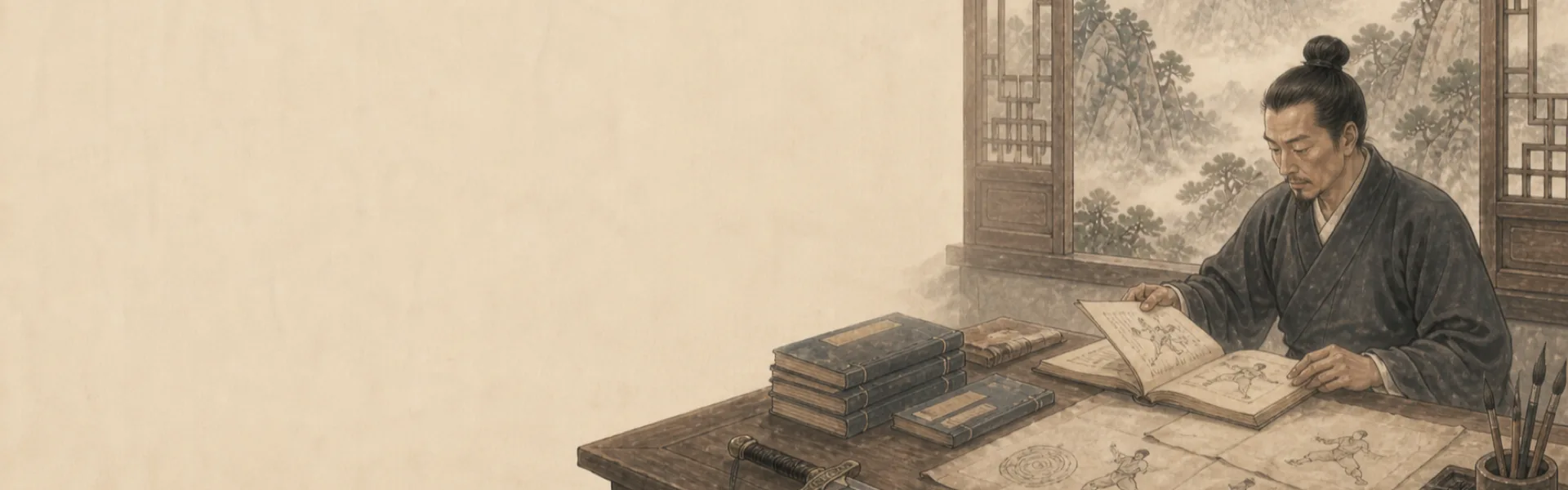
This guide offers a manageable route through history, taijiquan documents and Taoist cultivation. The book details identify particular editions or catalogue records; they are not claims that every edition is identical or that a complete book has been reviewed here. The annotations suggest uses and limits, not a universal ranking.
Begin with a question, not a ranking
Before choosing a book, write down one question. Are you investigating when an expression appears in print, how one teacher explains a movement, or what a religious practice means to its community? “Is this authentic?” is too broad until you specify the claim. A dated manual can document a teaching at a particular time without proving every generation in a lineage chart.
Match your reading to that question. For terminology, compare a passage with its surrounding explanation. For a historical event, look for evidence close to the event and follow the author’s references. For a present-day class, observe what is taught and how students are treated. One kind of evidence cannot simply substitute for the others.
Distinguish primary text, translation and interpretation
A primary source is evidence to examine, not a guarantee of accuracy. An epitaph, autobiography or training manual has an audience and a purpose. Ask who produced it, when, in what form it survives and whether the writer witnessed the event or repeated an account. Oral testimony matters as evidence of memory and transmission; its reach into a distant past needs separate corroboration.
Keep three layers visible in your notes: the source’s wording, the translator’s choices and your own interpretation. A transcription can make Chinese text searchable, but it is not the same as inspecting a printed page or manuscript. If an argument depends on one character or punctuation mark, seek an identified edition or facsimile before treating that detail as settled.
Our Zhang Sanfeng article gives a practical comparison. Read the Zhang Sanfeng notice in Ming History, volume 299 beside Huang Zongxi’s Wang Zhengnan epitaph in Huang Lizhou wenji, volume 4. Zhang Sanfeng is a Ming-dynasty Taoist figure of enduring importance to Wudang; Huang’s martial account uses a different, Song-period setting. Do not silently combine their chronologies. These linked Chinese transcriptions offer a starting point, not a completed critical comparison of editions.
Establish a broad historical background
Peter A. Lorge, Chinese Martial Arts: From Antiquity to the Twenty-First Century. English; Cambridge University Press; the linked catalogue record lists 2012, ISBN 9780521878814. Its contents provide a chronological route through Chinese martial history. Use it to orient a more specific question, not as a Wudang lineage certificate.
When reading a broad survey, make a small timeline with separate columns for the event being discussed and the document used to support it. Notice changes of setting: an army, a village, a commercial school and a religious community need not use the same term in the same way. Return to the cited source when a short overview carries more weight than it can reasonably bear.
Use a monastic case study without making it Wudang’s history
Meir Shahar, The Shaolin Monastery: History, Religion, and the Chinese Martial Arts. English; University of Hawaiʻi Press; paperback, September 2008, ISBN 9780824833497, as identified by the publisher. This is a study of Shaolin’s martial and religious history, not a history of Wudang.
Its comparative value is methodological. Ask what documents establish a relationship between an institution and a practice, then ask what evidence exists for the institution you are actually studying. Similar vocabulary or a shared religious setting does not establish direct transmission. Differences between Buddhist and Taoist communities also deserve attention rather than being flattened into one category of “temple martial arts.”
Compare dated taijiquan documents
Douglas Wile, Lost T’ai-chi Classics from the Late Ch’ing Dynasty. English with Chinese source texts; SUNY Press, 1996, ISBN 9780791426548. The catalogue description identifies translations and analysis of four nineteenth-century manuscript collections. This is a focused route into documents and competing interpretations, not a reason to accept every historical conclusion without checking its argument.
Choose one passage rather than trying to settle the entire history at once. Record the attributed author, the surviving witness or edition, the translator and the specific claim being made. Distinguish the age claimed for a teaching from the date of the document carrying that claim. If two translations differ, investigate the Chinese expression and context before deciding that one author must be careless.
The older spellings in book titles are useful search terms. Preserve them in a bibliography even when your own prose uses taijiquan or Qing. Do not present an explanatory translation of a title as the name of an officially published edition in another language.
Read Taoist cultivation in its own context
Livia Kohn, Chinese Healing Exercises: The Tradition of Daoyin. English; University of Hawaiʻi Press; paperback, September 2008, ISBN 9780824832698. The publisher’s description outlines a historical study of daoyin from early medical manuscripts through religious and later developments. It is relevant background, not proof that every martial exercise came from one Taoist source.
Kristofer Schipper, The Taoist Body. English translation by Karen C. Duval; University of California Press; paperback, March 1994, ISBN 9780520082243, according to the publisher. For French readers, Le Corps taoïste : Corps physique – corps social has a Fayard edition listed for 20 January 1993, EAN 9782213030258. These dates identify the linked editions, not the first appearance of the work.
Let a religious text pose religious questions. Ritual, community, conduct and bodily imagery need not be reduced to explanations of fighting technique. Equally, a historical account of healing practices is not evidence that a particular exercise treats a present-day medical condition. Our martial cultivation guide keeps purpose, practice and conduct distinct.
Read teaching manuals as situated sources
Chen Weiming’s 1925 Taijiquan shu provides one concrete example. The Chinese text presented with Paul Brennan’s English translation labels the Ten Essentials as spoken by Yang Chengfu and recorded by Chen Weiming. That attribution helps you identify the particular teaching being presented; it does not turn the whole book into a neutral history of every school.
Use the Chinese text and the translation as distinct resources. Do not copy a modern translation merely because the older Chinese work is public domain. For practice, bring one instruction to a teacher and ask how it is demonstrated within that school. A written cue may depend on prior instruction, a specific exercise and a partner’s cooperation.
Apply the same care to memoirs and interviews. Record who is speaking, what they personally observed and what they heard from others. You can respect a teacher’s experience while leaving a remote historical claim unresolved. Neither academic credentials nor practical skill makes every statement equally well supported.
Ask what a mechanics explanation actually measures
A movement explanation should name its task and conditions. Does it concern balance while standing, force during a controlled push, or timing during a strike? What was observed, with what equipment, and compared with what? A slow demonstration and a resisting interaction answer different questions. Avoid treating a persuasive metaphor as if it were a measurement.
When a source connects a traditional term to a scientific quantity, ask for its definition and the evidence for that particular connection. Neither dismiss the whole vocabulary nor assume that one experiment establishes all its meanings. The song, rooting and whole-body power guide offers a reader’s introduction; it is not a substitute for a research paper or supervised training.
Keep a usable edition and quotation record
A short record is more valuable than a folder of unattributed screenshots. For each passage, note:
- Author or attributed author, full title, editor and translator where relevant.
- Publisher, edition or printing, year and ISBN; for older works, volume and identified source copy.
- Page or section, the exact passage consulted and enough context to understand it.
- Whether you read an original, translation, transcription, facsimile or someone else’s quotation.
- The claim it supports, what remains uncertain and the date you consulted an online source.
Keep your quotation and your paraphrase visibly separate. If you have read only a catalogue description, say so. If a reference cannot be located, leave it as an unresolved lead rather than manufacturing a page number. Page counts, publication years and pagination can differ between formats; identify the copy actually used.
Choose a short reading route
For history, begin with the broad survey and then follow one document discussed in the internal and external arts guide or the Zhang Sanfeng article. For terminology, pair the three treasures guide with a passage in its stated context. For religion, begin with Schipper and use Kohn when your question concerns daoyin. Read one useful section carefully before collecting more titles.
You do not need to buy every book. Check a library catalogue, an authorised preview or an available source text first, then choose the work that matches your question and reading language. No prices, local availability or French translations of the other English titles are assumed here. Return to Foundations of the Internal Arts to connect your reading with the rest of the pathway.