Song, Rooting and Whole-Body Power
松、沉、整劲:核心功夫与检验方法
Song, rooting and whole-body power are ways of talking about how a practitioner organises movement and responds to contact. They are not a promise of immovability or a complete scientific explanation of the internal arts. This guide gives you a clearer way to understand the vocabulary, read a demonstration and ask useful questions in a supervised lesson.
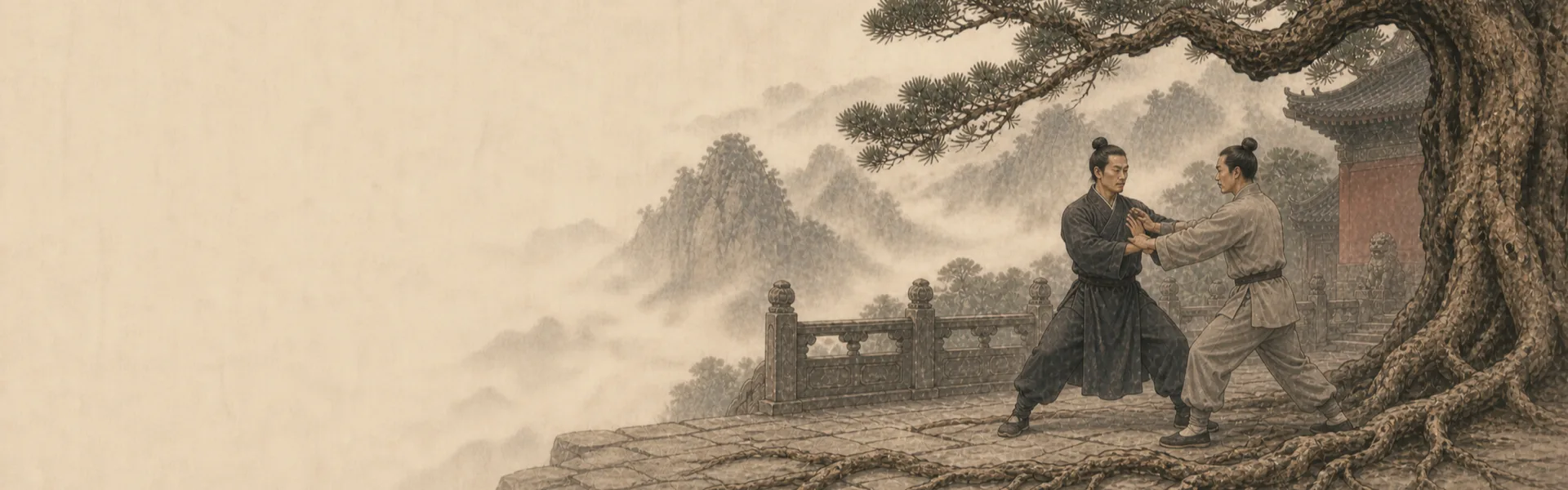
Keep three levels separate: what a historical text teaches, how your school interprets it, and what an observation actually shows. A change that feels convincing in a gentle exercise may be worth learning without proving that it works at every speed, in every direction or against an unexpected attack.
Song: release unnecessary effort without abandoning the task
Song is often translated as relaxation or loosening. In the Ten Essentials recorded in Chen Weiming’s 1925 Taijiquan shu, attributed there to Yang Chengfu’s oral teaching, loosening the waist and releasing the shoulders appear alongside coordination and continuity. That gives the instruction a specific teaching context rather than making it a rule to switch off every muscle.
In a lesson, ask which effort is unnecessary for the movement being taught. Can the teacher identify the change without asking you to lose your balance or force a joint into a position? “Relax more” becomes useful when it refers to a task you understand. It is less useful when every difficulty is blamed on an invisible tension that only the instructor can judge.
Support and adaptability are not opposites
A posture can look calm while still requiring muscular work. Conversely, making a limb feel soft does not establish that it is well organised for the next action. Do not treat stiffness and collapse as complete diagnoses, or assume that one appearance tells you everything about a student’s skill.
A better discussion asks what the person needs to do next: maintain the agreed position, change direction, step or stop? A chain, a ball or a spring may help an instructor explain one feature. None is an exact model of a living body, and an image should not be promoted into a claim about uniformly loaded connective tissue or mechanically “open” joints.
Peng can name a method and a broader quality
It is too restrictive to say that peng is never a technique. Chen Weiming’s book describes a named peng action and also discusses its presence during other pushing-hands actions. Read together, those passages show why a teacher might use the same word for a particular method and for an organising quality.
Ask which meaning is intended. If an instructor uses an inflated-ball image, ask what feature the comparison is meant to highlight. It need not imply that every joint expands by the same amount or that a soft-looking arm cannot be compressed. A historical description is a teaching source, not a measurement of tissue loading.
Rooting: balance depends on conditions
For a simplified standing model, OpenStax’s discussion of stability relates balance to the support area and the effects of forces and torques. Its account of friction also explains why contact with a surface matters. A body is not an unbroken pipe that sends every incoming force harmlessly into the floor.
In teaching, rooting can draw attention to how someone manages support. But a successful demonstration belongs to its conditions: stance, surface, direction, amount of pressure, timing and rules about stepping. Changing those conditions changes the question. Neither “a rooted person cannot move” nor “rooting is useless sideways” is an adequate general rule.
Whole-body power: identify the coordination being taught
The traditional foot–leg–waist–hand sequence appears in the essays and coordination discussion reproduced in Chen Weiming’s book. It is a meaningful instruction to relate the parts of an action. It should not be equated automatically with a single laboratory model that explains every strike, throw or form.
Ask what is supposed to happen together and what is supposed to happen in sequence in this particular movement. Large visible movement is not the only possible sign of contribution, and moving every part at once is not a definition of skill. A claim about force, power or energy transfer needs clearly defined quantities and suitable measurements, not just the phrase “kinetic chain.”
Coordination lists need context
You may encounter a list called the six harmonies, or instructions pairing hands and feet, elbows and knees, shoulders and hips. Ask which formulation the school uses and what “harmony” means for the task. It could concern timing, relative position, intention or another teaching emphasis; those meanings should not be silently treated as identical.
Do not conclude that a movement has no whole-body power merely because the hand arrives before a foot in one video frame. First establish what action was intended, which phase you are observing and what the teacher’s criterion is. A checklist can guide attention without becoming a universal pass-or-fail test for every martial method.
Rotation is a feature to explain, not a guarantee
If a teacher describes spiralling or silk-reeling, ask to see the particular coordination they mean. Which part turns, in relation to what, and for what purpose? Avoid turning the label into a requirement to twist every joint or make a visibly circular movement regardless of the task.
A curved action is not automatically easier, safer or more powerful than a straight-looking one. Nor does visible forearm rotation by itself distinguish an expert from a beginner. The useful comparison is between the intended task and the action being performed, not between two appearances stripped of context.
Partner work requires consent and controlled conditions
This page is not an invitation to test an unprepared person’s balance. Begin partner work with a competent instructor, agreed contact and a clear stop signal. Everyone should understand whether the activity is a cooperative demonstration, a controlled learning exercise or a separately supervised form of resistance training.
Use a suitable practice area away from edges and obstacles. Do not introduce surprise shoves, increase pressure to prove a point or prevent someone from stepping to recover. Ask permission before hands-on correction and accept refusal. Images of practice in dramatic mountain settings are illustrations, not instructions to recreate the setting or pose.
There is no requirement to stand beyond comfort or endure pain to establish that you are serious. Stop if a task causes pain or dizziness, and seek appropriate advice about symptoms rather than treating them as evidence that a “root” is developing. NCCIH’s tai chi guidance distinguishes practice from medical care and recommends checking an instructor’s experience.
Measure progress by the task, not a fixed promise
A course may use standing, forms and partner exercises for different purposes. Ask what each exercise is meant to teach and how it can be adapted. No universal timetable can be read out of the words song, root or jin; a teacher should not guarantee competence after a set number of months or explain every difficulty as insufficient dedication.
A practical learning note might record the task, the agreed conditions, the correction given and what remained unclear. Keep cooperative success separate from performance with changing conditions. The point is to make progress discussable, not to turn an informal demonstration into a scientific experiment or a certificate of fighting ability.
Read the sources and continue the foundations
Chen Weiming’s book is a historical teaching document. The linked edition includes the Chinese text and Paul Brennan’s English translation; the discussion here refers to the Chinese passages and uses its own explanatory wording. Its historical claims, health anecdotes and strong martial promises are not all endorsed by citing its teaching vocabulary.
Continue with Jing, Qi and Shen in martial learning, or return to Internal Martial Arts Foundations. For historical categories, see Internal and External Arts. The aim throughout is to keep traditional language, actual teaching and the strength of a claim in proportion.