Jibengong and Stance Training: Building Foundations Safely
基本功与桩功:安全建立训练基础
Foundational practice is where a movement becomes repeatable. In Chinese martial arts, jibengong (基本功) is a broad name for this work: stance practice, stepping, mobility, single movements, coordination and conditioning. It is not one universal Wudang syllabus.

A useful foundation is adjustable. The aim is not to copy the deepest posture or complete the highest repetition count, but to organise the body well enough to practise again with attention.
1. What Jibengong Means
Different schools group their basics differently. One class may begin with standing and stepping; another may use short combinations, weapons or partner exercises. The label identifies a function—building capacities that later practice needs—rather than a fixed list.
Ask what each exercise is preparing. A stance might teach weight placement, a step might train direction changes, and a repeated hand method might coordinate the whole action. This question is more useful than deciding which school owns the “correct” basics.
2. Read the Variables in a Stance
Observe width, depth, foot direction, weight distribution, torso angle and where the gaze rests. Changing one variable can change both the purpose and the load. A coach may therefore alter the same named stance for a new student, an older practitioner or a different drill.
Training postures are study tools, not necessarily frozen pictures of application. Begin at a depth where the feet stay settled, the breath remains unforced and the intended action is clear. Greater depth is an option, not proof of greater skill.
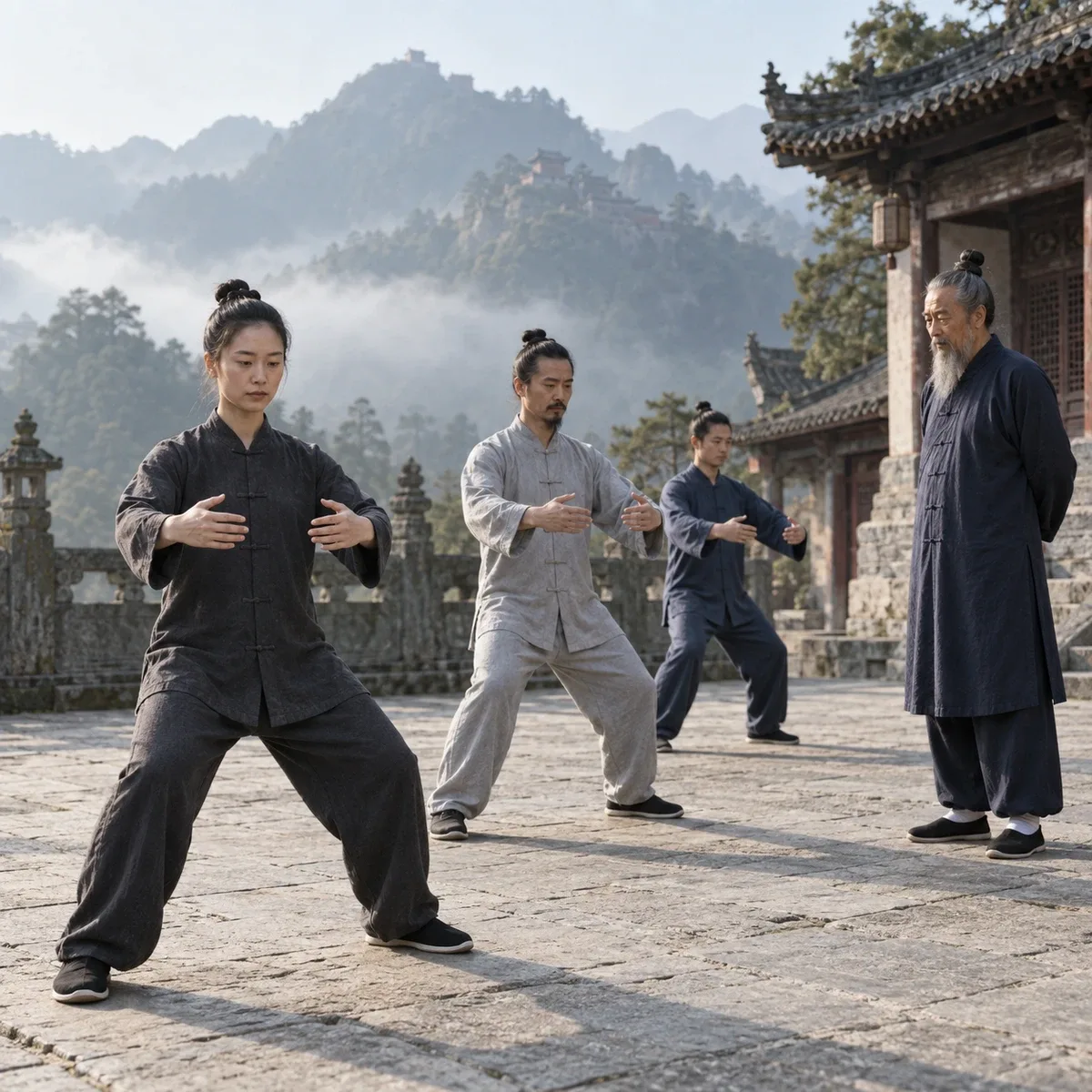
AI-generated editorial illustration of an imagined practice scene; no real teacher, school or event is depicted.
3. Feet, Knees and Direction
There is no single knee-to-toe rule that fits every body and every stance. What matters is whether the feet, knees and direction of force can be coordinated for the task without unwanted pain or loss of control.
Use a mirror, a line on the floor or qualified feedback to compare repetitions. Adjust range, stance width or support before adding duration. Do not use an article to diagnose joint pain or to force a position that repeatedly feels wrong.
4. Standing as an Observation Practice
Quiet standing gives time to notice balance, breathing, unnecessary tension and small shifts of weight. Short, attentive holds can reveal habits that fast sequences hide. Some traditions also explain standing through concepts such as qi, intention or internal connection; these are traditional teaching frameworks, not medical diagnoses.
Keep the task specific: choose a stance, a comfortable range and one point of attention. End the hold while the shape can still be adjusted deliberately. Longer is not automatically better.
5. Mobility Before Range
Hip, ankle, shoulder and trunk mobility can support stances and stepping, but mobility work should serve the movement being learned. Use controlled circles, transfers and easy ranges before demanding positions.
Dynamic and static stretching can both have a place. Their timing depends on the session, the intensity and the individual. Avoid a universal rule that every stretch belongs only at the beginning or only at the end.
6. Repetition with a Question
Single-movement practice becomes useful when each repetition has a purpose. Work on one feature—foot placement, timing, direction or recovery—then check whether it remains stable as the movement becomes smoother.
There is no magic number. Ten careful repetitions may teach more than two hundred rushed ones; at another stage, a larger volume may build familiarity. Stop the set before fatigue erases the feature you intended to study.
7. Strength and Conditioning
General strength, balance and aerobic work can sit beside traditional basics. Squats, carries, walking, resistance exercises or other suitable activities may support practice when their difficulty and technique match the person.
Conditioning is not a punishment for imperfect form, and fatigue does not prove that a method is authentic. Place demanding work where it will not make technical practice careless, and increase only what can be recovered from.
8. Dose, Recovery and Warning Signs
Change one main variable at a time: duration, range, repetitions, speed, resistance or weekly frequency. That makes the response easier to read. Build regularity before intensity and include easier days when the overall load rises.
Ordinary effort is not the same as a symptom that needs attention. Stop and seek appropriate advice for a significant injury, new swelling, chest pain, faintness or symptoms that concern you. A teacher can adjust a drill; a teacher or webpage should not replace clinical assessment.
9. Feedback and Progress
Progress can appear as steadier balance, clearer direction, a more repeatable step, less unnecessary tension or better control at a chosen range. Record one or two observable measures instead of chasing a fixed timetable.
Compare the practitioner with their earlier practice, not with someone whose anatomy, experience and aims differ. Video from a consistent angle can help, provided it is used for reflection rather than public performance pressure.
10. Build a Small Foundation Session
A compact session might include a gentle warm-up, two stance or stepping tasks, one repeated movement and an easy finish. Keep one learning question for each task. On the next session, retain what worked and change only one variable.
Foundations should make later practice clearer and more sustainable. For planning intensity, partner work and recovery across a week, continue to Training and Practice.