Training Sources and Reading Paths: From Manuals to Practice
训练资料与阅读路径:从拳谱到实练
Training knowledge reaches us through many kinds of source: concise traditional texts, printed manuals, photographs, teachers’ explanations, demonstrations, historical research, clinical studies and personal notes. They do not answer the same questions, and none can replace every other kind.

The most useful reading habit is therefore not to rank all sources from best to worst. It is to identify what you want to know, choose evidence suited to that question, record what the source directly shows and test practical interpretations within safe, supervised training.
1. Begin with one question
“What should I read?” becomes manageable when it is tied to a purpose. Are you checking the wording of a principle, the sequence printed in one manual, a lineage date, a teaching method, a health claim or what changed in your own practice? Each question needs a different trail.
Write the question at the top of your notes and decide what would count as an answer. This prevents a vivid story from being used as a date, a photograph from being asked to prove movement quality, or one positive study from becoming a promise for everyone.
2. Identify the witness before interpreting it
A work, a surviving copy and the version in front of you are related but not identical. Record the author or attributed author, title, editor, publisher, date, edition, page or section, language and stable catalogue or scan record. If any detail is uncertain, label it uncertain.
A transcription may modernize characters; a reprint may change layout; a translation must choose punctuation and technical vocabulary. Our guide to sources for the internal arts explains how to keep witness, edition, translation, commentary and later inference separate.
3. Read compact texts at the right scale
Traditional verses and short treatises often preserve priorities, relationships and memorable phrasing rather than a complete lesson. A line about empty and full, intention, continuity or the waist may guide attention, but it does not specify the posture, partner role, resistance, duration or correction method needed for a safe exercise.
Turn a phrase into a bounded question instead of a universal law. Ask how your school demonstrates it, what observable change the instruction seeks, under which conditions it stops applying and whether another careful interpretation exists. Words can refine practice without pretending to generate skill by themselves.
4. Use manuals as dated teaching records
An old manual can show what a named author or editor chose to print for a particular audience. For example, publications from 1915, 1921, 1925, 1930 and 1931 used text, sequences, photographs or drawings to present different martial curricula. Their dates make them valuable witnesses, not automatic origins.
Compare exact cases through the site’s guides to Taijiquan sources, Baguazhang sources, Xingyiquan sources and weapons sources. One book cannot represent every branch, and a printed omission does not prove that a practice was absent elsewhere.
5. Compare versions before declaring a rule
When two sources differ, first describe the difference precisely: terminology, order, posture, illustration, partner format or explanation. Then ask whether the works come from different authors, branches, dates, audiences or editorial purposes. Variation is evidence to investigate, not an instant ranking of authenticity.
Photographs deserve the same care. They can show clothing, placement, camera angle and one selected moment. They cannot by themselves reveal timing, pressure, intention, the movement immediately before or after, or whether the pose was adjusted for the camera.
6. Read research by method and outcome
A study title or summary is not enough. Record who participated, what they actually practised, how often and for how long, what the comparison group did, which outcome was measured, how many people completed the study and whether adverse events were collected. A result belongs to those conditions before it belongs anywhere else.
Systematic reviews can organize several studies, but their conclusions still depend on the included evidence. Check the search date, inclusion criteria, differences among programs and certainty assessment. For a practical example of cautious source boundaries, see the Qigong reading guide. Research should inform questions, not turn a named art into medical treatment or guaranteed prevention.
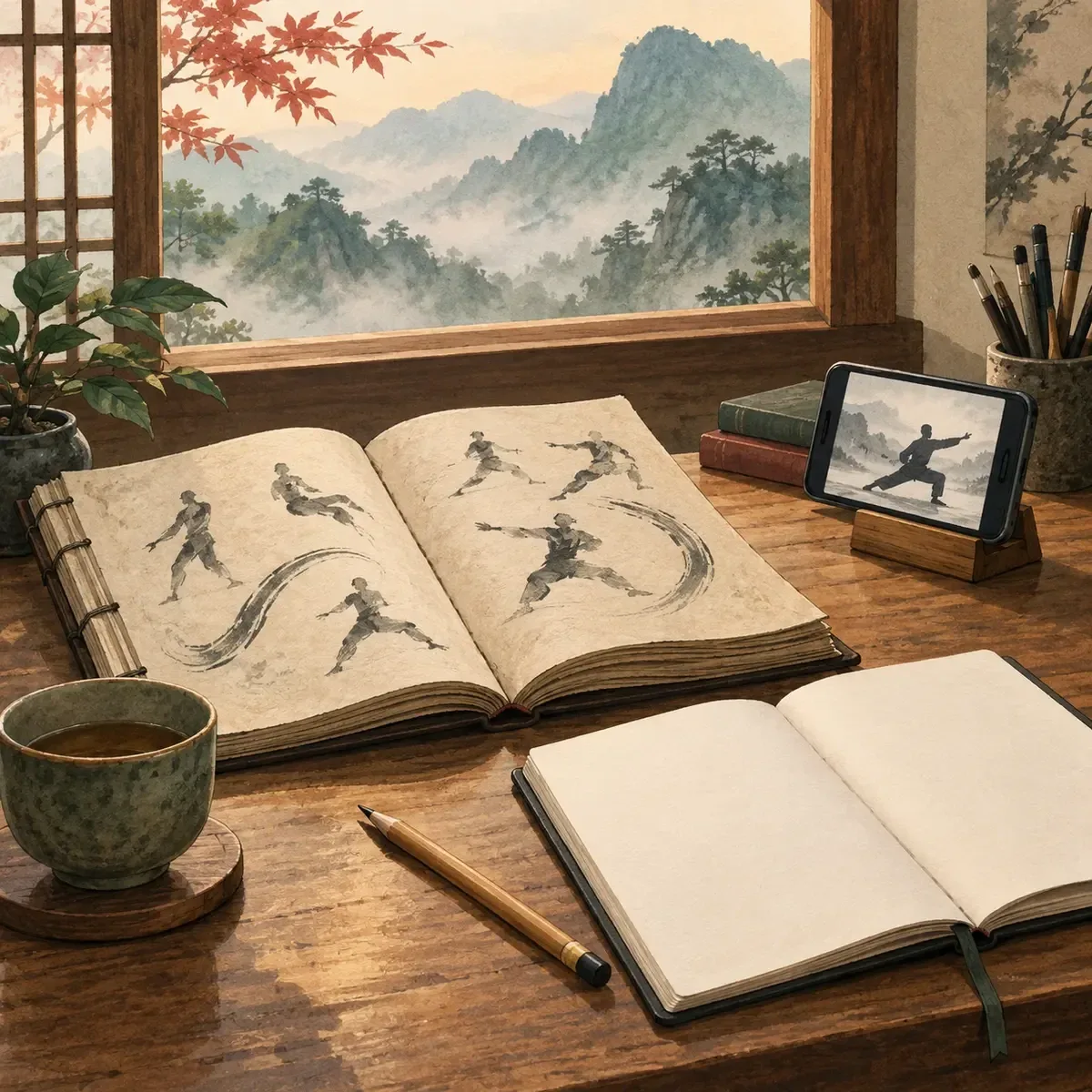
AI-generated editorial illustration comparing books, notes and video; the book and recording are imagined examples.
7. Use books and video as practice aids
Books are strong at preserving terminology, order and explanation. Video can show rhythm, transitions and the conditions chosen for a demonstration. Neither can feel your balance, select an appropriate partner, judge pain, obtain consent or adapt a drill to the space in which you are working.
When filming yourself, obtain permission from everyone visible and agree on storage and sharing. Compare a short clip with one clearly stated task rather than searching for every possible fault. A teacher’s correction, a video angle and your own sensation are three observations to compare, not three interchangeable verdicts.
8. Place testimony and ethnography in context
Teacher accounts, lineage narratives, memoirs and interviews can preserve names, relationships, values and experiences that a technical manual omits. Record who spoke, when, to whom, about which period, and whether the account is firsthand, remembered later or inherited from someone else.
Ethnography adds observation of a community, but the researcher’s access, relationships, language, location and period shape what could be seen. Respectful reading neither dismisses participant testimony nor treats an observer as neutral and all-knowing. Compare claims with independent records when the question requires them.
9. Make your own record usable
A training log is evidence about your practice, not proof about an entire art. Date each entry and note the exercise, duration or repetitions, teacher correction, partner conditions, effort, discomfort and the next question to test. Keep observation separate from explanation: “right knee moved inward” is different from “my qi was blocked.”
Short, permitted video clips can complement the log. Use the same viewpoint only when comparison requires it, and note changes in speed, surface, footwear, fatigue or instruction. Review the record periodically with a qualified teacher instead of interpreting every fluctuation alone.
10. Choose a short reading path
For practice, combine one source close to your current curriculum, one teacher-supported exercise and a dated training log. For history, start with a recoverable primary witness and scholarship that shows its evidence. For a health question, begin with current professional guidance and a review addressing one defined population and outcome.
Add another source only when the first path leaves a clear question unanswered. Keep reading alongside movement, feedback, consent and recovery. To connect these habits with session design, partner work and long-term review, return to Training and Practice.