Origins & Traditions of Chinese Herbal Medicine
中药的源流与传统
The history of Chinese herbal medicine is unusually well documented compared with most of the practices covered on this site, because it produced texts continuously for two thousand years and those texts were copied, printed, annotated, and criticised by people who took the subject seriously as knowledge.
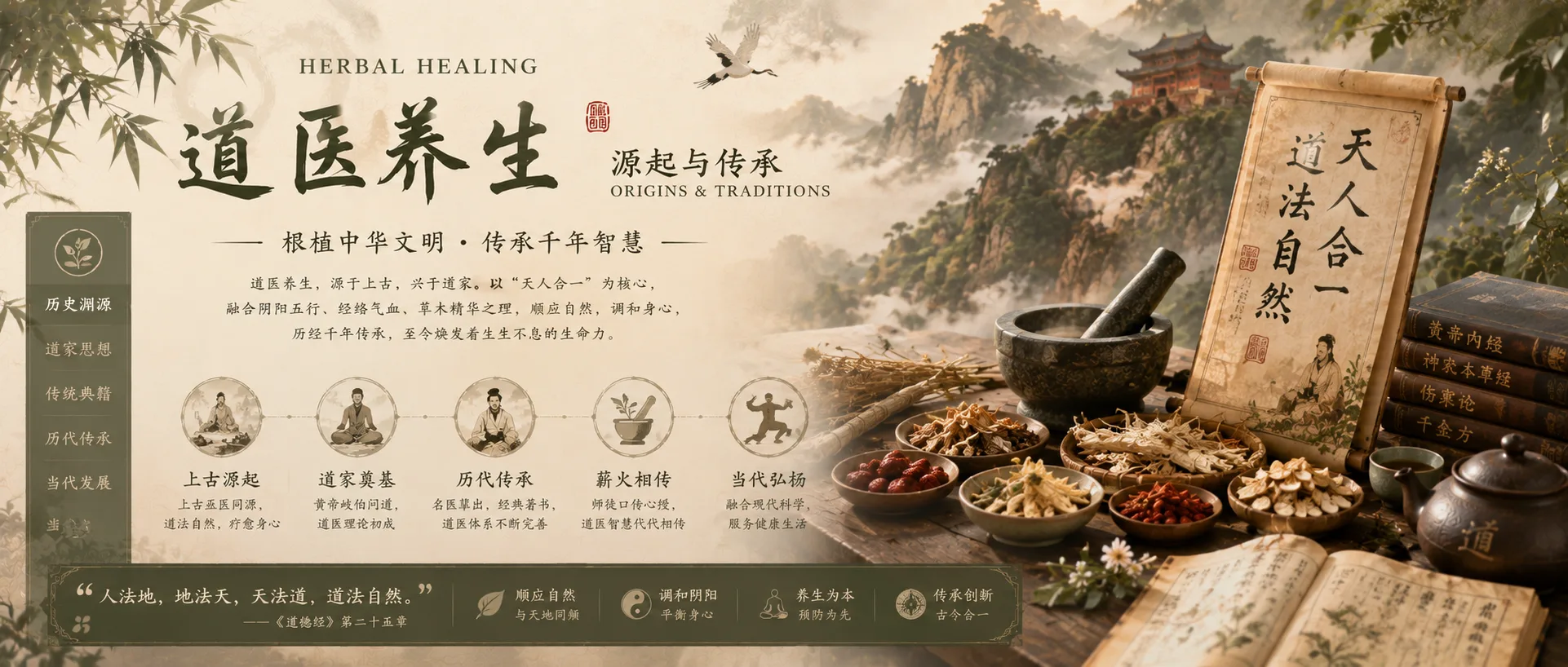
What follows traces that record from its legendary opening through the classical texts, the great compilations, the encounter with Western medicine, and the twentieth-century reconstruction that produced what is now called traditional Chinese medicine.
The legendary opening
Tradition credits the discovery of medicinal plants to Shennong, the divine farmer, who is said to have tasted a hundred herbs and encountered seventy poisons in a single day. This is a myth and nobody within the tradition treated it as a historical report.
It is worth noticing what the myth actually says. It describes discovery by systematic tasting, at considerable personal risk, with poisoning as the expected cost of the method. That is a reasonably accurate description of how a pharmacopoeia is actually assembled without chemistry, and the myth is more honest about the process than many later accounts.
The excavated evidence
The earliest hard evidence comes from tombs. The Mawangdui manuscripts, sealed in 168 BCE, include a text listing fifty-two ailments with treatments, using around 240 substances. It is not organised by theory. It is a list of complaints and things to try, some of them plainly magical.
This matters historically because it shows the practical pharmacopoeia predates the theoretical system. Herbs were being used and recorded before anyone organised them by temperature, flavour, and channel. The theory came afterwards and was applied to material already in use.
The Shennong classic
The Shennong Bencao Jing is the foundational text of the tradition. It was compiled around the first or second century CE, and the version we have is a reconstruction assembled from quotations in later works, since the original was lost.
It lists 365 substances, a number chosen to match the days of the year, which tells you something about the organising instincts at work. The substances are divided into three grades. The upper grade nourishes life and can be taken long-term without harm. The middle grade treats illness and requires care. The lower grade attacks disease and is toxic, to be used briefly and stopped.
This three-grade scheme is the tradition's first attempt at a safety framework, and it is a genuinely sensible one in principle. Its weakness is that the assignments were made by observation of short-term effects, so substances with slow cumulative toxicity were placed in the upper grade. Cinnabar, mercury sulphide, is classified as an upper-grade substance suitable for prolonged use.
Zhang Zhongjing and the formula tradition
Around 200 CE, during an epidemic that reportedly killed much of his own family, the physician Zhang Zhongjing produced the text now split into the Shanghan Lun and the Jingui Yaolue. This is arguably the most influential clinical work in Chinese medical history.
Its innovation was systematic. Rather than matching a herb to a symptom, it matched a formula to a pattern of signs, and it organised those patterns into stages of disease progression. It also established the structural logic of formula composition, with ingredients occupying defined roles.
Formulas from this text remain in daily use. That is a remarkable span of continuity, and it is worth acknowledging even while noting that continuity is not the same as efficacy.
The Tang and the state pharmacopoeia
Sun Simiao, working in the seventh century, produced two enormous compilations covering formulas, diagnosis, ethics, and regimen. His essay on the qualities required of a physician is one of the earliest sustained pieces of medical ethics in any tradition, and it insists on treating all patients equally regardless of status.
In 659 the Tang government issued the Xinxiu Bencao, a revised materia medica produced by a state commission with illustrations drawn from specimens collected across the empire. It is generally considered the world's first state-issued pharmacopoeia, predating European equivalents by many centuries.
Song printing and standardisation
The Song dynasty transformed the field through printing. Medical texts were printed by government offices, which meant standardised versions circulated widely rather than each lineage keeping its own manuscript variants.
The state also established pharmacies producing standardised prepared medicines, and issued a formulary specifying their composition. This is the beginning of manufactured Chinese medicine as opposed to individually compounded prescriptions, and many patent formulas sold today descend from this initiative.
Li Shizhen and the Bencao Gangmu
Li Shizhen spent nearly three decades on the Bencao Gangmu, completed in 1578 and printed after his death. It covers around 1,900 substances with over 11,000 formulas, and reorganises the whole materia medica by natural categories rather than by the traditional three grades.
What distinguishes it is his method. He travelled, collected specimens, interviewed farmers, fishermen, and hunters, and corrected earlier authorities where he found them wrong. He is explicitly critical of the alchemical tradition and warns against mineral drugs that earlier texts had recommended.
He was, in short, doing something close to empirical natural history, and the work is respected outside medicine as a landmark of Chinese science.
The Jin-Yuan debates
Between the twelfth and fourteenth centuries the tradition went through its most argumentative period, and it is worth knowing about because it contradicts the impression of a single unified doctrine handed down unchanged.
Four physicians are conventionally grouped as the masters of this era, and they disagreed with each other substantially. One held that most disease arose from excess heat and should be treated with cooling drugs. Another argued that disease should be treated by aggressive purging and expulsion. A third located the root of most illness in the spleen and stomach, and emphasised strengthening digestion. A fourth held that the body tends to have excess yang and insufficient yin, and prescribed accordingly.
These were not minor variations of emphasis. They were incompatible accounts of what causes illness, and they produced opposite treatments for the same presentation. The debates were conducted in print, with each side citing the classics in support.
The significance is twofold. It shows the tradition was genuinely self-critical and capable of internal argument. It also shows that appeals to classical authority did not settle questions, because all parties had classical authority available to them.
Warm disease theory
A further major dispute developed from the seventeenth century onward over the treatment of epidemic fevers. Zhang Zhongjing's cold damage framework had dominated for fourteen centuries, and a group of physicians in the lower Yangtze region argued it was actively harmful when applied to the epidemics they were seeing.
They developed an alternative framework describing disease progressing through different levels, and prescribed cooling and moistening treatments where the older tradition prescribed warming ones. Wu Youxing, writing during a devastating epidemic in 1642, went further and proposed that epidemic disease was caused by specific external agents entering through the nose and mouth, distinct for each disease.
That proposal is sometimes described as anticipating germ theory. The comparison should be handled carefully, since he had no way to identify or demonstrate such agents, but the reasoning was genuinely inferential rather than doctrinal: he observed that these diseases behaved differently from what the classics described, and concluded the classics were incomplete.
The encounter with Western medicine
From the nineteenth century, Western medicine arrived with missionary hospitals and colonial institutions, and the relationship was uncomfortable from the start.
By the early twentieth century, Chinese intellectuals were divided. Some regarded traditional medicine as an obstacle to modernisation and campaigned for its abolition. A 1929 proposal to ban it passed a national health committee and was withdrawn only after substantial organised protest by practitioners.
This episode matters because it explains a defensiveness that persists. The tradition was nearly legislated out of existence within living memory, and arguments about its validity are not, for many practitioners, purely academic.
The twentieth-century reconstruction
What is now taught as traditional Chinese medicine was substantially systematised in the 1950s and 1960s. The state established colleges, standardised curricula, and produced textbooks that presented a unified theoretical framework.
This process involved real editorial choices. Divergent regional traditions were harmonised, material considered superstitious was removed, and the theory was presented as more coherent than the historical record supports. The result is teachable and internally consistent, and it is not simply what physicians in the Ming or Qing were doing.
Recognising this is not a criticism. Every living tradition reorganises itself. But a student should know that the tidy system in the textbook is a modern product, and that the historical tradition was messier, more various, and more argumentative than its modern presentation suggests.
Key points
- The Mawangdui manuscripts show a practical pharmacopoeia existed before the theoretical system was applied to it.
- The Shennong Bencao Jing introduced a three-grade safety scheme that failed to detect slow cumulative toxicity.
- Zhang Zhongjing shifted the tradition from herb-to-symptom matching to formula-to-pattern matching, and his formulas remain in use.
- The Tang state pharmacopoeia of 659 predates European state pharmacopoeias by centuries.
- Li Shizhen's work involved fieldwork and explicit correction of earlier authorities, and is respected as natural history.
- Modern traditional Chinese medicine was substantially systematised in the 1950s and is tidier than the historical tradition it derives from.