Herbs of the Wudang Tradition
武当传统中的药草
The Wudang range has a genuine reputation as a source of medicinal plants, and unlike many claims about the mountain this one rests on verifiable ground. The region's botany has been surveyed, its plants collected and traded for centuries, and its Taoist communities did practise herbal medicine.
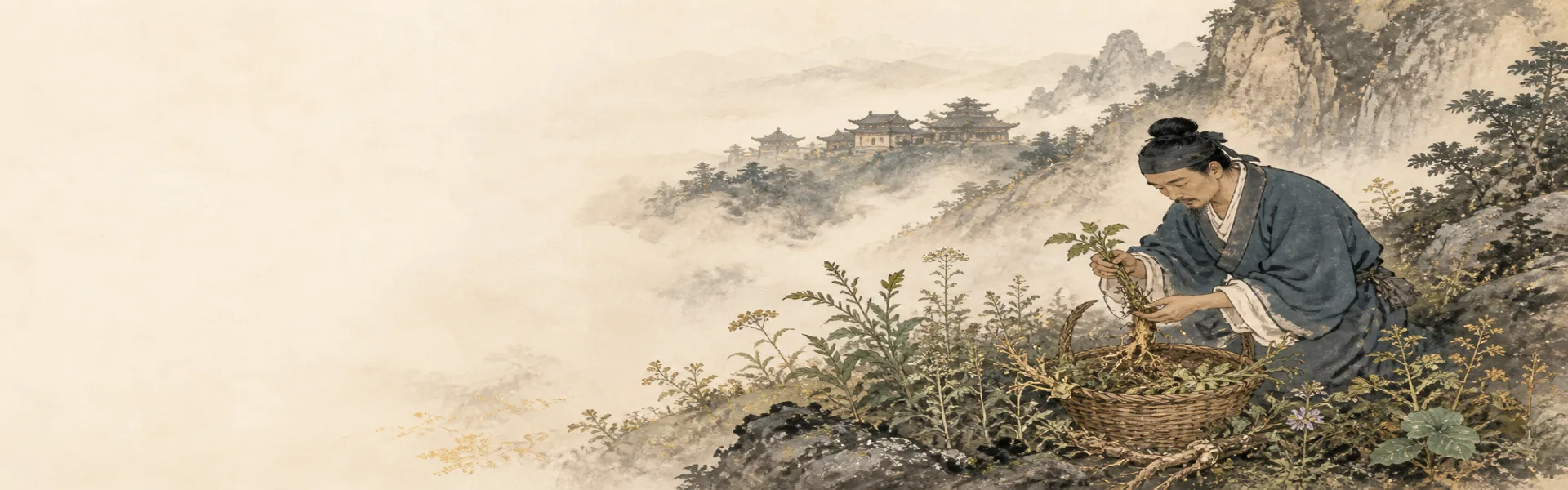
What follows describes what is actually there, what the Taoist communities did with it, and where the marketing claims outrun the evidence. No formulas, doses, or self-treatment instructions appear here, and that omission is deliberate.
Why the region is botanically rich
The Wudang mountains sit in northwestern Hubei at a climatic transition between the warm subtropical south and the temperate north. This positioning, combined with a substantial elevation range from river valleys to peaks above 1,600 metres, produces a large number of distinct habitats within a small area.
The result is high species diversity. Botanical surveys of the range have recorded well over a thousand vascular plant species with recorded medicinal use, which is a large figure even for a mountainous region in China.
The mountain's protected religious status also contributed. Temple lands were not cleared for agriculture in the way surrounding areas were, and centuries of restriction on cutting preserved forest that would otherwise have gone. This is an unintended conservation effect of religious landholding, and it is visible in the surviving old-growth stands.
What the collectors gathered
The region has long supplied the wider Chinese materia medica trade. Historical records show medicinal material moving from this area into regional markets, and collection was a significant part of the local economy for mountain households.
The plants involved are mostly not exotic. They are the standard workhorses of the pharmacopoeia that happen to grow well here: members of the ginseng family, various roots used as tonics, aromatic plants used for digestive complaints, and a range of species used for musculoskeletal injury.
That last category deserves attention because it connects to the martial arts. Trauma medicine, dealing with bruising, sprains, fractures, and the accumulated damage of hard training, developed in close association with fighting traditions across China, and Wudang is no exception.
Trauma medicine and the martial connection
The category the tradition calls dieda, meaning falls and strikes, covers external and internal preparations for injury. Liniments applied to bruising, poultices for sprains, and internal formulas for what the tradition describes as stagnant blood all belong to it.
This is the most plausible area of genuine Wudang specialisation, for a simple institutional reason. A community that trains people in physical combat generates a steady supply of injuries, and it will accumulate practical knowledge about treating them. The same pattern appears at Shaolin and in secular martial lineages.
Some of this knowledge is defensible. Several plants used in trauma liniments contain compounds with anti-inflammatory or analgesic activity. Some of it is unlikely to do much beyond providing a sensation of warmth and the benefits of massage that accompanies application. Distinguishing the two has not been seriously attempted.
Named local specialities
A handful of plants are marketed as Wudang specialities. Some of these associations are historically grounded and some are recent commercial construction.
Certain species genuinely have the region within their natural range and were locally collected, and this is verifiable from botanical distribution records. Others are grown throughout central China, and the Wudang label indicates where a particular supplier is based rather than any distinctive property.
The honest position is that a plant's growing location can affect its chemical composition, since soil, altitude, and climate do influence secondary metabolite production. Whether that difference is large enough to matter clinically is a separate question, and for most species it has not been established.
What the Taoist communities actually did
Monastic communities in mountainous locations needed medical capability. They were distant from towns, they had resident populations to care for, and treating local villagers was a normal function that generated goodwill and support.
The evidence suggests they practised standard Chinese medicine using locally available materials, rather than a separate Taoist system. Some Taoist clergy were competent physicians. A few, historically, were distinguished ones. But their medicine was the medicine of their period, applied by people who happened to be religious.
Where a genuinely Taoist element enters is in the framing rather than the pharmacology. Health was understood as part of cultivation, illness was sometimes interpreted in moral or karmic terms, and treatment could be accompanied by ritual. That is a real difference in context, and not a difference in what was in the pot.
The alchemical inheritance
Taoist external alchemy left a specific and largely negative legacy in this area. Alchemists worked extensively with mercury, lead, arsenic, and sulphur compounds, and some of these entered medical use.
Cinnabar, mercury sulphide, was used as a sedative and appears in classical formulas. Realgar, an arsenic compound, was used externally and internally. Both are genuinely toxic, and the tradition's classification of cinnabar as an upper-grade substance safe for prolonged use is one of its most consequential errors.
Modern practice in regulated jurisdictions has largely eliminated these, and any product containing them should be regarded as a serious problem rather than a traditional feature. Preparations containing mercury or arsenic compounds still occasionally surface in unregulated supply chains.
The idea of authentic regional origin
Chinese medicine has a long-standing concept usually rendered as authentic regional material, holding that certain herbs are properly effective only when grown in a specific place. Particular provinces are associated with particular herbs, and material from elsewhere is considered inferior even when it is the same species.
The idea has a defensible basis. Secondary metabolite production in plants genuinely varies with soil chemistry, altitude, temperature range, rainfall, and sun exposure, and for some species this variation is substantial and measurable. A plant grown at 1,200 metres on thin mountain soil is not chemically identical to the same species grown on irrigated lowland.
It also has an obvious commercial dimension. Regional origin claims support premium pricing, and the incentive to assert them is strong regardless of whether they are true in a given case. Mislabelling of geographic origin is a documented problem in the herbal trade.
The practical upshot for a reader is that origin claims are neither empty nor reliable. They point at something real that varies enormously in magnitude from species to species, and they are also exactly the sort of claim a supplier has reason to make whether or not it applies.
Where the claims outrun the evidence
Several claims circulate that deserve scepticism.
That Wudang possesses secret formulas transmitted only within Taoist lineages. Secrecy claims are unfalsifiable by construction, and where formerly secret formulas have been published they have generally turned out to be ordinary.
That herbs from the mountain are pharmacologically superior. Growing conditions do affect composition, but the specific claim of superiority is a marketing position rather than a finding.
That Taoist herbal medicine constitutes a distinct system. The evidence supports Taoist practitioners using the common tradition, not a parallel one.
That particular preparations extend life. This is the oldest claim in the tradition and the one with the least support. The historical record of the immortality pursuit is a record of failure, sometimes fatal.
Conservation, which is now a real issue
Demand for medicinal plants has put pressure on wild populations across China, and this affects Wudang. Species that were once common have become scarce through over-collection, and some are now protected.
Cultivation has taken over for many species, which relieves pressure on wild stock but raises questions about whether cultivated material is equivalent. The tradition itself holds that wild-grown material is superior, which increases demand for exactly the material that can least sustain it.
Anyone buying herbal products has a straightforward responsibility here: cultivated material is generally the responsible choice, and any product claiming rare wild-collected ingredients deserves scrutiny rather than enthusiasm.
Key points
- The Wudang range genuinely is botanically rich because it sits at a climatic transition with a large elevation range.
- Religious landholding unintentionally preserved forest that surrounding areas lost, a real conservation side effect.
- Trauma medicine is the most plausible area of genuine local specialisation, because martial training generates injuries.
- Taoist communities practised the standard medicine of their period using local materials, not a separate Taoist system.
- The alchemical legacy of mercury and arsenic preparations is a genuine hazard, not a traditional virtue.
- Wild-collection pressure is a real conservation problem, and claims of rare wild ingredients should prompt caution.