Formulas & Preparation
方剂与配制
Chinese herbal medicine is a medicine of combinations. Single herbs are prescribed occasionally, but the working unit is the formula, a structured combination of typically six to fifteen ingredients assembled according to defined principles and then prepared in one of several forms.
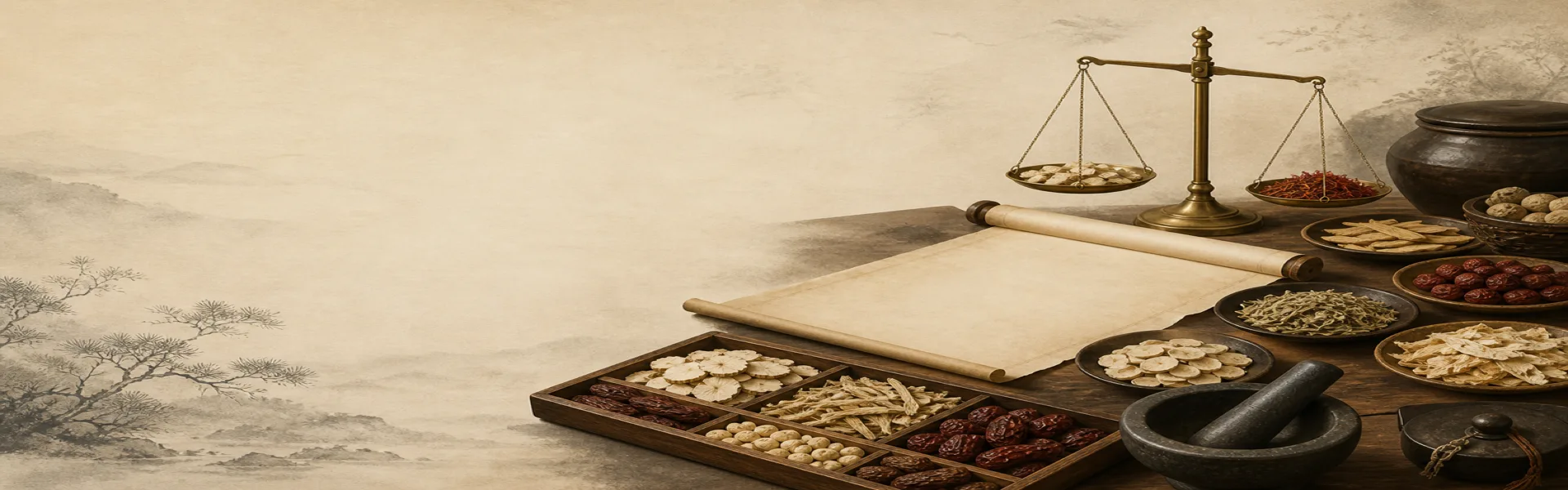
This page describes how formulas are built, how they are modified, and how the raw material is turned into something a patient takes. No formulas or doses are given, and self-preparation is not something these pages support.
Why combinations rather than single herbs
The tradition offers several reasons, and they differ in how defensible they are.
The first is that a formula can address several aspects of a presentation at once, treating the main problem while also handling accompanying symptoms. This is straightforward and needs no special theory.
The second is that ingredients can moderate one another. A herb with a useful action but a harsh effect on digestion can be paired with something that protects digestion. This is a real pharmacological strategy and modern medicine does the equivalent.
The third is that combinations produce effects unavailable from any single ingredient, through interaction rather than addition. This is the strongest claim and the least tested. It is not implausible, since compound interactions are real, but it is asserted far more often than it is demonstrated.
The structure of a formula
The conventional description uses court ranks: sovereign, minister, assistant, and envoy.
The sovereign addresses the principal problem and is usually present in the largest quantity. The minister reinforces the sovereign's action or treats a coexisting problem. The assistant has several possible functions: supporting the treatment in a secondary way, moderating the sovereign's harshness, or in some cases acting in an opposite direction to prevent the formula from overshooting. The envoy guides the formula toward a target region or harmonises the ingredients.
Licorice appears in an extraordinary proportion of classical formulas, usually in the assistant or envoy role, on the grounds that it harmonises and moderates. It also has genuine pharmacological activity, including effects on cortisol metabolism that can raise blood pressure and lower potassium with prolonged use. This is a good illustration of a general point: the tradition's harmonising ingredient is not inert.
Modification
Classical formulas are starting points rather than fixed recipes. A practitioner adds and subtracts ingredients according to the patient's presentation, and adjusts quantities. A formula named after a text from the third century may be prescribed today with three ingredients added and one removed.
This flexibility is presented as a strength, and it is one clinically. It is also the practice that makes the field extremely difficult to study, because two prescriptions bearing the same formula name may differ substantially.
It has a further consequence that is rarely discussed. When a modified formula works, the tradition credits the classical formula. When it fails, the modification or the pattern identification can be blamed. This asymmetry protects the classical repertoire from disconfirmation.
Preparation forms
The decoction is the classical form and still the most common in serious clinical practice. Raw herbs are boiled in water, usually twice, and the liquid is drunk. Decoctions are flexible, can be modified for each patient, and are absorbed quickly. They are also time-consuming, and they taste extremely unpleasant, which affects whether patients actually take them.
Pills and powders are the traditional convenience forms. Powdered herbs are bound with honey, water, or paste and formed into pills. These keep well, travel well, and are easier to take, at the cost of flexibility.
Granules, produced by extracting herbs and spray-drying the extract, are the modern equivalent and now dominate practice outside China. They dissolve in hot water, allow some individual adjustment by combining single-herb granules, and are considerably more palatable.
External forms include liniments, plasters, washes, and medicated wines, which are particularly associated with trauma medicine.
Whether granules are equivalent
This is a live practical question rather than a settled one. Granule manufacturing extracts herbs individually and combines the extracts, whereas a decoction boils the herbs together.
If interactions occur during cooking, producing compounds that do not exist in the separate extracts, then the two are not equivalent. There is laboratory evidence that co-decoction does produce chemical differences in some cases, including the formation of compounds absent from individual extracts and changes in the solubility of toxic constituents.
Practitioners divide on this. Traditionalists insist decoction is superior; pragmatists point out that a granule the patient takes is better than a decoction they abandon after three days. Both positions have merit and the question is genuinely open.
Processing the raw material
Before a herb enters a formula it is usually processed, and the tradition treats processing as altering its properties rather than merely cleaning it.
Methods include drying, stir-frying plain or with bran, roasting, charring, steaming, and treatment with honey, wine, vinegar, salt water, or ginger juice. Each is held to shift the herb's action in a specific direction. Honey-processing is said to increase moistening and tonifying effects; vinegar processing to direct the herb toward the liver; charring to increase haemostatic action.
Some of these have demonstrable chemical basis. The clearest case is aconite, whose most toxic alkaloids are hydrolysed into much less toxic compounds by prolonged heating. Traditional preparation of this herb involves extended processing, and the requirement was arrived at empirically over a long period during which people were presumably poisoned. Poisonings still occur where processing is inadequate.
Cooking a decoction
The traditional instructions are detailed and some of them matter chemically. Herbs are soaked before boiling. Certain ingredients are added early and boiled longer, typically minerals, shells, and toxic herbs requiring extended heating. Others are added in the last few minutes, typically aromatic herbs whose active volatile oils would evaporate.
Some ingredients are prepared separately and combined at the end, and a few are dissolved in the finished liquid rather than boiled at all.
These instructions are not ritual. Boiling aromatic herbs for an hour genuinely does drive off the volatile compounds that make them useful, and undercooking aconite genuinely does leave dangerous alkaloids intact. This is an area where traditional practice encodes real chemistry that the tradition could observe without being able to explain.
Dose, and why it is not simple
Traditional doses are recorded in classical texts, but transferring them into modern practice is more complicated than it appears, and this is not widely understood.
The units have changed. The weight measures used in the Han dynasty were not the same as later measures bearing the same names, and the conversion is disputed among scholars. Some reconstructions suggest classical doses were several times larger than what is commonly prescribed today. A practitioner following a Han text with modern units may be prescribing a fraction of what the original specified.
There is also the question of what the recorded dose refers to. A classical formula might be prepared as a large volume of decoction consumed over a day, or in divided doses, and texts are not always explicit.
The result is a genuine and under-acknowledged uncertainty at the centre of the tradition. Formulas are described as time-tested over centuries, but if the doses now used differ substantially from those originally intended, the accumulated experience does not transfer as cleanly as the claim suggests.
Quality and what can go wrong
Several problems affect the material itself, independent of whether the formula is any good.
Species substitution, where a cheaper or more available plant is supplied under the name of another. This is documented and sometimes dangerous, since the substituted species may have different toxicity.
Contamination with heavy metals or pesticides, which reflects growing and processing conditions.
Adulteration with undeclared pharmaceuticals. Products marketed for pain, sleep, or diabetes have been found containing steroids, sedatives, or glucose-lowering drugs.
Degradation through age or poor storage, which mostly reduces effectiveness rather than creating hazard.
These are supply chain problems, and the practical response is buying from suppliers subject to testing requirements rather than assuming that traditional means safe.
Key points
- The working unit is the formula, structured by sovereign, minister, assistant, and envoy roles.
- Moderating one ingredient with another is genuine pharmacological strategy; the claim of emergent combination effects is plausible but under-tested.
- Modification of classical formulas is clinically sensible but creates an asymmetry that shields the classical repertoire from disconfirmation.
- Decoctions, pills, and granules differ in flexibility, palatability, and possibly in chemistry, and granule equivalence is genuinely unsettled.
- Processing has real chemical effects, most clearly in aconite, where prolonged heating hydrolyses the most toxic alkaloids.
- Species substitution, heavy metal contamination, and pharmaceutical adulteration are documented supply chain problems.