Further Reading & Everyday Practice
延伸阅读与日常实践
This page covers what to read if you want to understand Chinese herbal medicine properly, and what parts of the tradition can reasonably be applied in everyday life without a practitioner. The second category is smaller than popular writing suggests, and the boundary matters.
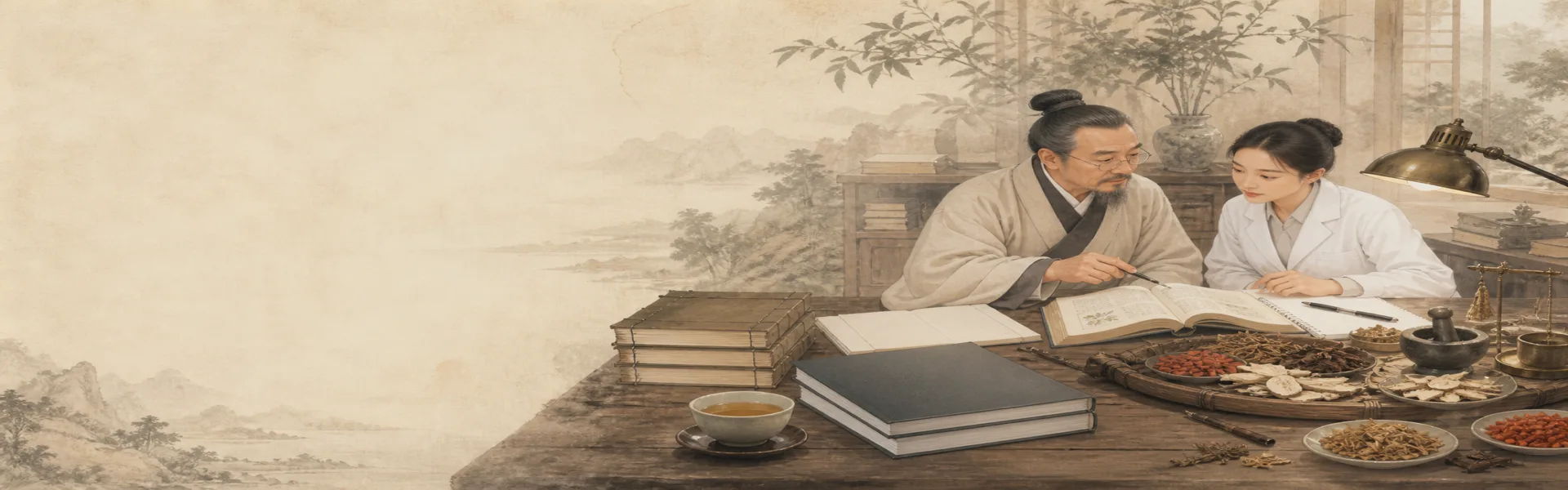
The general rule this section follows: material that is essentially food, used in ordinary quantities, is a different proposition from medicine. Everything on the medicinal side belongs with a qualified practitioner and an informed doctor.
The food and medicine boundary
Chinese tradition has a concept usually translated as food and medicine sharing the same source, and it is one of the genuinely useful ideas in this area. Many substances sit on the boundary: ginger, cinnamon, jujube, goji berries, mung bean, lotus seed, tangerine peel, and a long list of others are eaten as food and also appear in the materia medica.
This overlap gives a workable practical rule. Substances that populations have eaten in ordinary food quantities for centuries carry low risk when used that way. The same substances concentrated into medicinal doses, extracted, or taken continuously for long periods are a different matter, and the safety record of the food does not transfer.
Chinese regulators maintain an official list of substances classified as both food and medicine, which is a reasonable reference point for where this boundary is generally drawn.
What can sensibly be done at home
Culinary use of the crossover substances is the honest answer, and it is more worthwhile than it sounds. Ginger in cooking, warming spices in winter dishes, cooling foods in hot weather, soups made with jujube and goji, and congee as a light meal during illness are all traditional, low-risk, and pleasant.
The benefit is partly nutritional and partly a matter of attention. Eating according to season and to how you feel is a reasonable habit regardless of the theory attached to it, and the tradition provides a framework that makes people notice what they eat and when.
Everyday teas of the same kind belong here too: chrysanthemum, hawthorn, tangerine peel, and similar preparations used casually rather than therapeutically.
What should not be done at home
Self-prescribing classical formulas. These are medicines with defined indications, and using them without pattern diagnosis is straightforwardly unsafe.
Using anything marked toxic in the tradition, or any preparation containing mineral ingredients such as cinnabar or realgar.
Wild collection for medicinal use. Misidentification is easy, several dangerous plants closely resemble medicinal ones, and the consequences of getting it wrong include death.
Treating any diagnosed condition, or any symptom that has not been assessed. The risk here is not the herb but the delay.
Continuous long-term use of any concentrated preparation without supervision, which is precisely the pattern that produced the aristolochic acid disaster.
The seasonal framework
Traditional dietary advice is organised by season, and the general shape is sensible: lighter and cooling foods in summer, warming and more substantial food in winter, attention to digestion in the damp late-summer period, and moistening foods in dry autumn weather.
Stripped of theory, this amounts to eating seasonally available food, adjusting intake to activity and temperature, and paying attention to how food affects you. None of that requires the five-phase framework to be literally true, and all of it is reasonable.
The framework becomes a problem when it hardens into rules that override evidence or appetite, or when it is used to justify avoiding whole categories of food on theoretical grounds. Restrictive eating justified by traditional theory is still restrictive eating.
Tonics, and why they need particular care
Tonic herbs are the category most likely to be taken casually and long-term, and this makes them the category where cumulative problems are most likely to arise.
The traditional logic is that tonics supplement deficiency, and that supplementing is inherently safer than attacking. There is something to this, since tonic herbs are generally milder than purgatives. But the tradition is also clear that tonics are inappropriate where there is no deficiency, and that supplementing in the presence of an active problem can make it worse. That warning has almost entirely disappeared from popular use.
Ginseng illustrates the difficulty. It has real pharmacological activity, which is why it is worth taking seriously. It can also cause insomnia, agitation, headache, and raised blood pressure, and it interacts with anticoagulants and with drugs for diabetes. It is not a general-purpose health substance to be taken indefinitely by anyone.
The practical implication is that continuous unsupervised use of concentrated tonic preparations is exactly the usage pattern with the least traditional justification and the greatest cumulative risk.
Reading on history and scholarship
Paul Unschuld is the essential author for anyone serious about this subject. His histories of Chinese medicine and of the materia medica are detailed, sceptical, and grounded in the primary sources. He is not a promoter of the tradition and not a debunker, which makes him unusually useful.
Nathan Sivin's work on Chinese science and medicine is similarly rigorous and more accessible in places.
Volker Scheid's Chinese Medicine in Contemporary China examines how the modern tradition was actually assembled in the twentieth century and is the best account of that process.
For the classical texts themselves, translations vary enormously in quality. Unschuld's translations of the Huangdi Neijing are the scholarly standard, though they are demanding.
Reading on evidence and safety
Cochrane reviews are the most reliable summaries of trial evidence for particular conditions and are written to be readable without specialist training.
For safety specifically, national medicines regulators publish alerts on contaminated and adulterated products, and these are worth checking if you use commercial preparations. Several regulators maintain searchable databases of products found to contain undeclared pharmaceuticals.
The published literature on aristolochic acid nephropathy is worth reading directly if you want to understand how such a problem is identified, because it is a clear case study in epidemiological detective work.
Reading for practice
Standard practitioner references exist and are used in teaching institutions worldwide. Bensky's materia medica and formula volumes are the usual English-language references and are thorough and reasonably careful about safety.
These are professional texts rather than self-treatment guides, and reading them does not qualify anyone to prescribe. Their value for a general reader is in showing what the tradition actually says, which is often more measured than popular accounts suggest.
Popular herbal books vary from acceptable to actively dangerous. The warning signs are the same as elsewhere: claims of treating serious disease, absence of safety information, dismissal of drug interactions, and recipes presented for self-treatment of diagnosed conditions.
Finding a practitioner
Where regulation exists, use it. Several countries register Chinese medicine practitioners with defined qualification and continuing education requirements, and registration can usually be checked online.
Where it does not, the questions worth asking are practical. What training did they complete and how long was it. Do they carry professional insurance. Will they communicate with your doctor. What do they do if a patient does not improve. How do they source their herbs and are those products tested.
The answer to the last question sorts a surprising number of practitioners, because a good one will know their supply chain and a careless one will not have thought about it.
Questions worth asking in a consultation
What is in this formula, by name. A practitioner should be willing to tell you, and reluctance is a warning sign.
Does anything here interact with my medication. If the answer is that herbs do not interact with drugs, leave.
How long should I take this, and when should we reassess. Open-ended prescriptions without review are the pattern associated with cumulative harm.
What would make you tell me to see a doctor instead. A good practitioner has a clear answer.
A note on what this section has tried to do
These pages have set out a tradition that its own enthusiasts often describe less accurately than its critics do, and that its critics often dismiss more completely than the evidence warrants.
The position they have tried to hold is that both the genuine content and the genuine problems are real, that the two do not cancel out, and that a reader is better served by being told where the uncertainty lies than by being handed a verdict.
Key points
- The food and medicine overlap gives a workable rule: ordinary food quantities of culinary substances are low risk, concentrated or prolonged use is not.
- Culinary and seasonal eating is the reasonable home application; self-prescribing formulas and wild collection are not.
- Seasonal dietary advice is sensible when read as ordinary good habit and problematic when it hardens into restriction.
- Unschuld, Sivin, and Scheid are the essential authors for understanding the tradition historically rather than promotionally.
- Regulator alerts on adulterated products are worth checking, and Cochrane reviews are the best evidence summaries.
- Asking what is in a formula and whether it interacts with your medication sorts good practitioners from careless ones quickly.