The Mawangdui Daoyin Tu: Reading an Early Chinese Exercise Chart
马王堆《导引图》:怎样读懂一幅早期中国导引图像
The Daoyin Tu (导引图, “Chart of Guiding and Pulling”) is compelling because it shows bodies in motion rather than describing movement only in words. Yet it is neither a modern exercise manual nor proof of a Wudang routine. This guide reads the chart first as an early-Han archaeological object, then asks how it belongs in the longer history of qigong without erasing the distance between an ancient image and present-day practice.

Begin with the archaeological object
Tomb 3, Mawangdui and an early-Han date
The chart came from Tomb 3 at Mawangdui in Changsha, Hunan. The Wellcome Collection’s catalogue for its licensed reconstruction identifies the tomb as sealed in 168 BCE and the original as held by the Hunan Museum. A 2024 Xinhua account of fifty years of Mawangdui research places the chart among the medical manuscripts and other materials recovered during the excavation of the three tombs, completed in 1974.
That context matters. The chart belonged to a burial assemblage with texts, maps, paintings, garments, lacquerware and many other objects. It should not be detached from that archaeological setting and treated as a timeless poster. The Mawangdui finds illuminate the intellectual and material worlds of the early Western Han; they do not by themselves document a continuous school, teacher-student lineage or Wudang origin.
Forty-four figures, not forty-four complete instructions
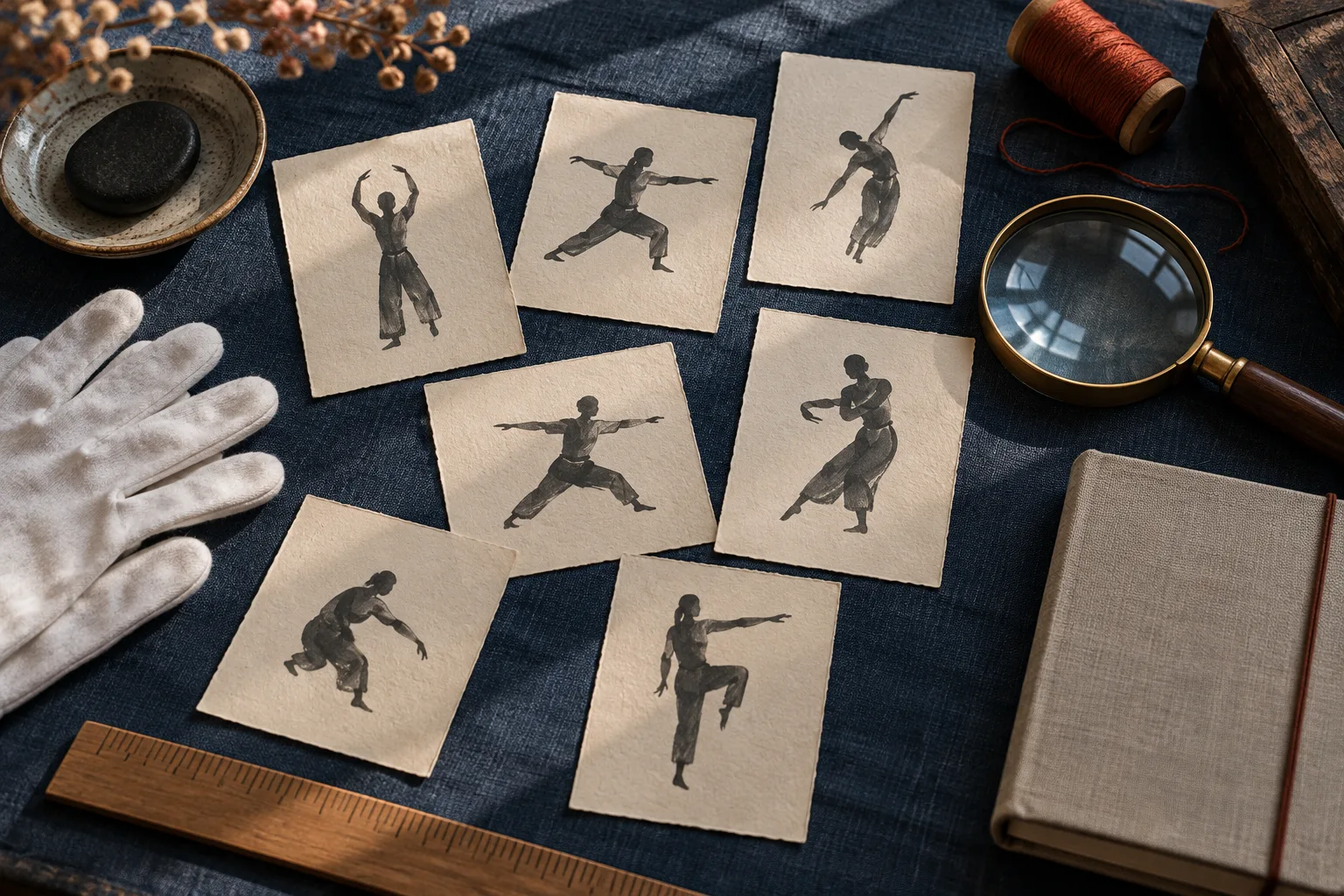
The surviving composition presents forty-four human figures in four rows. People bend, turn, stretch, raise their arms and assume varied stances; a few interact with implements. Short inscriptions once accompanied many figures, but damage and difficult characters make parts of the wording uncertain. The official Chinese museum portal’s notice for a new Mawangdui archaeology book also highlights the forty-four figures of the Daoyin Tu.
A figure records a selected moment. It does not automatically tell us how the motion began, how long it lasted, how breathing was coordinated, how often it was repeated or who supervised it. Modern animations and routines can be thoughtful interpretations, but the surviving chart alone cannot certify every transition. This is the first discipline of reading: distinguish what is visible from what has been reconstructed.
Read image, caption and material together
Look for variation before imposing a sequence
The four rows can tempt a modern viewer to read from one pose to the next as if following a fixed class. Scholars instead compare posture, direction, clothing, implements and surviving labels before proposing relationships. The figures show that bodily cultivation could encompass more than one kind of action. Their variety is evidence; a single mandatory choreography is not.
The Wellcome Collection catalogue describes its image as a reconstruction and notes animal-associated postures such as a “bear walk.” That wording is useful when kept attached to the catalogue record. It should not license a viewer to give every damaged pose an animal name, a meridian function or an auspicious meaning without further textual support.
Colour and captions are evidence with limits
The chart is often reproduced as a clean grid, but the excavated silk was fragile and fragmentary. Restoration drawings, tracings, photographs and digital animations answer different questions and can make uncertain contours look more definite than they are. Whenever possible, identify whether the image before you is the original, a museum display copy, a scholarly line drawing or a modern re-creation.
Captions can connect a pose with a name, action or bodily concern, but a short ancient label is not equivalent to a contemporary diagnosis or treatment protocol. A peer-reviewed historical overview, Dao Yin (a.k.a. Qigong): Origin, Development, Potential Mechanisms, and Clinical Applications, is useful for tracing later terminology; its modern clinical discussion remains separate from what archaeology alone proves about this particular chart.
Keep the ancient chart and modern practice distinct
Continuity does not mean identical choreography
Modern “Mawangdui Daoyin” sets usually arrange selected motifs into teachable sequences with named movements, counts and transitions. Those systems may be culturally valuable, but they are reconstructions or new compositions based on ancient material. They are not recordings transmitted unchanged from 168 BCE. A responsible teacher or museum label should make that creative step visible.
The distinction also protects the chart from anachronism. “Qigong” is the familiar umbrella term today, while the ancient object belongs to the older vocabulary of daoyin and nourishing life. Use the site’s overview of qigong forms and families to compare modern systems, but do not force the Mawangdui figures into a later institutional genealogy.
Historical interest is not a medical prescription
The chart shows that movement and health were connected in early Chinese culture. It does not establish that copying a pictured pose is safe or effective for a particular modern condition. A damaged figure lacks the screening, dosage, progression and adverse-event information required for clinical advice. Anyone with pain, dizziness, balance problems, recent surgery or a significant medical condition should seek appropriate professional guidance before starting unfamiliar exercise.
For a contemporary evidence discussion, consult Health Benefits & the Evidence. For practice structure rather than archaeological reconstruction, see The Three Regulations. Neither page turns an ancient caption into a diagnosis; both keep cultural interpretation and health claims on different evidentiary tracks.
Use a six-step method for careful viewing
Move from record to interpretation
- Identify the version: original silk, display copy, photograph, tracing, reconstruction or animation.
- Record the context: Tomb 3 at Mawangdui, early Western Han, and the wider burial assemblage.
- Describe before naming: note stance, direction, limbs, clothing and implements before assigning a technique.
- Separate legible from restored: mark which contours and captions survive and which are supplied by editors.
- Compare sources: check museum catalogues, excavation scholarship and modern practice manuals for different kinds of claims.
- State the boundary: label reconstructions as reconstructions and never convert a damaged image into personal medical advice.
Let the chart enlarge, not flatten, qigong history
The Daoyin Tu is important not because it gives us a ready-made class, but because it preserves a rare visual archive of bodies, gestures and health culture more than two millennia ago. Harvard CAMLab’s Hunan Museum collaboration, The Art of Life, situates Mawangdui within a much broader early-Chinese imagination of life and the cosmos. That wider frame guards against reducing the tombs to a single fitness claim.
A good next step is to compare this archaeological evidence with what a contemporary qigong session involves. The comparison reveals both resonance and change: pictures can preserve postural ideas, while teachers, communities and modern health standards supply contexts the silk cannot. Respect for the chart begins with allowing it to remain an ancient, incomplete and extraordinarily rich object.