Getting Started & Further Reading
如何入门与延伸阅读
Starting qigong is easier than starting most physical practices, because the entry requirements are low and the early stages are undemanding. The difficulty is not physical. It is finding instruction that is neither vague nor extravagant, and then practising often enough for anything to happen.
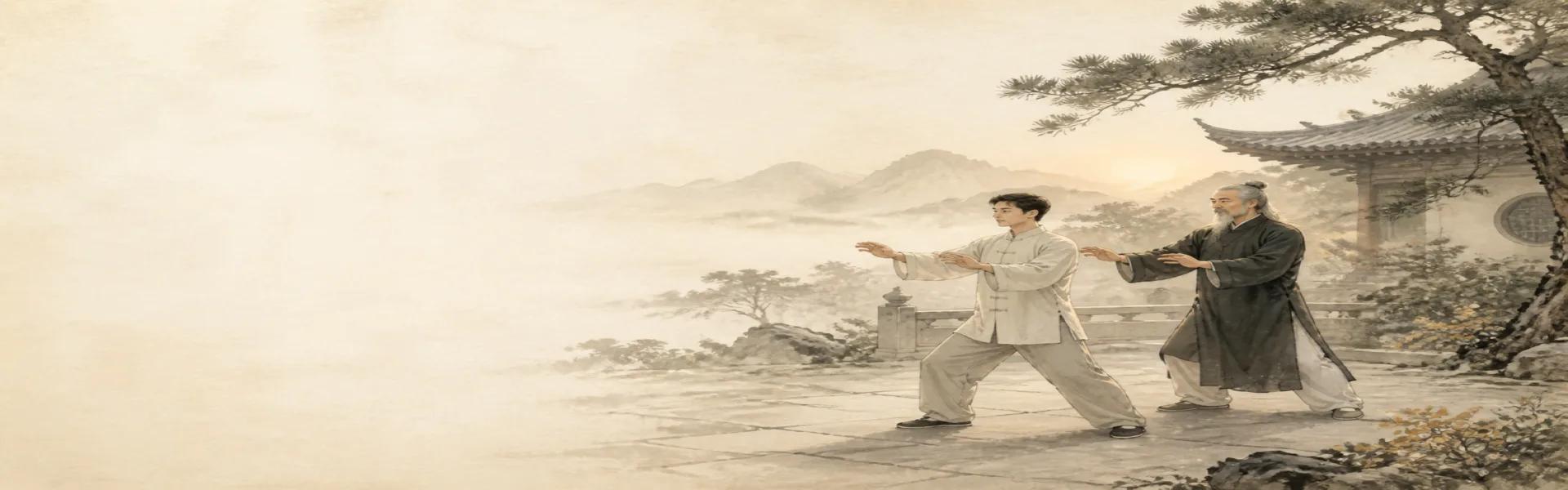
This page covers how to begin sensibly, what to look for and avoid, and what to read. It does not recommend particular schools or teachers, since circumstances vary and any such list would date quickly.
What you need
Very little. Enough floor space to extend both arms in all directions. Clothing that does not restrict the waist, shoulders, or knees. Flat flexible shoes, or bare feet on a surface that is not cold. That is the whole list.
You do not need equipment, special clothing, a mat, incense, or music. Nothing about the practice requires a particular setting. Traditional practice outdoors at dawn is pleasant and has obvious appeal, but it is not a requirement and its absence will not affect your progress.
Choosing where to start
For most people the sensible first set is the eight-section brocade. It is short, gentle, taught almost everywhere, well documented, hard to do dangerously, and has more research behind it than most alternatives. Learning it well takes a few weeks and provides a foundation for anything else.
A reasonable alternative for people wanting the shortest possible route to the calming effect is a simple breathing practice combined with a few minutes of standing. This has fewer moving parts and no sequence to memorise, which suits some people better.
Avoid starting with anything described as advanced, secret, or requiring transmission. These are not more effective for a beginner and the framing is a warning sign more often than not.
In person or online
In-person instruction is genuinely better for the first months, for one specific reason: you cannot see your own alignment. Most beginners have postural habits they are unaware of and cannot detect by feel, and a teacher corrects in seconds what video cannot correct at all.
Online instruction is a reasonable substitute where nothing local exists, and it is far better than not practising. If you use it, film yourself from the side and from the front occasionally and compare with the instruction. This is unglamorous and effective, and it partly replaces what a teacher provides.
Group practice has a benefit that has nothing to do with technique. Regular attendance at a fixed time creates a commitment that solo practice does not, and adherence is the main determinant of whether anything comes of this.
Judging a teacher
Good signs: corrections are specific to you rather than announcements to the room; explanations are given in plain language when asked; questions about lineage receive concrete or honestly uncertain answers; physical limitations are accommodated without drama; there is no pressure to commit to long expensive programmes.
Warning signs, in rough order of seriousness: any suggestion that practice can treat serious illness; any discouragement of medical care; claims of extraordinary abilities; treating scepticism as an obstacle to progress; escalating financial commitments; discouraging contact with other teachers or styles; and secrecy about what is being taught and why.
The one about doubt deserves emphasis. Any practice that requires you to stop evaluating it has removed the mechanism by which you could discover a problem. Good teachers are comfortable with questions because they have answers, or because they are willing to say they do not know.
Building a routine
Start shorter than you think necessary. Ten minutes daily for the first month is better than thirty minutes twice a week, and much better than an ambitious schedule abandoned after ten days.
Fix the time rather than the duration. Practising at a consistent point in the day removes the daily decision, which is what actually defeats most people. Morning suits many because nothing has yet intervened, but any consistent time works.
Expect the first two weeks to feel pointless. The sensations people describe have not appeared, the movements are unfamiliar, and there is no obvious progress. This phase is normal and is where most people stop.
Common beginner problems
Aching shoulders during standing. Normal, and it means the arms are too high or held with too much effort. Lower them and shorten the duration.
Knee pain. Not normal, and it usually means the knees are travelling past the toes or turning inward relative to the feet. Correct the alignment rather than pushing through.
Dizziness or breathlessness. Almost always caused by trying to control the breath. Stop managing it and let it be ordinary.
Restlessness and boredom. Expected. It is information about the state of your attention rather than about the practice.
Feeling nothing at all. Also expected, and not a sign that the practice is not working. Sensations tend to appear somewhere between the third week and the third month, and some people never get much of them while still gaining the physical benefits.
Who should be careful
Qigong is one of the safest forms of exercise, but a few situations call for caution or medical advice first.
Uncontrolled high blood pressure, recent cardiac events, and glaucoma are reasons to avoid forceful breath retention, strong isometric holds, and any practice involving straining. The gentle moving sets are generally fine, but the strenuous ones are not equivalent.
Pregnancy is compatible with gentle practice but rules out reverse abdominal breathing, deep squatting, and strong twisting. Recent surgery, acute injury, and active infection are reasons to pause rather than modify.
A history of psychosis, mania, or dissociative episodes warrants genuine caution about intensive or retreat practice specifically. Short daily sessions are a different proposition from hours of sustained inward attention, and the reported adverse psychological effects come overwhelmingly from the latter.
None of this is a reason for most people to hesitate. It is a reason to mention what you are doing to a doctor if you already have something being managed.
Practising at Wudang
Many visitors want to practise at the mountain itself, and it is a reasonable thing to want. Instruction is available there in various forms and durations, and the setting genuinely does affect the experience.
Two practical points. First, what is taught under a Wudang name is not necessarily unique to Wudang, and the material is often the same nationally circulated sets taught anywhere else. Second, and more usefully, an intensive period away from ordinary life is a good way to establish a practice, and that benefit is real regardless of what is taught.
Anyone considering an extended stay should be clear that intensive daily practice is physically demanding in ways that occasional classes are not, and should build up beforehand rather than arriving unprepared.
Further reading
On history and scholarship, the most useful English-language work is by academic sinologists rather than practitioners. Livia Kohn has written extensively on Taoist body practices and their history, and her surveys are accessible without being credulous. David Palmer's Qigong Fever is the standard study of the twentieth-century movement and is essential for understanding how the modern field came to be.
For the classical background, Kristofer Schipper's The Taoist Body remains the best single introduction to how Taoism understood the body, though it is not a practice manual.
For practice, printed manuals are of limited use compared with instruction, and their main value is as a reminder of a set you have already learned. Official Chinese health qigong publications for the standardised sets are clear, cheap, and free of extravagant claims, which distinguishes them from much of the popular literature.
For evaluating health claims, the Cochrane reviews covering qigong and taijiquan are the most reliable summaries available and are written to be readable by non-specialists.
A realistic expectation
If you practise fifteen to twenty minutes most days for three months, you can reasonably expect to stand more easily, notice your posture more accurately, sleep somewhat better, and feel steadier in a way that is hard to describe but noticeable. You may or may not experience the sensations traditionally described as qi.
You should not expect the practice to resolve serious health conditions, and you should be suspicious of anyone who suggests otherwise. What it offers is modest, cumulative, and reliable, which is a better bargain than it sounds.
Key points
- Requirements are minimal: floor space, unrestrictive clothing, and consistency; no equipment or special setting is needed.
- The eight-section brocade is the sensible first set for most people, and avoiding anything billed as advanced or secret is good early advice.
- In-person teaching matters most in the first months because you cannot perceive your own alignment.
- Fix the time of day rather than the duration, and start shorter than seems necessary.
- Treating scepticism as an obstacle is the most serious warning sign a teacher can display.
- Realistic returns over three months are easier standing, better postural awareness, and improved sleep and steadiness.