The Three Regulations
三调
Every qigong method, from the simplest health set to the most elaborate internal alchemy, is conventionally analysed into three simultaneous adjustments: regulating the body, regulating the breath, and regulating the mind. In Chinese these are tiaoshen, tiaoxi, and tiaoxin. The framework is genuinely useful, and it is also the single most helpful thing a beginner can be given, because it converts a vague instruction like relax and feel your qi into three specific and checkable tasks.
The word translated as regulating does not mean controlling. It means adjusting toward a condition and then allowing that condition to maintain itself. This distinction matters practically, because the commonest beginner error in all three areas is applying too much effort.
Regulating the body
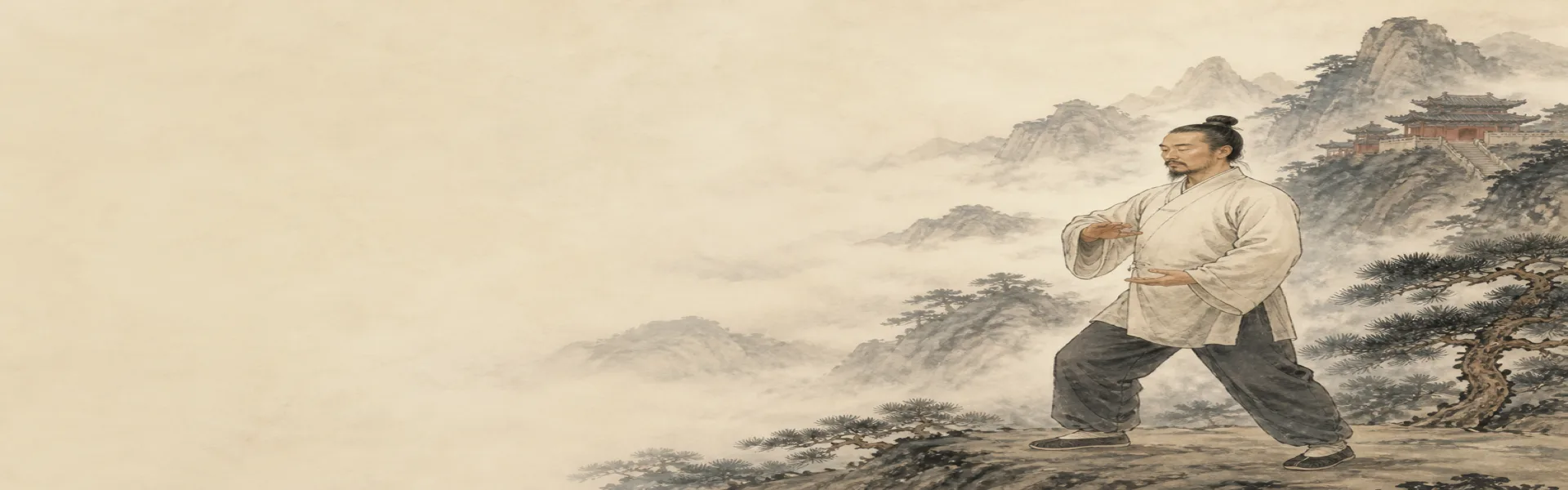
This covers posture, alignment, and the quality of movement. The aim is a structure that supports itself with the least muscular work, so that the skeleton carries the load and the muscles are doing only what is necessary to keep it arranged.
The standard instructions are consistent across traditions. The head is suspended as though from the crown, which lengthens the neck without tilting the chin up. The chest is not pushed out; it settles slightly, which allows the upper back to broaden. The shoulders drop and the elbows hang. The lower back releases its exaggerated curve without being forcibly flattened. The knees are unlocked. The weight falls through the middle of the feet.
What makes this difficult is that most people cannot accurately feel their own alignment. You will believe you are standing straight while leaning noticeably backward, and no amount of internal attention corrects this reliably. A mirror, a photograph from the side, or a teacher's hand solves in seconds what can otherwise persist for years.
Why alignment is treated as fundamental
The traditional explanation is that misalignment obstructs the flow of qi. Whatever you make of that, there are mechanical effects that are not in dispute. Holding a joint away from its neutral position requires continuous muscular effort. That effort produces fatigue, and fatigue produces compensation elsewhere. Sustained tension also restricts breathing, since the diaphragm cannot move freely if the ribs and abdomen are braced.
There is also a straightforward attentional argument. If the body is uncomfortable, attention returns to the discomfort. A posture that can be held without strain is a precondition for the third regulation rather than merely a preliminary to it.
Regulating the breath
The instruction is that breathing should become slow, fine, even, deep, and continuous. These five words appear repeatedly in the literature and each is a separate criterion. Slow refers to rate. Fine refers to the absence of audible sound. Even means the inhale and exhale are unhurried and the transitions are not abrupt. Deep refers to the movement reaching the abdomen. Continuous means without holding or gaps.
The critical instruction, and the one most often ignored, is that this state is approached indirectly. You do not force the breath to be slow. You arrange the posture, settle the attention, and stop interfering, and the breath slows on its own. Forcing produces breath-holding, oxygen debt, dizziness, and a rather unpleasant tightness in the chest.
Abdominal breathing is the usual starting point: the belly expands gently on the inhale and releases on the exhale. This is not a special technique but a description of how unrestricted breathing works. Most adults have partially lost it through habitual bracing, and recovering it is more a matter of releasing than of doing.
Reverse breathing and other variants
Some methods use reverse abdominal breathing, in which the abdomen draws in on the inhale and expands on the exhale. This is a real technique with a long history, used particularly in martial and alchemical contexts, and it does generate a different pattern of internal pressure.
It is also the technique most likely to cause problems when practised without instruction. Practised forcefully, it can produce chest tightness, headache, and blood pressure changes. Traditional teachers generally introduced it only after ordinary abdominal breathing was established, and that sequencing was sound.
Other variants include lengthening the exhale relative to the inhale, which has measurable effects on heart rate variability and is among the better-evidenced elements of the whole practice, and various forms of breath retention, which carry more risk and less demonstrated benefit.
Regulating the mind
This is the hardest of the three to describe and the one most often mystified. The practical content is straightforward: hold attention on a chosen object, notice when it has wandered, and return it without irritation. The chosen object varies. It may be a point in the lower abdomen, the sensation of the breath, the movement of the hands, a colour, or a mental image.
Two states are distinguished in the traditional literature, and the distinction is worth having. One is scattered attention, where the mind is chasing thoughts. The other is dullness, where the mind is quiet but has gone slack and is drifting toward sleep. Beginners usually recognise the first and rarely recognise the second, and teachers spend a good deal of time pointing it out.
The classical formulation is that attention should be present but not fixed, often rendered as being there and not being there. This sounds evasive but describes something real: gripping the object of attention tightly produces tension and headache, while releasing it entirely produces drifting. The workable middle is a light, renewed contact.
How the three interact
The regulations are not independent, and this is the reason for treating them as one framework rather than three exercises. Tension in the body restricts the breath. Forced breathing agitates the mind. An agitated mind produces bracing in the body. The loop runs in both directions, which means an intervention anywhere affects the whole.
This has a practical consequence. When something is not working, it is usually more effective to adjust a different regulation than the one that seems to be failing. If attention will not settle, checking the shoulders and letting the exhale lengthen often does more than trying harder to concentrate.
The traditional description of the end state is that the three merge, so that there is no longer a sense of separately managing posture, breath, and attention. Whether or not one accepts the accompanying theory, the experience described is recognisable to most people who practise regularly.
Common errors
Excessive effort is the dominant error and appears in all three areas: standing rigidly, breathing deliberately, concentrating fiercely. The results are fatigue, headache, and a growing conviction that the practice does not suit you.
The opposite error is doing the movements while thinking about something else, which reduces qigong to mild calisthenics. It is not harmful, but it removes most of what distinguishes the practice.
A third error is chasing sensations. Once a practitioner learns that warmth or tingling is supposed to appear, attention shifts from the practice to monitoring for signs of success. This reliably interferes with the state that produces the sensations in the first place.
What can go wrong
Traditional literature has a term for practice going badly, describing the practitioner as having deviated. The reported symptoms include persistent tension, headache, insomnia, agitation, and in rare cases more serious psychological disturbance.
Modern clinical reports are consistent with this. Adverse effects are uncommon, and they cluster in identifiable circumstances: very long sessions, intensive retreat conditions, practice without supervision, forceful breath work, and pre-existing psychiatric vulnerability. Anyone with a history of psychosis or dissociation should approach intensive practice cautiously and with medical advice.
The traditional remedy is to stop the specific method, return to simple walking and ordinary activity, eat normally, and resume gently. This is sensible advice and matches what would be recommended on other grounds.
Applying the framework as a diagnostic
Beyond describing practice, the three regulations work as a checklist. If a session goes badly, you can ask which regulation broke down. Was the posture strained. Was the breath being pushed. Had attention gone slack or become gripped.
This is more productive than the vague self-assessment that beginners otherwise fall into, in which a session is judged by whether it felt impressive. It also gives you a way of evaluating instruction. A teacher who can tell you which of the three you are getting wrong, and what specifically to change, is teaching. A teacher who responds to every difficulty by advising more practice may not be.
Key points
- The three regulations are body, breath, and mind, and they are meant to be adjusted simultaneously rather than in sequence.
- Regulating means adjusting toward a condition and letting it maintain itself, not controlling; excessive effort is the dominant beginner error.
- Correct alignment is treated as fundamental for mechanical and attentional reasons that do not depend on accepting any theory of qi.
- Breath should be allowed to become slow and deep indirectly; forcing it produces dizziness, tightness, and no benefit.
- Attention has two failure modes, scattering and dullness, and beginners typically notice only the first.
- Adverse effects are uncommon but real, clustering around intensive unsupervised practice and pre-existing vulnerability.