Origins & History of Qigong
气功的源流与历史
The history of qigong is awkward to write because the subject did not exist under that name until the 1950s. What can be traced is the history of the practices later gathered under it, and those have several distinct lines of descent that only converged recently. Treating them as one continuous tradition produces the tidy five-thousand-year story that appears in most introductions and which the evidence does not support.
What follows separates the strands: the archaeological record, the early textual references, the medical line, the religious line, the martial line, and the twentieth-century reorganisation that produced the modern field.
The earliest physical evidence
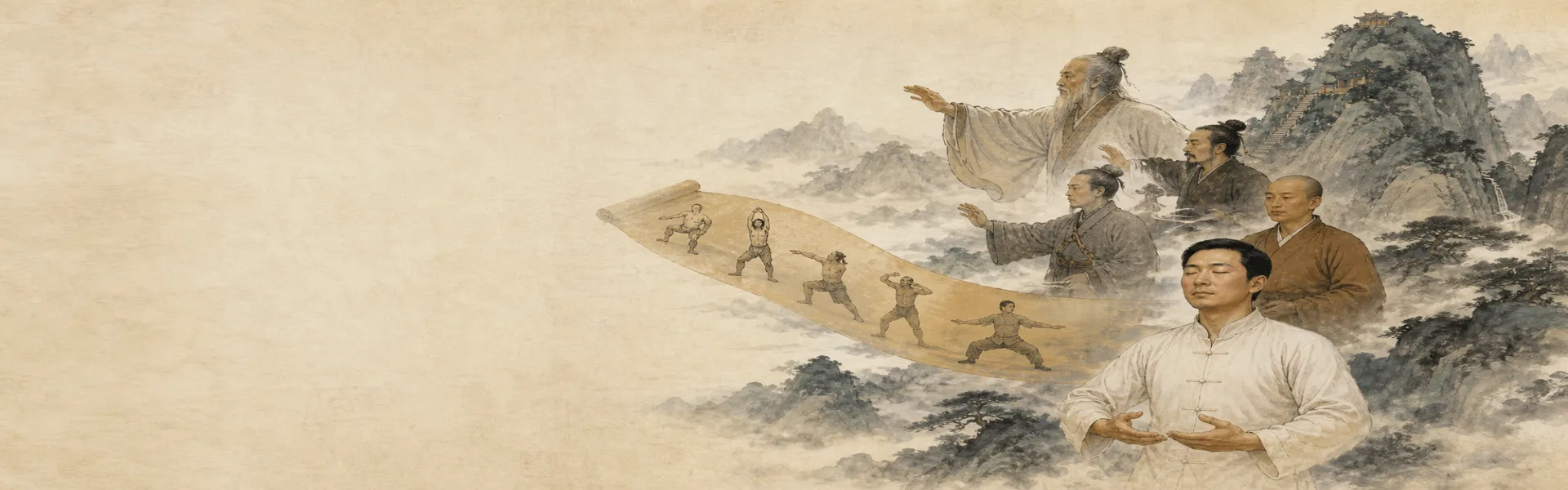
The oldest concrete evidence is a painted silk chart recovered from a tomb at Mawangdui, near Changsha, sealed in 168 BCE. It shows forty-four figures in various postures, some clearly stretching, some apparently imitating animals, with brief captions. A few captions name ailments, which indicates the exercises were understood as therapeutic rather than merely gymnastic.
The same tomb complex produced texts on breath cultivation and dietary regimen. A second site, Zhangjiashan, yielded a text usually called Yinshu, a book of stretching, which describes exercises in words and organises them by season and by complaint.
This material establishes several things firmly. Structured therapeutic exercise existed in China by the second century BCE. It was already associated with breathing practice. It was already linked to specific illnesses. And it was already sufficiently developed to be written down and illustrated, which implies a period of development before that.
Early textual references
A passage in the Zhuangzi, compiled in the third century BCE, mentions people who exhale and inhale in particular ways, who stretch like bears and extend like birds, and who do this because they want to live long. The passage is dismissive of them; the point being made is that the sage does not need such methods.
That dismissal is historically useful. A text does not bother to mock a practice nobody does. The passage tells us that by the third century BCE there was a recognisable population of longevity practitioners with characteristic techniques, and that intellectual opinion about them was already divided.
An inscription on a jade block, usually dated to around the fourth century BCE, describes the circulation of breath through the body in a short rhythmic text. Its interpretation is disputed, but it is the earliest surviving description of anything resembling internal circulation practice.
The medical line
Chinese medicine absorbed these exercises early and kept them. The Huangdi Neijing, assembled around the first century BCE, includes daoyin among therapeutic methods alongside acupuncture, moxibustion, and drugs, and assigns it to particular regions and conditions.
The physician Hua Tuo, active in the second century CE, is credited with the Five Animal Frolics, a set of movements imitating tiger, deer, bear, ape, and bird. The attribution comes from his biography in a standard history, which is relatively good evidence that he taught something of the sort, though the sets practised today under that name are much later reconstructions.
Sun Simiao in the seventh century included extensive breathing and stretching regimens in his medical compilations, organised by season and by organ. Later medical writers continued the tradition, and by the Ming dynasty printed collections of therapeutic exercises were widely available with illustrations.
The religious line
Taoist practice took the same raw material in a different direction. Where physicians used breathing and movement to treat complaints, religious practitioners used them as the physical basis of a programme aimed at transformation, and eventually at immortality.
Early religious methods included holding the breath for extended counts, visualising deities resident in the body's organs, ingesting qi rather than food, and various forms of guided circulation. Ge Hong, writing in the fourth century, describes many of these in detail and is candid that most practitioners fail at them.
From roughly the eighth century onward, internal alchemy reorganised this material around a chemical metaphor. The body became the vessel, breath and essence became the ingredients, and attention became the fire. This is the framework that most Taoist cultivation practice has used since, and it is where the vocabulary of jing, qi, and shen as stages of refinement comes from.
The martial line
The martial strand is the shortest and the least documented before the Ming. Fighting men certainly had conditioning methods, but these were largely transmitted orally within schools and rarely written down.
The Yijinjing, a set of exercises attributed to Bodhidharma and associated with Shaolin, is the best known martial-adjacent text. Its preface claims sixth-century origin; scholarship since the 1930s has placed the actual composition in the early seventeenth century, and the attribution is regarded as fabricated. This is not a marginal opinion but the settled view.
What is genuinely established is that by the Ming period, military and martial writers describe breathing and structural training as part of preparation, and that from the nineteenth century onward the internal martial arts made this training explicit and central.
The eight-section brocade
The most widely practised traditional set deserves separate treatment because its history illustrates the general pattern. References to an eight-section brocade appear from the Song dynasty onward, from roughly the twelfth century. Descriptions vary considerably between sources.
Two major branches developed, one performed seated and one standing, and within each the movements differ between transmissions. The version most people learn today was standardised by a Chinese state sports body in 2003, which selected and regularised movements from several older versions.
So the set is genuinely old as a named tradition, genuinely variable across its history, and the specific form most commonly taught is twenty-odd years old. All three statements are true simultaneously, and this pattern recurs throughout the subject.
The twentieth-century reorganisation
The decisive event in the modern history of the field was administrative rather than technical. In the late 1940s and early 1950s, Liu Guizhen, a party cadre who had recovered from illness using breathing methods learned from a village teacher, promoted those methods within the public health system.
He and his collaborators did three things. They chose a new name without religious associations. They standardised the practices into teachable protocols. And they established clinics where the methods were prescribed and outcomes recorded. A qigong sanatorium opened at Tangshan in 1954, and others followed.
This is why modern qigong looks the way it does: short standardised sets, secular vocabulary, clinical framing, and a claim to be a branch of medicine. That presentation was a deliberate construction, made for reasons that included the political necessity of separating the practices from religion.
Disruption and boom
The field was suppressed during the Cultural Revolution, when it was treated as feudal superstition, and its institutions were dismantled. It returned in the late 1970s with unusual force.
The revival of the 1980s went well beyond the earlier clinical framing. Mass practice in parks, charismatic teachers, published claims of extraordinary abilities, and serious institutional attention to the paranormal all characterised the period. Some research institutes conducted experiments on external qi emission; the results did not withstand scrutiny, and the more careful investigators said so at the time.
Regulation tightened sharply at the end of the 1990s. What survived and is now promoted is closer to the 1950s model than to the 1980s one: standardised health sets, taught publicly, with modest claims.
How to read historical claims
A few practical tests help. Ask whether a named source can be produced and dated. Ask whether the earliest reference describes the same practice or only the same name. Ask whether the lineage has a documented middle or only an impressive beginning and a present-day end.
Most qigong lineage claims fail the third test. This is not usually deliberate deception. Transmission was oral, records were not kept, and later practitioners filled gaps with what seemed reasonable. The result is that a great deal is asserted about the period before 1900 that cannot be checked in either direction.
Key points
- Therapeutic exercise with breathing is documented in China by the second century BCE through excavated charts and texts.
- The Zhuangzi's mockery of longevity practitioners shows the practices were already common and already contested by the third century BCE.
- Medical, religious, and martial strands developed separately for two thousand years and were only merged into one category recently.
- The Yijinjing's attribution to Bodhidharma is a seventeenth-century fabrication, and this is the settled scholarly view rather than a minority position.
- Modern qigong was deliberately constructed in the 1950s as a secular clinical discipline, which explains its present shape.
- Lineage claims typically have a documented present and an asserted past with nothing verifiable in between.