Famous Forms & Families of Qigong
气功的著名功法与家族
There are hundreds of named qigong sets in circulation and no authoritative list. Some are genuinely old traditions with variant transmissions. Some are twentieth-century compositions by identifiable people. Some are standardisations produced by state sports bodies in the last thirty years. And some were invented last decade by whoever is teaching them.
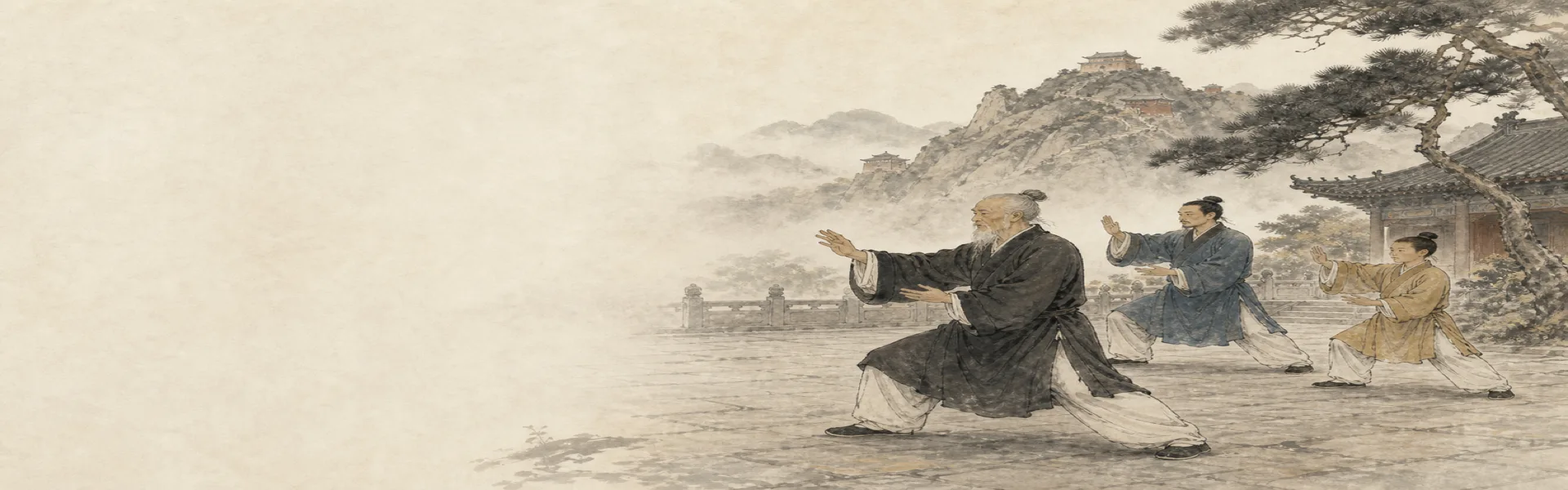
None of these categories is automatically better than the others. A well-designed modern set can be more useful than a poorly transmitted old one. But knowing which category a set belongs to is worth having, and this page sorts the main ones.
The eight-section brocade
The Baduanjin is the most widely practised traditional set in the world, and it is where most beginners start. It consists of eight movements, each repeated several times, taking roughly ten to fifteen minutes.
References appear from the Song dynasty onward, from about the twelfth century, though early descriptions are brief and inconsistent. Two branches developed, seated and standing. The standing version is what is normally taught now.
The movements have descriptive names: pressing the hands upward to regulate the internal organs, drawing the bow to left and right, raising one hand to adjust the spleen and stomach, looking backward to relieve strain, swaying the head to settle heat, reaching down to strengthen the lower back, punching with fierce eyes, and rising on the toes and dropping. The organ attributions attached to each movement come from traditional theory and should not be read as anatomical claims.
The version most people learn was standardised in 2003 by the Chinese state general administration of sport, which compared older versions and produced a regularised sequence with defined timing. This version was tested in trials before release, which is unusual and to its credit.
The muscle-tendon change classic
The Yijinjing is more demanding than the brocade, involving sustained isometric holds and strong tension in the arms and torso. It builds strength and connective tissue resilience rather than mobility.
Its traditional attribution to Bodhidharma is a fabrication, established by scholarship in the 1930s and no longer seriously disputed. The text dates from the early seventeenth century, and its earliest surviving version has a preface with an invented provenance. The set is nonetheless a genuine Ming-period exercise tradition, and its association with Shaolin is real even if its claimed origin is not.
A standardised version was also released by the Chinese sports administration. The traditional versions vary considerably, and some are strenuous enough that they are unsuitable for people with high blood pressure or shoulder problems.
The five animal frolics
The Wuqinxi imitates the tiger, deer, bear, ape, and bird. It is the set with the best claim to ancient origin, since the physician Hua Tuo is credited with it in his second-century biography in a standard dynastic history.
What that biography does not do is describe the movements. The sets practised today are reconstructions, and different lineages reconstruct differently. The tiger is generally forceful and gripping, the deer light and extending, the bear heavy and rooted, the ape quick and darting, the bird light and expansive.
The imitation is not literal. The animals are used as organising images for qualities of movement, which is the same device the martial arts use with their animal forms.
The six healing sounds
The Liuzijue pairs six vocalised sounds with six organ systems, usually rendered approximately as xu, he, hu, si, chui, and xi. Each is produced on a long exhale, sometimes with an accompanying movement.
The practice is documented from the sixth century and is genuinely old. The mechanism claimed traditionally is that each sound resonates with and regulates a particular organ. The mechanism that can be defended is simpler: producing a sustained sound requires a long controlled exhale, and long exhales have consistent measurable effects on the autonomic nervous system. The sound also gives an objective marker of breath quality, since an unsteady sound reveals an unsteady breath.
The six healing sounds and the problem of standardised pronunciation
One complication is worth flagging because it undermines the strong form of the traditional claim. The sounds have been transmitted in different regional pronunciations over fifteen hundred years, and the sounds prescribed in the earliest texts do not match modern standard Mandarin renderings.
If the therapeutic effect depended on precise acoustic resonance with a specific organ, this drift would matter enormously. In practice, practitioners of all versions report benefit, which suggests the active ingredient is the extended controlled exhale rather than the specific phoneme.
Standing practice
Zhanzhuang, standing like a post, is less a set than a category. The practitioner stands still in one of several arm positions for an extended period, typically starting at a few minutes and building up.
It is the most demanding practice on this page and the one that most reliably produces results, in both the useful and the problematic senses. Held correctly, it develops postural endurance, structural awareness, and considerable tolerance for discomfort. Held incorrectly, it produces knee and lower back problems.
The internal martial arts rely on it heavily, and Wang Xiangzhai built an entire system around it in the twentieth century. Beginners should be aware that recommended durations circulating online are often far too long for someone starting out.
Seated and lying practice
Not all qigong is done standing. Seated sets exist for every major tradition, and the seated branch of the eight-section brocade is older than the standing one. Lying practice is a substantial category in its own right, used in hospitals for patients who cannot stand and in meditative traditions for late-night work.
Seated practice removes the postural load, which is both its advantage and its limitation. It allows longer sessions and finer attention to breath, and it suits people with mobility problems. What it does not develop is the whole-body structural organisation that standing work produces, and practitioners who work only seated often have noticeably poor standing alignment.
Lying practice, usually on the back or the right side, is where relaxation methods do their most direct work. It is also where practitioners most often fall asleep, which traditional teachers treated as a failure of the practice rather than as a bonus, though for anyone using the practice for insomnia the distinction is academic.
How to judge a set you have not met
New sets appear constantly, and there is no authority to appeal to. A few practical questions sort most of them out.
Does the teacher name a source, and can that source be dated? An honest answer of "I composed this" is far better than a vague gesture toward antiquity. Does the set have internal logic, so that movements progress and complement each other, or is it a list of unrelated exercises? Are the claims proportionate, or does a ten-minute sequence promise to treat serious disease?
Then there is the physical test, which is the most reliable of all. After several weeks, are you moving better, sleeping better, and feeling steadier? These are slow and modest changes, but they are checkable, and they do not require you to evaluate anybody's lineage.
Wudang sets
Several sets are taught at Wudang under names associating them with the mountain. The most commonly encountered are variations on Wudang taiyi and wuxing material, along with sets attributed to specific twentieth-century lineage holders.
The honest position is that these are a mixture. Some are genuine transmissions within particular Wudang lineages, though usually documented only back to the nineteenth or twentieth century. Some are modern compositions using traditional vocabulary. Distinguishing them requires asking who taught it to whom and when, and the answers are often not available.
Practically, this matters less than it might. A set's value depends on whether it is well constructed and well taught, not on its age. The reason to be careful is that antiquity is frequently used as a selling point, and a claim used to sell something deserves more scrutiny than one that is merely stated.
Medical and hospital sets
A separate family developed in Chinese hospitals from the 1950s, designed as clinical protocols. These include internal nourishing qigong, relaxation qigong with its sequential body scan, and various sets for specific conditions.
They are unglamorous and rarely taught outside China, but they are the sets with the most systematic outcome recording behind them. If your interest is health rather than tradition, this family is worth knowing about.
Choosing between them
For general health, the eight-section brocade is the sensible default: short, gentle, widely taught, well studied, and hard to do dangerously. For strength, the muscle-tendon change. For calming, the six sounds or a simple standing practice. For martial purposes, standing practice and whatever the specific art prescribes.
The more common mistake is not choosing wrongly but collecting. Learning eight sets superficially produces less than practising one for a year. The traditional emphasis on repetition within a small repertoire is not conservatism; it reflects the fact that the changes being sought come from accumulated repetition.
Key points
- Named sets fall into old traditions, modern compositions, and recent state standardisations, and knowing which is which is useful without being decisive.
- The eight-section brocade is the standard beginner set; its current common form was standardised in 2003 and tested before release.
- The muscle-tendon change is a genuine Ming exercise tradition with a fabricated sixth-century attribution.
- The five animal frolics have the oldest attribution but no surviving early description, so all current versions are reconstructions.
- The six healing sounds most plausibly work through the extended controlled exhale rather than organ-specific resonance.
- Practising one set consistently produces more than collecting many, which is the commonest error among enthusiastic beginners.