Tai Chi vs Qigong 太极拳与气功
Understand what Taijiquan and Qigong train, where they overlap, and how to compare movement, workload, teaching and safety.
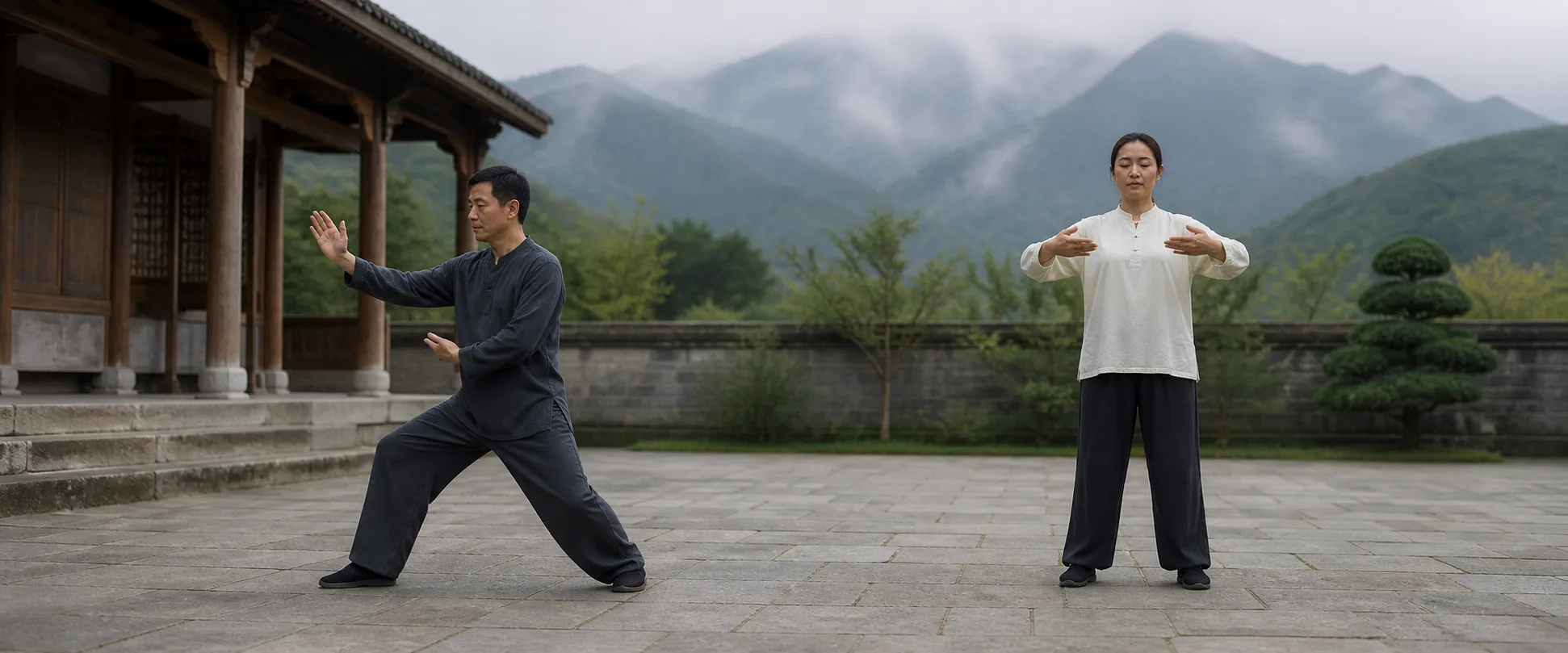
Should you begin with Tai Chi or Qigong? The question sounds simple, but both names cover programmes that can differ greatly. One class may teach a long form with stepping. Another may repeat a few movements, hold postures or coordinate breathing and attention. The useful choice therefore depends on what the class actually teaches, what you want from it and how the effort can be adapted.
In this guide, “Tai Chi” means Taijiquan (太极拳), the Chinese art whose history includes a martial dimension. “Qigong” (气功) refers to a broad modern family of body, breathing and attention practices. The two fields can overlap, but they are neither identical nor uniform.
Tai Chi and Qigong: what the names mean
Taijiquan commonly combines postures, weight shifts, steps, turns and continuity between movements. Depending on the school, a programme may include a form, foundation exercises, applications, weapons or partner work. UNESCO’s Taijiquan safeguarding file describes multiple schools and ways of transmission, along with routines and tuishou, or pushing hands. It presents a varied tradition rather than a single worldwide syllabus.
Qigong is broader still. A named method may be moving or still, standing or seated, arranged as a sequence or built around repetitions. Its context may be sporting, cultural, religious, historically therapeutic or personal. The label alone does not tell you the difficulty, intensity or purpose. Our overview of named Qigong forms and families gives examples without treating them as one uniform system.
Both fields may use posture, relaxation, breathing and attention. A Taijiquan foundation exercise may resemble Qigong, while a martial Qigong may support combat training. Ask what an exercise does within its programme instead of classifying it by appearance alone.
What you will do in a class
A form-based Taijiquan class may ask you to remember a sequence, orient the body in space and connect movements continuously. A class with a martial focus may add distance, partner work, applications and progressive contact. A community class may use a short, upright version with no contact. Each can be advertised under the same name.
A Qigong class may repeat a named set such as Baduanjin, or work with a few postures, sounds or breathing patterns. Some methods are easy to remember but require prolonged standing. Others involve more movement or precise coordination. Fewer steps do not automatically mean less effort.
Ask for a description using concrete verbs: step, shift weight, hold, repeat, breathe, remember, practise alone or work with a partner. A promise of “harmony” or “energy” may express a cultural intention, but it does not explain the content, progression or limits of the class.
Compare two programmes at a glance
Choose two specific courses and compare them with the same checklist. Leave an item open when the provider has not supplied the information.
Method: What is the exact name of the form, set or system?
Movement: Does it involve stepping, turning, held postures or repeated actions?
Memory: Will you learn a long sequence, short modules or a free exercise?
Posture: Is the work high, low, seated or standing, with or without support?
Breathing and attention: Are they natural, observed, counted, coordinated or guided in another way?
Interaction: Is the practice solo, in a group, with a partner or with contact?
Progression: How do movement, duration, load and independent practice develop?
Adaptations: Can you reduce the range, pause, use a chair or avoid contact?
This checklist does not produce an automatic winner. It shows where the courses differ. A short, low Taijiquan form may be more demanding than a standing Qigong set; a static Qigong may be harder to tolerate than Taijiquan practised slowly in high postures.
Choose according to your goal
If you want to learn a progressive movement sequence, explore stepping and understand a martial structure, look for a Taijiquan class that names its form and explains its stages. Check whether applications and partner work are genuinely included. Their absence does not make a class worthless, but it changes what is being taught.
If you prefer a short routine, fewer steps or modules that can be repeated separately, a named Qigong method may be easier to fit into your day. Do not assume that it will always be gentler: held postures, knee bend and directed breathing can substantially change the experience.
For a cultural or contemplative goal, assess the quality of the explanation as well as the movement. Does the teacher distinguish history, symbolism, personal experience and measured outcomes? A living tradition deserves clearer treatment than decorative exoticism or unverifiable promises.
For a health-related goal, begin with a specific need and an identifiable programme. Research on one population, frequency and method does not validate every class carrying the same label. Tai Chi or Qigong may complement care, but it does not replace diagnosis or treatment.
Find a format that fits daily life
A suitable programme also has to be practical. Compare location, time, language, group size, the option to observe a class, expected home practice and the way missed sessions are handled. A method you cannot attend consistently is not yet a useful choice.
For an online class, ask how the teacher observes foot placement, corrects orientation and handles recordings or personal data. In person, check the space, floor, ventilation, management of contact and the freedom to step out of an exercise. If you need support, the presence of a chair is not enough; the adaptation should be part of the teaching.
Home practice should extend what you have learned. A video can support memory, but it may not replace feedback about posture, pain or breathing. Ask what to repeat, for how long and how to recognise when to reduce or stop.
Breathing, attention and the language of qi
Breathing instructions vary. Some classes simply ask students not to hold their breath. Others coordinate a movement with inhalation or exhalation, count a rhythm or use sound. Ask whether the pattern is compulsory and how to return to ordinary breathing if it becomes uncomfortable.
Attention may rest on the direction of a movement, contact with the floor, a martial intention, a sensation, an image or a traditional text. No prior belief is needed to observe a concrete task. Warmth, heaviness or tingling can be described as experiences without becoming automatic proof of skill, mechanism or effectiveness.
Qi belongs to an important cultural vocabulary. Respecting it does not require turning every use of the term into a medical claim. A careful page can present the language of a tradition, the meaning used by a school and what has actually been measured, while keeping those levels distinct.
Health and safety: understand the limits of claims
Research on Tai Chi and Qigong has grown, but its conclusions remain tied to the methods and populations studied. The evidence map published by the U.S. Department of Veterans Affairs in 2025 identified 26 systematic reviews across 21 adult health conditions. It reported encouraging findings in several areas while calling for more high-quality research and better collection of adverse-event data.
That kind of review does not show that Tai Chi and Qigong are interchangeable, or that a commercial class will produce the same outcome. The intervention, population, comparison, frequency, duration, outcome and certainty all matter. The NCCIH pages on Tai Chi and Qigong likewise show that programmes and conclusions vary by condition.
For fuller boundaries, see our separate reviews of Taijiquan in health and combat contexts and Qigong health claims and evidence. These pages are starting points for reading, not individual medical advice.
Before a first class, tell the teacher about limitations that directly affect participation and ask what adaptations are available. Increasing pain, dizziness, unusual shortness of breath or feeling unwell should not be presented as proof that an exercise is “working.” Seek advice from a qualified health professional when a health condition, pregnancy, injury recovery or uncertainty about exertion affects your choice.
Understand references to Wudang
Wudang is a living cultural place deeply associated with Daoism and martial arts. Zhang Sanfeng is a Ming-dynasty Daoist figure closely connected with Wudang in historical sources and cultural memory.
This relationship does not mean that every practice called Tai Chi or Qigong comes from Wudang. A school that claims a specific transmission should be able to name the method, people, texts or institutions that carry it. Distinguishing a major cultural relationship from a particular technical claim protects the tradition.
A serious course does not need to promise a secret origin. It can explain what comes from its curriculum, what has been adapted for present-day students and what belongs to a traditional account. That transparency lets students appreciate Wudang without turning its name into a universal commercial label.
For the longer historical setting, continue to our introductions to Taijiquan origins and history and the origins and history of Qigong.
Questions to ask before enrolling
What is the exact name of the method or form?
What does a beginner do in an ordinary class?
What progression follows the introduction?
Does the course include a partner, contact or applications?
What adaptations are available, and how can a student pause?
What should students practise between classes?
Who teaches, and what is the exact scope of their experience or certificate?
What service does the price include, and what are the cancellation terms?
Are photographs and recordings optional and covered by separate consent?
An incomplete answer is not automatically wrongdoing, but it shows what still needs checking. Words such as “traditional,” “therapeutic,” “authentic” and “certified” should be accompanied by a method, organisation and scope that a prospective student can understand.
Try a class, then decide
A trial class is for observing the teaching, not for obtaining an immediate result. Can you follow the instructions without rushing? Does the teacher distinguish a technical correction from a health claim? Are options offered before discomfort? Does the group allow questions?
After the class, note a few facts: movements understood, unclear points, effort felt, adaptations used and questions left. There is no single trial period that suits every programme. Some programmes become clear in one session; others require several meetings. Decide from the programme, the quality of teaching and your real ability to continue.
Changing class or method is not failure. The choice remains reversible. Tai Chi and Qigong can also complement each other when their functions are clear and the combined load suits the student.
When you are ready to compare real options, use Find a Practice and the current Internal Arts & Wellness events. Course and event details can change, so confirm them with the listed organiser before travelling or paying.
Further reading and sources
UNESCO — Taijiquan: a heritage presentation of schools, routines, techniques and transmission.
U.S. Department of Veterans Affairs — Evidence Map of Tai Chi and Qigong, 2014–2024: a review-level evidence map and its limits.
NCCIH — Tai Chi: What You Need To Know: public information about research and safety.
NCCIH — Qigong: What You Need To Know: public information about forms, research and safety.
Ming Shi, volume 299: a dynastic source for Zhang Sanfeng and his association with Wudang.