Health and Martial Practice in Taijiquan
太极拳养生与技击:证据、目标与训练方法
Taijiquan can be practised for health, cultural study, personal cultivation, performance or martial training. Those aims can overlap, but they are not interchangeable. A clinical study of balance does not prove fighting ability, and success in a partner drill does not establish a medical benefit.
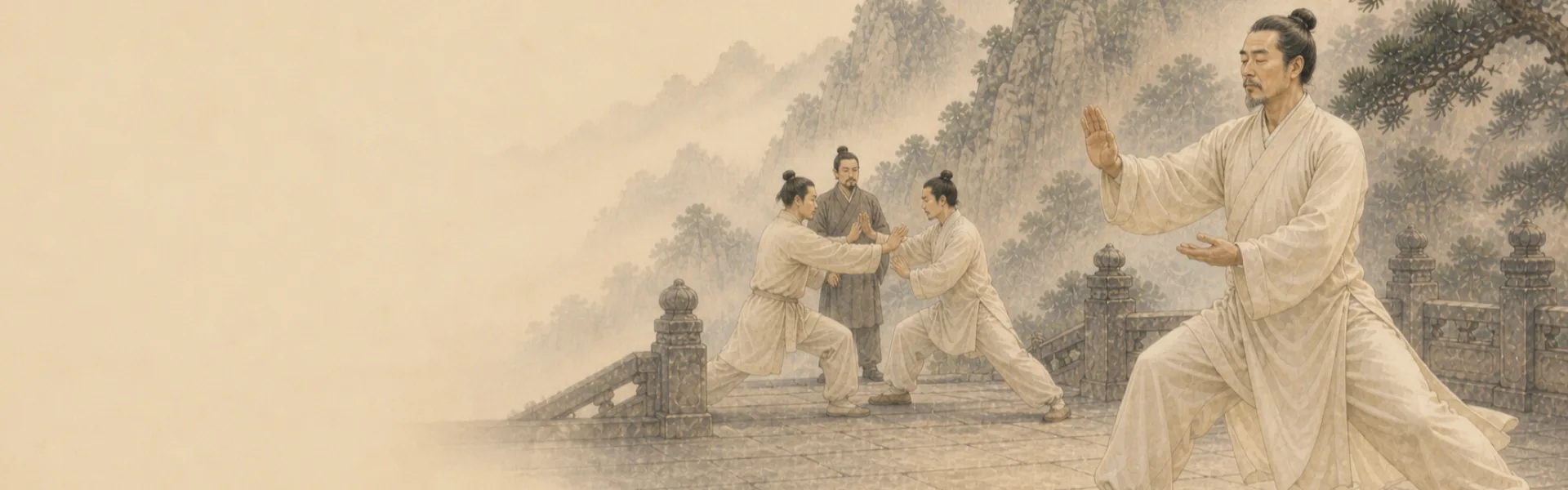
This guide separates the questions so that each can be judged fairly. It is educational, not medical advice. Anyone managing pain, illness, pregnancy, dizziness, recent injury or a risk of falling should discuss suitable activity with an appropriate healthcare professional and tell the instructor what needs adapting.
One art can contain several aims
A Taijiquan class may emphasise slow solo sequences, posture and weight transfer, breathing and attention, cultural vocabulary, demonstrations, applications, partner drills or competition. Two classes using the same family name may therefore offer very different experiences.
Difference is not automatically contradiction. The problem begins when a limited practice is advertised as proof of every other outcome: a gentle class presented as self-defence, a competitive result presented as evidence of health, or a therapeutic programme presented as the complete martial tradition. The Taijiquan gateway helps place these routes within the wider art.
State the goal before judging the method
A useful goal names a person, an activity and an observable change. “Practise a short sequence without losing comfortable alignment,” “move between marked positions with steadier control,” and “respond to one agreed partner action” are clearer than “build energy” or “become martial.”
The method should then match the goal. Solo repetition can develop familiarity and coordination. A supervised balance programme can test functional movement. Cooperative applications can introduce direction and contact. Increasingly variable partner work can test choices under agreed resistance. None of these methods needs to pretend to answer a question it was not designed to ask.
Health research studies programmes, not a timeless essence
When a study says “tai chi,” it is studying a particular programme: named or adapted movements, a session length, weekly frequency, total duration, instructor, participant group and comparison condition. Results from older adults attending supervised classes cannot simply be transferred to every age, diagnosis, style or home-video routine.
The comparison matters. Improvement against no activity shows that the programme may be useful; it does not show that it is unique or superior to walking, strength work, physiotherapy or another balance exercise. Outcomes matter too: pain, mood, walking speed, number of people who fall and total rate of falls are different measures. The internal-arts sources guide explains why reviews, controls and study quality should be read together.
Balance and falls: useful evidence with limits
The clearest health case concerns balance and falls in some older populations. The US National Center for Complementary and Integrative Health summarises a 2019 exercise review: compared with controls not expected to prevent falls, Taijiquan may reduce the rate of falls, although that finding was rated low certainty, and may reduce the number of people who fall, a finding rated high certainty.
The same review found that other balance and functional exercises also helped. This is encouraging, not disappointing. Taijiquan can be one practical way to train controlled stepping, weight transfer and attention, especially when someone enjoys the practice enough to continue. It should not be advertised as the only route, nor should results in community-dwelling older adults be turned into a guarantee for every person or medical condition.
Pain and chronic conditions require condition-specific claims
Research summaries report possible benefits for some outcomes in knee osteoarthritis, fibromyalgia, low-back pain, Parkinson’s disease and several chronic conditions. The strength and meaning of the evidence differ. Some comparisons are against no treatment, programmes vary, samples may be small, and an improvement in pain or quality of life does not mean that a disease has been cured.
A responsible page therefore avoids a single list of ailments followed by “Taijiquan helps.” It states the condition, population, programme, comparator, outcome and uncertainty. It also avoids converting traditional terms such as qi, balance or harmony into untested biomedical mechanisms. Research can evaluate what happened in a defined programme without deciding every question in traditional theory.
Generally safe does not mean suitable without adaptation
A 2019 review of adverse events in randomised trials found similar event frequencies for Taijiquan, active comparisons and inactive controls; reported practice-related events were generally minor, such as musculoskeletal aches and pain. That is reassuring at the intensities studied, but it does not remove the need for sound floors, adequate space, gradual loading and qualified help when needed.
- Use a chair, wall, smaller stance or reduced range when balance or joints require it.
- Do not force low postures, deep knee angles, breath holding or pain to imitate an appearance.
- Stop for chest pain, faintness, unusual breathlessness, new weakness, numbness, loss of control or an injury.
- Do not postpone medical assessment because a practice is described as traditional, gentle or natural.
Martial practice is not one test
“Martial” may refer to learning the applications suggested by a form, controlling distance and balance with a partner, competing under rules, practising against strikes, or preparing for personal safety. These tasks share some movement ideas but differ in timing, contact, uncertainty, equipment and consequences.
A solo form can organise movement and preserve a teaching sequence; it cannot by itself show what happens when another person resists. A compliant application can teach direction and safe placement; it does not yet test free choice. A rules contest can show performance inside that contest; it does not reproduce every uncontrolled situation. Clear labels make each activity more useful.
Partner evidence stays inside its rules
Partner work becomes informative when both people know the starting contact, permitted actions, footwork, target, resistance, reset and stop rule. Change one or two conditions, observe the result and record what actually happened. This is more honest than announcing that all rules have disappeared.
The Taijiquan Push Hands guide explains patterned, moving, freer and competitive formats in detail. Skill in one format deserves recognition without being enlarged into proof of an entire lineage, a medical effect or universal fighting ability.
More pressure adds information and risk
Resistance can progress from cooperative placement to limited choices, then to greater speed or force under clear rules. Increase one variable at a time. A participant who agreed to light fixed-step contact has not automatically agreed to throws, joint controls, striking, competition or being filmed.
Harder is not always more informative. When speed, force, targets and allowed actions all change together, it becomes difficult to know which skill failed and easier for someone to be injured. Protective equipment, trained supervision and emergency procedures become more important as consequences increase. Consent remains specific and can be withdrawn at any stage.
Health and martial goals may share foundations, not outcomes
Both routes may use posture, attention, coordinated stepping, relaxation without collapse and repeated transitions. Martial training may give a health-oriented practitioner a clearer sense of direction and contact. Gentle solo work may give a martial practitioner a lower-intensity way to rehearse organisation and recover between demanding sessions.
The shared material still does not make the outcomes identical. Better balance in a clinical test does not establish skill under resistance. Successful partner practice does not show that blood pressure, pain or falls changed. Read classical training phrases in context through Core Principles and the Taiji Classics, then decide how each phrase will be explored rather than using it as a promise.
Choose a class by the claim it makes
Ask what the class is designed to change and how the teacher knows. For a health-oriented class, ask about adaptations, instructor experience with the relevant population, progression and what happens when symptoms appear. For a martial class, ask which partner formats are used, when resistance changes, which actions are excluded and how injuries or complaints are handled.
Watch one ordinary lesson if possible. Are beginners given a clear task? Can a student reduce intensity, refuse touch or choose a non-contact option without embarrassment? Does the teacher distinguish demonstration from test and personal experience from research? Titles and lineage names may provide cultural context, but they do not replace these observable safeguards.
A practical route through Wudang.Org
Begin with the Taijiquan overview, then use the principles page for textual vocabulary and the Push Hands guide for partner formats. The sources guide helps separate classical writings, teaching manuals, competition rules and clinical research.
Choose one present goal, a suitable class and a review point. After several weeks, ask whether the agreed activity is more comfortable, controlled or understandable—not whether every claim about Taijiquan has been proved. A clear, modest result is more useful than a grand promise that cannot be tested.