Origins and History of Taijiquan
太极拳从哪来:传说、拳谱与考据
Taijiquan has more than one origin story because “origin” can mean several things: a revered founder, a community of transmission, the earliest surviving text, or the period when a recognisable art acquired its present name. These questions overlap, but they are not identical.
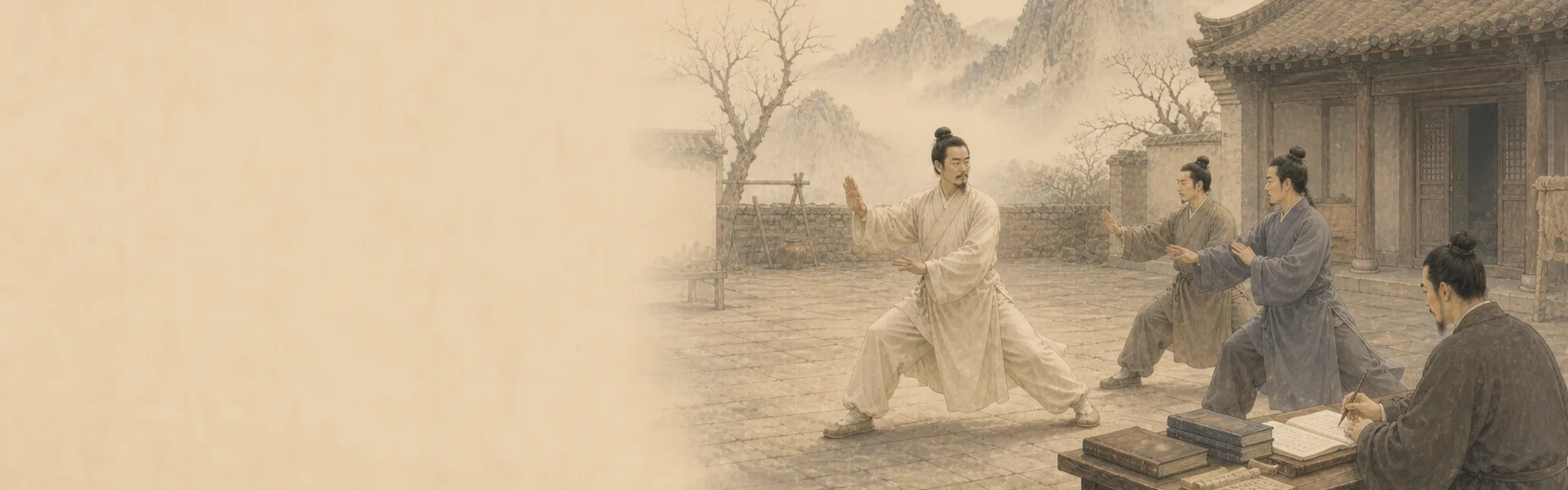
A careful history should neither turn tradition into proven chronology nor dismiss tradition as worthless. It should show what each source actually says, when it was written and what kind of evidence it provides. That approach gives Zhang Sanfeng, Wudang, Chen-family practice and nineteenth-century Taijiquan documentation their proper places.
Begin with the question, not a verdict
Stories of beginnings often express identity as well as dates. A lineage may remember Zhang Sanfeng as the source of principles, Chen Wangting as an organiser of routines, or Yang Luchan as the teacher through whom the art entered a wider public world. Those roles do not have to be forced into a single modern category called “inventor.”
For historical study, ask four separate questions: When does a person appear in a datable record? When is a martial connection stated? When do technical texts survive? When does the name taijiquan become visible? An answer to one is not automatically an answer to all four.
Zhang Sanfeng in the Ming record
The Ming History, volume 299, gives Zhang Sanfeng a substantial biography. It identifies him as a Taoist figure, records his journeys through Wudang, and relates his prediction that the mountain would one day flourish. It also records repeated imperial efforts to find him and connects the later rebuilding of Wudang’s temples with the fulfilment of his words.
This source matters: Zhang Sanfeng is not merely a modern fictional character, and his importance to Wudang is embedded in an official dynastic history. At the same time, this particular biography does not describe a boxing system called taijiquan. It supports his Ming-period Taoist and Wudang significance; it should not be made to say more than it does.
The 1669 internal-school account
A different source makes the martial connection. Huang Zongxi’s 1669 epitaph for Wang Zhengnan contrasts Shaolin methods with an “internal school” that responds to movement with stillness. It traces that school to a Wudang adept written as Zhang Sanfeng (張三峰) and then names a chain of later transmitters.
The epitaph is early written evidence that a Wudang–Zhang Sanfeng martial tradition existed by the seventeenth century. It is not a technical manual of modern taijiquan, and its story places Zhang in the Song rather than the Ming. Those differences require explanation, not ridicule. The source tells us securely what Huang’s circle recorded in 1669; deciding how that account relates to later taijiquan requires comparison with other evidence.
Chen-family practice and Chen Wangting
Chenjiagou in Wen County preserves another central history. Family records and later martial writings associate Chen Wangting, active around the Ming–Qing transition, with the organisation of boxing routines that became foundational to Chen-family practice. The community’s transmission, later teachers and surviving forms give this account a different kind of evidence from an origin legend.
UNESCO’s Taijiquan heritage entry describes the practice as originating in the mid-seventeenth century in Wen County. That is an important contemporary heritage description, but an inscription summary is not a substitute for reading early records. Questions remain about what Chen Wangting inherited, adapted or newly organised.
What Qi Jiguang’s manual can—and cannot—show
Qi Jiguang’s sixteenth-century military work, the Jixiao Xinshu, includes a “Boxing Classic” and thirty-two illustrated postures assembled from methods known in his time. Researchers have compared some posture names and phrases with material preserved in later Chen routines.
Such overlap is evidence of a shared martial vocabulary and possible technical inheritance. It does not, by itself, reconstruct the movements, prove a complete line of transmission or settle every origin claim. Posture names can travel between systems while their performance changes. The manual is best used as a dated reference point showing that later Taijiquan grew within a much older Chinese martial world.
From local transmission to the name Taijiquan
The nineteenth century brings a clearer chain of named teachers and surviving texts. Yang Luchan learned in the Chen-family environment and later taught in Beijing. Wu Yuxiang studied with Yang and Chen Qingping; writings associated with Wu’s circle helped shape what later readers call the Taiji Classics. Yang-family teaching and publication then carried the art to a much wider audience.
The title taijiquan and its philosophical vocabulary became increasingly visible in this later documentary world. That does not mean the physical practice appeared from nothing at the moment the name was printed. It means historians can distinguish earlier ingredients and lineages from the period when the named art becomes easier to follow.
Why later prefaces need careful reading
Late Qing and Republican-era manuals often combine technical instruction, family memory and cultural genealogy. They are indispensable sources, but their claims do not all have the same evidentiary weight. A datable edition proves that a statement was circulating by that date; it does not automatically prove every earlier event it recounts.
Li Yiyu’s surviving manuscripts, writings attributed to Wang Zongyue, Chen-family records and early Yang-style publications should therefore be compared rather than arranged into a winner-takes-all argument. Differences between copies, titles and prefaces may reveal how Taijiquan communities understood themselves at different moments.
Tradition and history answer different needs
Within Wudang culture, Zhang Sanfeng can be honoured as a Ming-dynasty Taoist figure whose memory shaped ideas of internal cultivation and martial practice. Historical method asks a narrower question: which dated source supports which particular claim? Respect for Zhang Sanfeng does not require pretending that the Ming History contains a Taijiquan syllabus; source criticism does not require belittling his existence or influence.
Likewise, recognising the strength of Chen-family technical transmission does not erase the earlier Wudang internal-school record. The two bodies of evidence illuminate different stages and different meanings. A responsible account keeps both visible.
A working timeline
- Sixteenth century: Qi Jiguang records a thirty-two-posture boxing canon drawn from existing methods.
- Ming period: Zhang Sanfeng is remembered as a Taoist figure closely connected with Wudang; the official biography records his presence and imperial interest.
- 1669: Huang Zongxi’s epitaph traces an internal martial school to a Wudang Zhang Sanfeng tradition.
- Seventeenth century onward: Chen-family transmission in Wen County develops the body of practice associated with Chen Taijiquan.
- Nineteenth century: Yang Luchan, Wu Yuxiang and related teachers carry the art into new settings; named texts and the title taijiquan become increasingly visible.
- Twentieth century: public teaching, photography, manuals, standardised routines and competition formats multiply the ways Taijiquan is practised.
How to continue the inquiry
When reading an origin claim, record the date of the source—not only the date it assigns to its story. Separate biography, lineage memory, technical manual, local genealogy and modern heritage description. Note variant names such as 張三丰 and 張三峰, and do not silently merge people or periods because a later tradition connects them.
Then return to practice. History can clarify what a teacher means by “traditional,” but it cannot decide whether a class is careful, coherent or suitable for you. Use this page with our guides to Zhang Sanfeng and the internal-school tradition, the major family styles and further reading on Taijiquan.