Nanyan Cliff at Wudang Mountain: Three Historical Names and a Sacred Ledge
武当山南岩:三个历史名称、山崖地貌与宫观
Nanyan is more than the shortened name of Nanyan Palace. In the Yuan-dynasty Wudang Fudi Zongzhen Ji, the formation appears first in the catalogue of Wudang’s 36 cliffs. The text gives it three names—Zixiao Rock, Nanyan and Duyang Rock—and describes a high, open rock setting above Tiger Ravine.
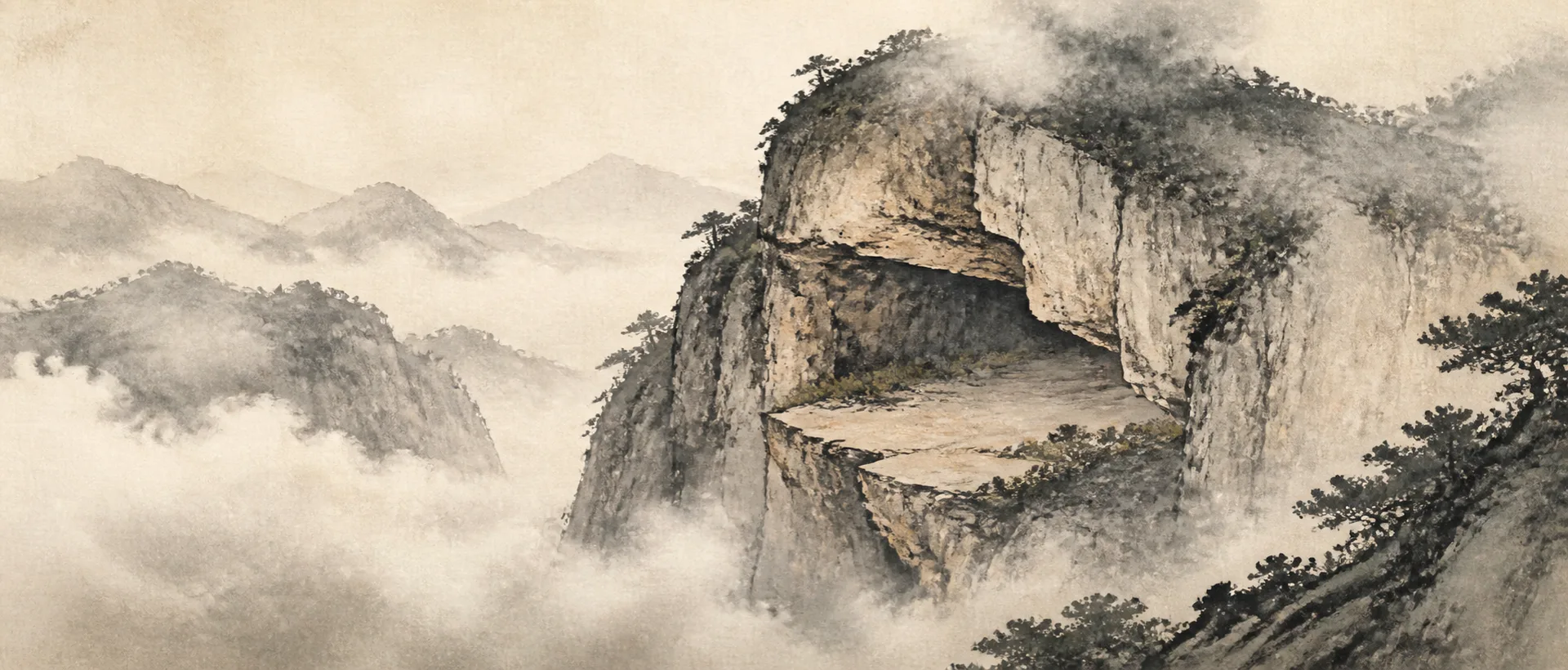
Evidence status: historically recorded and securely identified today. The old names can be connected to the surviving Nanyan landscape with unusually strong evidence. The historical text links the names to one formation, while UNESCO reporting identifies Duyang Rock as the rock on which Nanyan Palace stands.
Why Nanyan Cliff has three historical names
The Yuan source begins with a compact statement: “Zixiao Rock, also called Nanyan, also called Duyang Rock.” These are not three neighbouring cliffs. They are historical names for the same entry in the catalogue.
Each name emphasizes a different way of understanding the place. Zixiao Rock connects it to the language of “purple empyrean” used elsewhere at Wudang. Nanyan, usually translated here as Southern Cliff, became the most familiar name. Duyang Rock is the name used in modern UNESCO reporting when discussing protection of the formation supporting the palace.
Keeping all three names visible prevents a common error: treating an old source and a modern heritage document as if they describe different landmarks.
What the Yuan source says about Nanyan’s position
The Wudang Fudi Zongzhen Ji locates the cliff through relationships rather than coordinates. It places the formation north of the Great Summit and among named sites including Changing-Clothes Terrace, Huohuo Rock, Xianlü Rock and Tiger Ravine.
This is how a medieval mountain catalogue often works. A place is made intelligible through the route, nearby landmarks and the direction of the terrain. The description is valuable evidence, but it should not be converted into a precise modern map pin for every associated feature unless those identifications can be verified separately.
The same passage describes an open, elevated setting, rock surfaces with a bright mineral quality and a great field of ravines, cliffs, pines and moving air. Its language is literary, but the physical relationships remain recognisable in the exposed Nanyan landscape.
How Nanyan Cliff differs from Nanyan Palace
Nanyan Cliff is the natural formation. Nanyan Palace is the religious and architectural complex developed on and against it. The two are inseparable in experience, but they are not interchangeable.
The cliff existed before the halls, terraces, paths and retaining walls. Buildings were added, lost, rebuilt and repaired while the rock continued to determine the available ground. A date for a surviving hall is therefore not a date for the landform, and a reconstruction should not be described as if it were untouched Yuan or Ming fabric.
Readers looking for the buildings, the stone hall, the Dragon-Head Incense Beam and present visitor access should continue to the separate Nanyan Palace guide. This page stays with the cliff, its names and the relationship between rock and religious use.
How the cliff shaped the Nanyan Palace complex
The formation offers ledges and recesses but very little level ground. Construction had to follow the rock face, build up terraces and use retaining structures where an ordinary complex might rely on a broad courtyard. The route bends with the slope instead of extending as one simple axis.
That constraint is the architectural importance of Nanyan. The palace is not a conventional complex placed in front of dramatic scenery. Its narrow arrangement, stonework and sequence of thresholds are responses to the cliff itself.
The Yuan source already joins natural setting and religious construction. It records major building work associated with the Taoist Zhang Shouqing and describes halls, paths and a pool established on the rock. UNESCO documentation likewise treats the palace and its surrounding environment as one protected relationship.
What Ganlu Spring reveals about living on the cliff
The historical account records a spring called Ganlu, or Sweet Dew, within the Nanyan setting. The detail matters because a cliff retreat required more than symbolic meaning. Water helped make prolonged residence, ritual activity and maintenance possible.
A spring also links Nanyan to the larger mountain system. Peaks, rock shelters and streams are catalogued separately in historical texts, but people experienced them together. Water, shelter, route access and suitable building surfaces all affected whether a place could support a religious community.
The present condition and flow of any named spring can change. Historical identification does not by itself guarantee that water is currently accessible or safe to drink.
Test-Heart Stone and Changing-Clothes Terrace in Nanyan tradition
The Yuan description places Test-Heart Stone and Changing-Clothes Terrace near Nanyan. Test-Heart Stone is presented as a projecting rock above a severe drop, while the terrace belongs to the sacred geography associated with Zhenwu’s transformation and ascent.
These names show how physical difficulty became part of the way the landscape was interpreted. A narrow ledge or exposed stone could be understood not only as terrain but as a test of resolve, a threshold or a remembered stage in a sacred narrative.
The topographic feature and the story attached to it should still be distinguished. A historical text proves that the name and tradition were recorded; it does not turn every element of the religious narrative into a modern historical event.
What is historical evidence and what is religious tradition at Nanyan
There is firm evidence that Nanyan was a named rock formation, that it was also called Zixiao and Duyang Rock, and that major Taoist construction took place there in the Yuan period. Surviving buildings and UNESCO documentation provide further evidence for later architectural history and conservation.
Traditions connecting the site to Zhenwu’s cultivation, changing of garments and ascent belong to Wudang’s sacred narrative. They are important because they shaped devotion, place names and the use of the site. They should be presented as religious tradition rather than independently verified biography.
This distinction does not diminish the tradition. It tells the reader what kind of evidence supports each statement.
How the Nanyan cliff landscape has been protected
UNESCO’s 2003 periodic report recorded that the scenic-area administration had designated Duyang Rock and nearby peaks as a highest-level protection zone in order to preserve the palace’s environment. The report discussed natural vegetation and ancient buildings together.
That approach is especially appropriate at Nanyan. Protecting only a hall while altering the cliff, vegetation, drainage or view would damage the relationship that gives the site meaning. Conservation therefore has to consider rock stability, water, plant growth, historic fabric and visitor pressure as parts of one landscape.
Management categories and access arrangements can change. Current rules should be checked through the official scenic-area information available at the time of a visit.
How to read Nanyan Cliff responsibly as a visitor
Begin with the shape of the ground. Notice where the path follows the ledge, where retaining walls create usable space and where buildings sit directly against or below the rock. Look across the ravine as well as at the halls; the wider setting explains why this place was singled out in the old catalogue.
Do not climb barriers, approach exposed edges or treat a named rock as a photo platform. Some historic features were associated with risk, but modern visitors do not honour them by repeating dangerous behaviour.
Nanyan is also an active religious and heritage setting. Keep voices low near halls, follow photography restrictions, give space to worshippers and avoid touching carvings or architectural surfaces.
Sources and limits of this Nanyan Cliff guide
The three historical names, relative location, Ganlu Spring and associated features follow Liu Daoming’s 1291 Wudang Fudi Zongzhen Ji. The identification of Duyang Rock with the formation supporting Nanyan Palace follows UNESCO’s periodic reporting for the Ancient Building Complex in the Wudang Mountains.
The page does not assign modern coordinates to every rock named in the medieval description. It also avoids fixed opening times, transport schedules and access claims because those details require current local confirmation.
Where the historical text uses literary or sacred language, this guide explains the landscape meaning without presenting the passage as a geological survey.
Key points about Nanyan Cliff
Nanyan is the first entry in the Yuan catalogue of Wudang’s 36 cliffs.
Zixiao Rock, Nanyan and Duyang Rock are three historical names for the same formation.
Nanyan Cliff is the landform; Nanyan Palace is the complex built on and against it.
The cliff’s ledges, recesses, water and steep approaches shaped how the palace could develop.
Ganlu Spring, Test-Heart Stone and Changing-Clothes Terrace appear in the historical description, but sacred narratives should remain clearly labelled as tradition.
UNESCO reporting treats protection of the rock, nearby peaks, vegetation and buildings as one landscape problem.
Continue exploring Nanyan and Wudang’s cliff landscape
Visit the separate guide to Nanyan Palace, its stone hall and Dragon-Head Incense Beam
Return to the historical directory of Wudang Mountain’s 36 cliffs
Learn how Wudang’s terrain shaped its temples and sacred routes
Plan the wider journey with the Wudang Mountain map and route guide