Yinxian Rock at Wudang Mountain: Cave, Inscription and Hermit Traditions
武当山隐仙岩:岩洞、至顺三年题刻与隐士传统
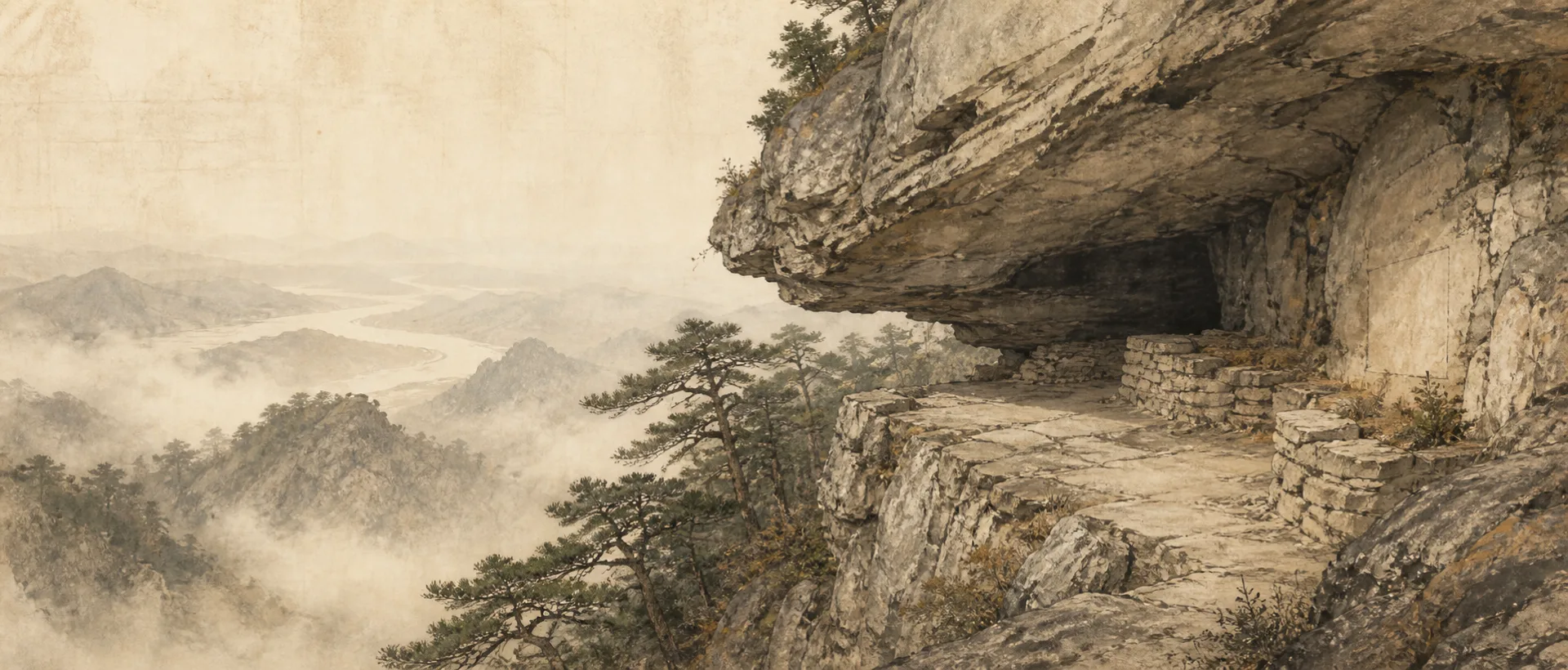
Yinxian Rock is one of the clearest examples of a Wudang “cliff” that is also a habitable rock shelter. The 1291 Wudang Fudi Zongzhen Ji calls it Yinxian Rock, Yin Immortal Rock and North Rock, places it above Zhuguan, and describes a high formation overlooking the Han River.
Evidence status: historically recorded and supported by physical evidence. The 1291 description, a later Ming building record and a dated cliff inscription documented by archaeologists in 2020 all connect religious use with the same named place. Stories about ancient immortals remain religious tradition, not independently verified biography.
Why Yinxian Rock has three historical names
The Yuan catalogue begins: “Yinxian Rock, also called Yin Immortal Rock, also called North Rock.” The three Chinese forms are 隐仙岩, 尹仙岩 and 北岩. They should not be expanded into three separate landmarks.
The first name means “Hidden Immortal Rock” and suits the site’s long association with withdrawal and mountain cultivation. The second changes the first character to the surname Yin, linking the place to Yin Xi and Yin Gui in the tradition recorded immediately afterwards. “North Rock” gives a relative position rather than a sacred identity.
Preserving all three names matters for search and historical reading. A reader may encounter any one of them in a gazetteer, inscription report or modern account.
Where historical sources place Yinxian Rock
The 1291 source places Yinxian Rock above Zhuguan, or Bamboo Pass. It describes a formation rising into cloud and mist with a view toward the Han River. Modern accounts commonly associate the rock with the area north of Wulong Palace.
These are relational descriptions, not survey coordinates. “Above” may describe the slope, a route sequence or both. The old text helps identify the wider setting, but it should not be turned into a precise visitor map pin without current field verification.
The page therefore explains the historical geography while avoiding an unverified walking route. Access conditions around remote rock shelters can change, and a path that appears on a travel post is not automatically an authorised public route.
Why Yinxian is a rock shelter as well as a cliff
Modern descriptions often call Yinxian a large cave, while the old catalogue groups it among Wudang’s 36 “yan.” There is no contradiction. In this context, yan can refer to an overhanging rock face, recess or cliff shelter suitable for occupation.
The shelter offered qualities valued by mountain practitioners: enclosure, a commanding outlook and separation from busy routes. At the same time, a usable retreat required foundations, roofs, water, fuel and a safe approach. The landscape was not a ready-made monastery; people adapted a difficult natural space.
This distinction also prevents a common error. The rock formation is older than any hall or room built within it. Construction dates describe human use, not the age of the cliff.
What the 1332 inscription at Yinxian Rock records
During a natural-landscape survey in June 2020, specialists from the Wudang archaeology research centre examined a weathered inscription on the rock wall and made a rubbing. Their reading dates it to the first day of the fourth lunar month in Zhishun 3, equivalent to 1332.
The inscription records that a donor identified as Mr Tan contributed fifty liang in paper money toward foundation work. It is an unusually concrete trace of economic and building activity: a named donor, a monetary contribution, a construction purpose and a date all appear together.
The discovery was reported through Chinese media rather than published there as a full archaeological study. The wording should therefore follow the specialists’ reported reading and remain open to refinement if a formal transcription is published.
What the inscription changes about Yinxian Rock’s building history
A Ming gazetteer, quoted in the archaeological report, records imperial construction at Yinxian Rock in 1412: three brick halls and three rooms for Daoist residents. Before the 1332 inscription was examined, that Ming record could look like the earliest firm construction date.
The inscription moves documented foundation work at the site back by about eighty years. It does not prove that any structure visible today dates from 1332, nor does it tell us the complete shape of the Yuan building. It proves that donors were financing construction at the named rock by that year.
This is why inscription evidence is valuable. A short practical record can correct the chronology without requiring a grand architectural claim.
How to read the traditions of Yin Xi and Yin Gui at Yinxian Rock
The 1291 text says that the ancient figures Yin Xi and Yin Gui lived at the rock and that later immortals refined elixirs there. It also mentions the more recent recluse Tian Suoyi. These statements show that Yinxian was already understood as a place of withdrawal and cultivation when the catalogue was compiled.
Yin Xi is famous in Daoist tradition as the guardian of the pass who received the Daodejing from Laozi. Connecting him to Wudang gives the mountain a place within a much larger sacred history. The tradition is culturally important, but the 1291 record was written many centuries after the period in which Yin Xi was said to have lived.
The responsible formulation is therefore precise: the text records a tradition associating Yin Xi and Yin Gui with Yinxian Rock. It does not independently prove their residence there as a modern historical fact.
What the stone chessboard and mysterious sounds mean in the Yuan account
The catalogue describes a stone chessboard beneath a large tree beside the rock, with stones arranged as seats. Tradition identified it as a place where Yin Gui played chess. The same passage speaks of ritual sounds in the stillness of night and of immortal visitors guarded by wild animals.
These details turn the shelter into a lived sacred landscape. A tree, a flat stone and nighttime sounds become signs through which readers imagine seclusion, companionship and the nearness of another realm.
They should be read as part of the text’s religious and literary register. A named stone may be a real feature, while the story attached to it expresses how the place was understood rather than functioning as an archaeological report.
What remains uncertain about Yinxian Rock today
The historical name and general location are well attested, and the 1332 inscription provides physical evidence for Yuan-period activity. The present condition, date and completeness of any surviving halls or residential rooms require a current architectural survey.
Likewise, this page does not claim that every feature named in the Yuan account can still be identified on the ground. Trees disappear, paths move, rock surfaces weather and names may shift between local traditions.
Current opening arrangements and route safety also need direct confirmation from the scenic-area or heritage-management authority. Absence from a standard visitor itinerary should not be treated as permission to enter a remote or protected area independently.
How to visit or study Yinxian Rock responsibly
If authorised access is available, treat the rock wall and its inscription as heritage evidence rather than a surface to touch, trace or photograph at close range without guidance. Rubbings should be left to qualified conservation and archaeology teams.
Stay on permitted paths, avoid unstable ledges and do not enter closed structures. Remote cliff shelters can combine loose stone, wet surfaces and limited mobile coverage even when a route looks short on a map.
For readers who cannot visit, the most useful approach is to compare the 1291 description, the reported inscription and the larger Wulong Palace landscape. This reveals how natural shelter, religious memory and practical building history meet at one site.
Sources and limits of this Yinxian Rock guide
The three names, position above Zhuguan, view toward the Han River, named figures and stone-chessboard tradition follow Liu Daoming’s 1291 Wudang Fudi Zongzhen Ji.
The 1332 inscription and the quoted Ming construction record follow a June 2020 report based on work by specialists from the Hubei Provincial Institute of Cultural Relics and Archaeology’s Wudang research centre. The media report supplies a specialist reading, but it is not a substitute for a full archaeological publication.
No exact coordinate, guaranteed access route or claim about the age of present structures is made here. Those details require current field evidence.
Key points about Yinxian Rock
Yinxian Rock, Yin Immortal Rock and North Rock are three historical names for the same formation.
The Yuan catalogue places it above Zhuguan and describes a high rock shelter overlooking the Han River.
A dated 1332 inscription records a paper-money donation for foundation work.
The inscription shows building activity about eighty years before the Ming construction record quoted in later reporting.
Associations with Yin Xi, Yin Gui, immortals and a stone chessboard are historically recorded traditions, not independently verified biographies.
Present access and the date of surviving structures require current official or field confirmation.
Continue exploring Yinxian Rock and Wudang’s western landscape
Return to the historical directory of Wudang Mountain’s 36 cliffs
Learn how Wudang’s terrain shaped temples, retreats and sacred routes
Read the guide to Wulong Palace and Wudang’s quieter outlying sites
Use the Wudang Mountain map and route guide for the wider landscape