Nanyan Palace at Wudang Mountain: Cliff Temple and Dragon-Head Incense
武当山南岩宫:悬崖宫观与龙头香
Nanyan, the Southern Cliff, is the most dramatic place on the mountain and the one that most reliably impresses visitors who have found the rest of the site merely interesting. It is also where the mountain's history turns uncomfortable, because the famous object here killed people for centuries and was eventually banned.
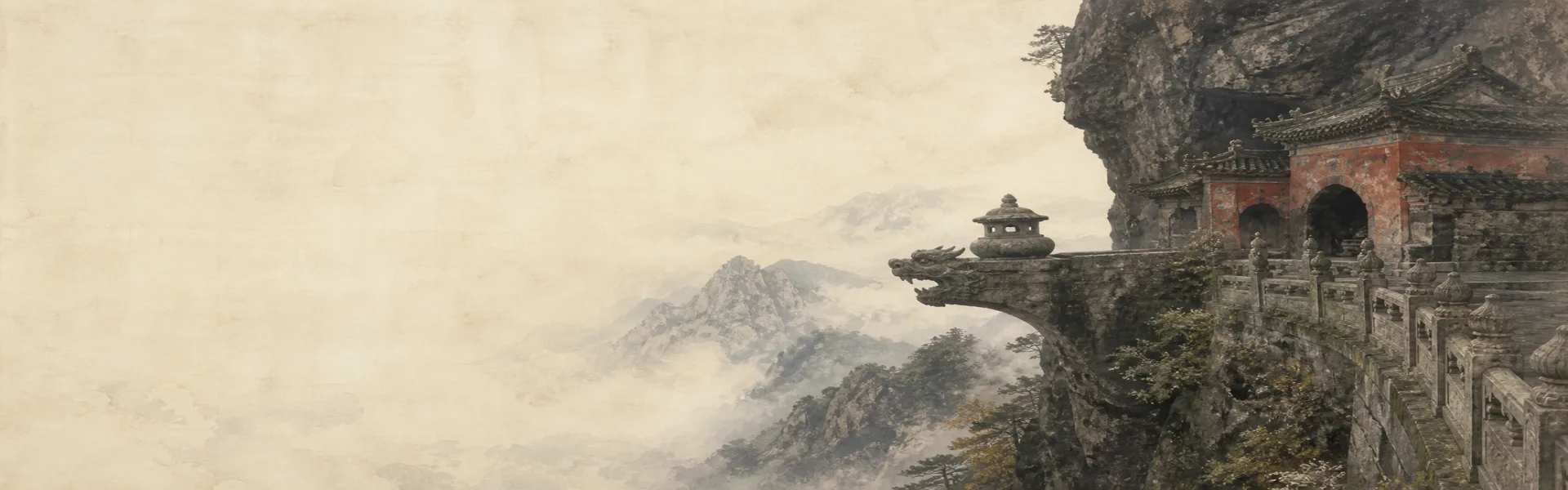
What is here
The complex occupies a south-facing cliff on the middle-to-upper mountain, and it is built along and against a sheer face with a very long drop below. There is a gateway approach, a group of halls set on the ledge, an early stone hall built directly against the rock, the projecting carved beam that made the place famous, and a set of associated sites a short distance away connected with Zhenwu's ascent.
The setting does most of the work. Where the mid-mountain palace persuades you by composure and correct siting, Nanyan persuades you by exposure. Buildings stand where there is barely room for them, the ground ends abruptly, and the view opens across a great deal of empty air. In cloud, when the drop is hidden and the halls emerge from grey, it is better rather than worse.
Building on a ledge
The engineering problem here was more severe than anywhere else on the central route, and the solutions are visible if you look for them.
There was no level ground, so terraces were constructed by building out from the cliff on masonry substructures, effectively manufacturing the site. Retaining walls do work that on an ordinary site would be done by the ground itself. Buildings are narrow, following the ledge rather than sitting on an axis, so the usual courtyard grammar is compressed or abandoned. Where the rock could carry load, it was used directly as foundation and in places as wall.
This is why Nanyan looks so different from every other complex on the mountain. Elsewhere the builders imposed a plan on the landscape; here the landscape dictated the plan, and the buildings string themselves along a line that the cliff decided. The result is the least regular and most memorable arrangement on the site.
The stone hall
The most important building here is a hall of the Yuan period, earlier than the Ming campaign, and it is built entirely of stone.
The reason is the position. A timber hall on an exposed cliff face, with lamps and incense burning inside it, in a place where firefighting is impossible and where wind and damp attack the fabric continuously, is a building waiting to be lost. Stone solved that, and the survival of this hall while timber halls around it burned is the argument in favour of the decision.
What makes it interesting architecturally is that the stone imitates timber. The members are carved to reproduce columns, beams, bracket sets and eaves of the kind that would be assembled in wood, even though stone does not require and does not naturally take those forms. This tells you something about Chinese architecture generally: the timber frame was so completely the idea of what a building is that when builders worked in another material, they copied the language of wood. You can see the same instinct in the bronze hall on the summit.
The Dragon-Head Incense Beam
Projecting horizontally from the cliff edge is a carved stone beam roughly three metres long, narrow, and unsupported at its outer end, with a censer carved at the tip. The sides are carved as dragons, which gives the object its name.
Beneath it there is nothing for a very long way.
Its purpose was to place incense at a point of maximum difficulty and maximum exposure. Pilgrims would go out along the beam, on hands and knees, to set incense in the censer at the end, and the value of the offering lay in the risk taken to make it. That logic is not peculiar to this mountain: costly and dangerous offerings appear across religious traditions, and a gift that risks nothing is understood to be worth less.
Today the beam is fenced off and you cannot go out on it, which is unambiguously the right decision.
Why it was banned
People fell. Not occasionally, but repeatedly, over a long period, and the deaths were an accepted feature of the practice rather than an accident that anyone expected to eliminate. Some of those who died were attempting the offering; the practice also attracted people who came intending to die there, treating the fall as a form of self-offering.
In the seventeenth century a senior Qing provincial official prohibited it and had a stele erected recording the prohibition. That stele is part of the site, and it is worth reading what it represents: a secular administrator overruling a religious practice on the grounds that it was killing people, at a site whose own clergy had not stopped it.
The episode is a useful corrective to a comfortable picture of Chinese religion as uniformly serene and life-affirming. Popular devotion here included a strand that valued danger, and the tradition contained both that strand and the authorities who suppressed it. Report both; do not tidy it.
The fire and what it cost
The principal hall of the complex was destroyed by fire in the 1920s, and the loss shapes what you see now.
This is the fate that stone was chosen to avoid, arriving exactly where predicted. Timber halls on this mountain have burned repeatedly across its history, and Nanyan's exposure — wind to fan a fire, no water, no access for help — made it among the worst places to keep a wooden building with open flame inside it.
What remains is therefore a mixture: the Yuan stone hall, historic masonry, terraces and carved stone, alongside rebuilt and reconstructed timber elements of much later date. When you find the site smaller or less coherent than photographs suggested, this is why.
Ascension Cliff and nearby
A short distance away are the sites associated with the culmination of Zhenwu's story: the cliff from which he is said to have ascended, and a small number of related spots including a projecting rock traditionally used to test resolve.
Their significance is narrative rather than architectural. This is the point in the designed ascent where the biography turns: the long cultivation is over and transformation occurs, immediately before the climb to the summit where he is worshipped as a god. If you are following the sequence deliberately, do not skip this in order to save time for the summit, because the summit means considerably less without it.
Note also the pattern repeated here: a dramatic natural feature, a story attached to it, and a practice built on the story. That is how most sacred sites on this mountain came into being.
Why the cliff was chosen at all
It is worth asking why anyone built here, given how difficult and expensive it was.
Part of the answer is the story: the ascent had to be commemorated where it was said to have happened, and the tradition placed it on this face. But the choice also follows a broader logic. Cliffs and caves were the classic settings for reclusive cultivation long before the Ming programme, valued precisely because they were hard to reach, exposed to the elements, and set apart from ordinary life. A ledge on a precipice is an unimprovable statement that the person living there has left the world of level ground.
Once such a place acquires a reputation, patronage follows, and patronage builds. The sequence at Nanyan is therefore the same as at many Chinese sacred sites: hermits first, then a shrine, then a state-funded complex whose scale has nothing to do with the solitude that made the place attractive in the first place. The final irony is visible on any busy day, when the cliff chosen for its remoteness carries a queue.
What is original
The stone hall is genuinely Yuan, and it is one of the most valuable single buildings on the mountain. Terraces, retaining walls, stairways, gateways, carved stone including the beam, and the prohibition stele are historic. Timber halls are substantially rebuilt following the fire and later works. Images are modern. Railings, safety measures, paving and viewing arrangements are contemporary and necessary.
The rule of thumb applies with unusual force here: what is stone is likely old, what is wood is likely new.
Practical information
Nanyan sits on the central route above the mid-mountain palace and is normally visited between it and the summit. Circulation is narrow, involves stairs, and passes close to drops with railings; it is not a good place to be hurried, in a crowd, or distracted by a phone.
Those uncomfortable with heights should know in advance that exposure here is real and largely unavoidable if you want to see the main features, though the approach and the halls themselves are safe and enclosed. Do not climb on or over railings, and do not attempt to reach the beam. Wind can be strong. Mist reduces the drama but not the interest, and reduces the danger. Photography rules vary and are sometimes restricted inside halls. As elsewhere, early is quieter.
Sources and limits. The Yuan date of the stone hall, the Ming expansion, the seventeenth-century prohibition and the twentieth-century fire follow the mountain's gazetteers and published studies; precise dates and the exact extent of loss vary between accounts. The dimensions of the beam are approximate. Accounts of deaths associated with the practice are reported in the historical record and in the prohibition itself but were not systematically counted. Access arrangements and safety provisions change and none are stated here.
Key points
Nanyan is the most dramatic complex on the mountain, built along and against a sheer south-facing cliff.
Terraces were manufactured out from the rock, so the cliff dictated the plan instead of a plan being imposed on the site.
Its most important building is a Yuan stone hall, built in stone because fire and exposure made timber untenable.
The stone is carved to imitate timber forms, showing how completely the timber frame defined what a building was.
The Dragon-Head Incense Beam projects about three metres over a very long drop, and the offering's value lay in the risk.
Pilgrims died there repeatedly, some deliberately, until a Qing official prohibited the practice and recorded it on a stele.
The principal timber hall burned in the 1920s, which is why the site is a mixture of Yuan stone and much later rebuilding.
Nearby Ascension Cliff is where the designed narrative turns, and skipping it weakens the summit.