A path into the reading
Inside a Wudang Temple Hall
How to enter, move, participate and photograph the space without disrupting its religious use
Start here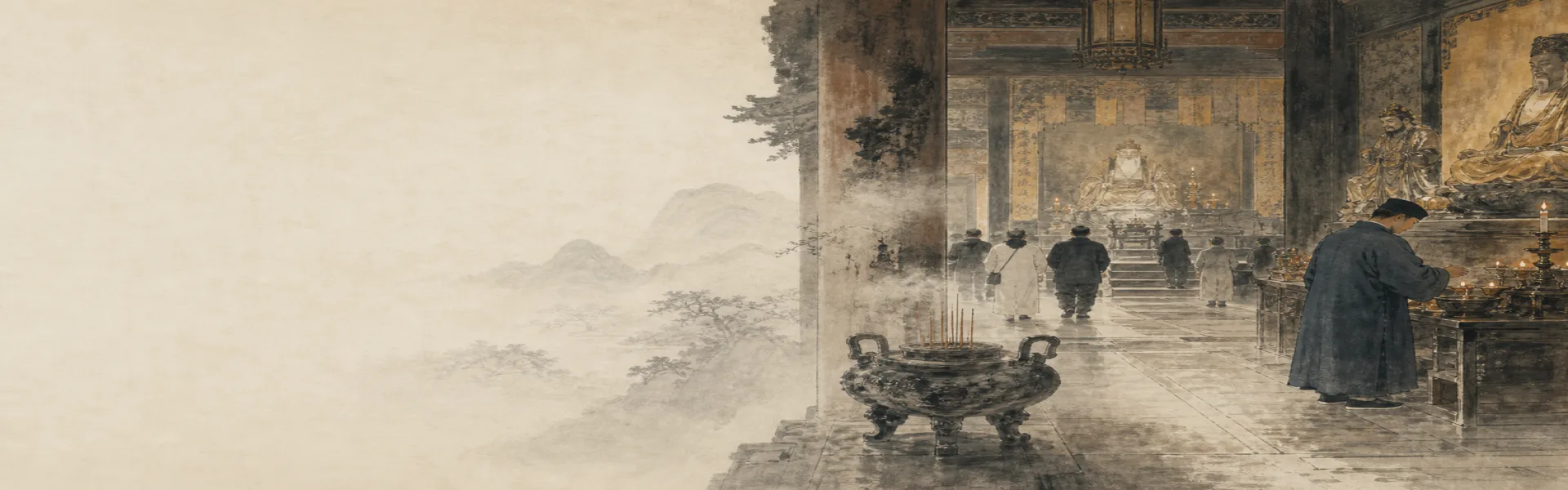
01 Find your bearings
Entering and Moving Around a Wudang Temple Hall
Doors, thresholds, the central line, worshippers and objects that should not be touched
Explore this sectionGo further
Deeper reading
- Entering and Moving Around a Wudang Temple HallDoors, thresholds, the central line, worshippers and objects that should not be touched
- Incense, Bowing and Offerings at Wudang TemplesHow visitors may participate, what the gestures mean and what is never required
- Photography and Respect in Wudang TemplesWhen to take photographs, when to stop and how to protect worshippers, services and heritage
The full guide
What should I know before reading further?
This page explains what is actually going on inside a Wudang hall. It starts with the layout, because almost every piece of temple etiquette follows from the geometry of the building rather than from a list of prohibitions, and once you can read the layout you can work out for yourself where to stand and what to leave alone.
Read more The complete guide
This page explains what is actually going on inside a Wudang hall. It starts with the layout, because almost every piece of temple etiquette follows from the geometry of the building rather than from a list of prohibitions, and once you can read the layout you can work out for yourself where to stand and what to leave alone.
How a Wudang temple is laid out
The organising principle is an axis. A Chinese temple of this kind is arranged along a straight line running from the entrance to the most important hall, with courtyards and gates strung along it and subsidiary buildings placed symmetrically on either side. What matters increases as you move along the axis, so the further in you go, the more important the building.
At Wudang this scheme meets a mountain, and the mountain wins. Level ground is scarce, so the axis is compressed, bent, or converted into a staircase, and courtyards become terraces stacked at different heights. The intention is unchanged and the execution is adapted. When a Wudang complex looks irregular, it is usually a standard plan negotiating a slope.
Inside a hall, the same logic applies in miniature. The principal figure sits at the back, facing the door, on the centre line. Attendant or subsidiary figures stand to the sides. An altar table in front of the figure holds incense burners, candles, offerings and ritual implements. In front of that there is usually a cushion or kneeler, and open floor space where people stand or a service is conducted.
Everything is symmetrical about that centre line, and the centre line is the point. It connects the door, the space, the altar and the figure, and it is the most important feature of the room.
Why the layout produces the rules
Once the axis is visible, the conventions stop being arbitrary and become obvious, which is far easier to remember than a list.
The central line is functional, so do not stand on it. Not because it is forbidden, but because it is the line along which a person bows toward the figure, and standing on it means standing in the way of whatever the room is for. Enter to one side, stand to one side, and cross the middle of the room briskly rather than lingering there.
The same applies to doorways. Where a hall has a central door and two side doors, the central one belongs to the axis. Using a side door is the ordinary habit and it costs you nothing.
The altar area is equipment in use, which is why nothing on it should be touched, moved or leaned on. This includes things that look decorative and things that look discarded. If it is on or near the altar, it has a function.
The cushion in front of the altar is not seating. It is the most commonly misused object in a Chinese temple, and the mistake is completely understandable, since it looks exactly like something to rest on. Assume anything at floor level in front of an altar is for kneeling.
And because the figure faces the door along the axis, the position that obstructs most is directly in front of it. If you want to look closely, do so from an angle. You will see the sculpture better anyway.
The three things visitors do inside
In practice, almost everything visitors do inside a hall falls into three activities, and all three are straightforward.
Looking. This is what most visitors come for and it requires nothing except staying out of the way. You may look at anything visible from the public floor for as long as you like. Standing quietly and examining a sculpture is never wrong.
Offering. Bowing, kneeling, incense and small offerings are available to anyone who wishes, and expected of nobody. Nobody will invite you and nobody minds if you do not. The relevant point is that a gesture performed without meaning it is not more respectful than not performing it, so there is no reason to imitate what you see out of politeness.
Photographing. This is entirely governed by local notices, which vary between temples and between halls in the same temple, and which override anything written here. Where photography is permitted, keeping it discreet and never photographing a person at worship covers the whole of it.
What visitors are not doing, and should not start, is handling. The commonest genuine offences are all forms of touching: picking something up to see what it is, running a hand over a carving, sitting on ritual furniture, or leaning on an altar table while looking at something above it.
When a service is in progress
Encountering a service is the most interesting thing that can happen to a visitor, and it needs almost no special behaviour.
You may stay and watch. Morning and evening rites are the fixed points of the temple's day, they are not performances and not scheduled for visitors, but they are generally not conducted in private either. Watching is ordinary.
Watch from the side or the back, never from the middle of the floor, and never between the clergy and the altar. Find a position, take it, and stay there rather than moving around, since movement is far more distracting than presence.
Silence is the one real requirement. Not whispering, which carries surprisingly well in a stone hall, but actual silence, and a phone that cannot ring.
Do not join in. Chanting and prescribed movement are the work of the resident community, and attempting to follow along is not participation but interference. Standing still is the correct form of attention.
If you arrive in the middle and decide to leave, do so quietly, from the side, without crossing in front of anyone. Leaving is fine; leaving through the middle is not.
Reading what is actually in the hall
A hall becomes considerably more interesting once you can read it, and the basics take a paragraph rather than a course.
Start with the central figure, since the hall is named for and organised around it. At Wudang, the figure you will meet most often is Zhenwu, recognisable by dark robes, a sword, bare feet, loose hair, and a tortoise and snake somewhere about him. He is the god of this mountain and its principal object of devotion.
Note that he is not the highest god. The Three Pure Ones and the Jade Emperor rank above him, and where they appear they will occupy the more important position. Zhenwu is a powerful officer with a defined portfolio, and the mountain is his rather than the pantheon's summit. Understanding this prevents a common misreading in which Wudang appears to be worshipping the supreme deity of Taoism.
Look at the material as well as the figure. Bronze, dressed stone and weathered joinery are generally old. Bright paint, crisp carving and machine-cut stone are generally recent. Most halls contain both, because most halls have been repaired repeatedly, and the mixture is the ordinary condition of a working building rather than a defect.
Read the inscriptions if you can, or photograph them where permitted. Boards above altars, stone stelae in courtyards and carved couplets on columns are the building telling you what it thinks it is, and they are frequently more informative than the interpretive signage.
The commonest mistakes, and how small they are
It is worth putting the risk in proportion, because anxiety produces more awkwardness than ignorance does.
The frequent errors are these: sitting on a kneeling cushion, standing directly in front of an altar while somebody waits behind you, walking through the middle of a service, photographing a person at prayer, touching a carving or an altar object, using a flash, and talking at outdoor volume indoors. That is close to the complete list.
None of these causes lasting offence and all of them are corrected by moving or stopping. If somebody indicates that you should not do something, they are giving you information rather than a rebuke. Adjust and continue.
The response that makes things worse is elaborate apology. It draws attention, prolongs the interruption, and turns a two-second correction into an event. Step aside, stop, and carry on looking at the building.
The pages that follow
Three pages take this in more detail. One covers entering a hall and moving around inside it: doors, thresholds, the central line, and what not to touch. One covers incense, bowing and offerings, describing how each is done for anyone who wants to, and making clear that none of it is required. One covers photography and physical respect, including what is generally acceptable, what is not, and why the answer always defers to local notices.
The whole of this section reduces to three habits: keep off the centre line, keep your hands to yourself, and follow the signs. Everything else is explanation.
Sources and limits: this page describes the general layout of Chinese temple architecture and common practice at working Taoist temples. Individual halls differ, and rules on photography, incense and access are set locally and change. Notices and instructions at any specific site always take precedence over anything written here. This page does not set out doctrine or prescribe religious practice.
Key points
- A temple is organised along an axis, with importance increasing as you move inward. At Wudang the axis is bent and stacked to fit the mountain.
- Inside a hall the centre line connects door, floor, altar and figure. It is functional, so stand to one side of it.
- Use a side door where there is one, and cross the middle of the room briskly rather than standing in it.
- Everything on or near the altar is equipment in use. Do not touch, move or lean on any of it.
- The cushion in front of an altar is for kneeling, not sitting. It is the most commonly misused object in a Chinese temple.
- Visitors look, offer or photograph. Looking requires nothing, offering is optional, and photography follows local notices.
- If a service is happening you may watch from the side or back in actual silence, but do not join in or cross the middle.
- The usual figure at Wudang is Zhenwu, in dark robes with a sword, bare feet and a tortoise and snake. He is powerful but not the highest god.
- Bronze, dressed stone and weathered timber are old; bright paint and crisp carving are recent. Most halls mix both.
- Mistakes are small and fixed by moving or stopping. A long apology is more disruptive than the error.
Recommended next page
Where next?
Incense, Bowing and Offerings at Wudang TemplesHow visitors may participate, what the gestures mean and what is never requiredA few alternatives