Photography and Respect in Wudang Temples
武当宫观拍照与礼仪分寸
Photography is the area where visitors most often go wrong, not through disrespect but because a camera changes how you move, where you stand and what you pay attention to. This page sets out what is generally acceptable, what is not, and why the answer always defers to the notice on the wall in front of you.
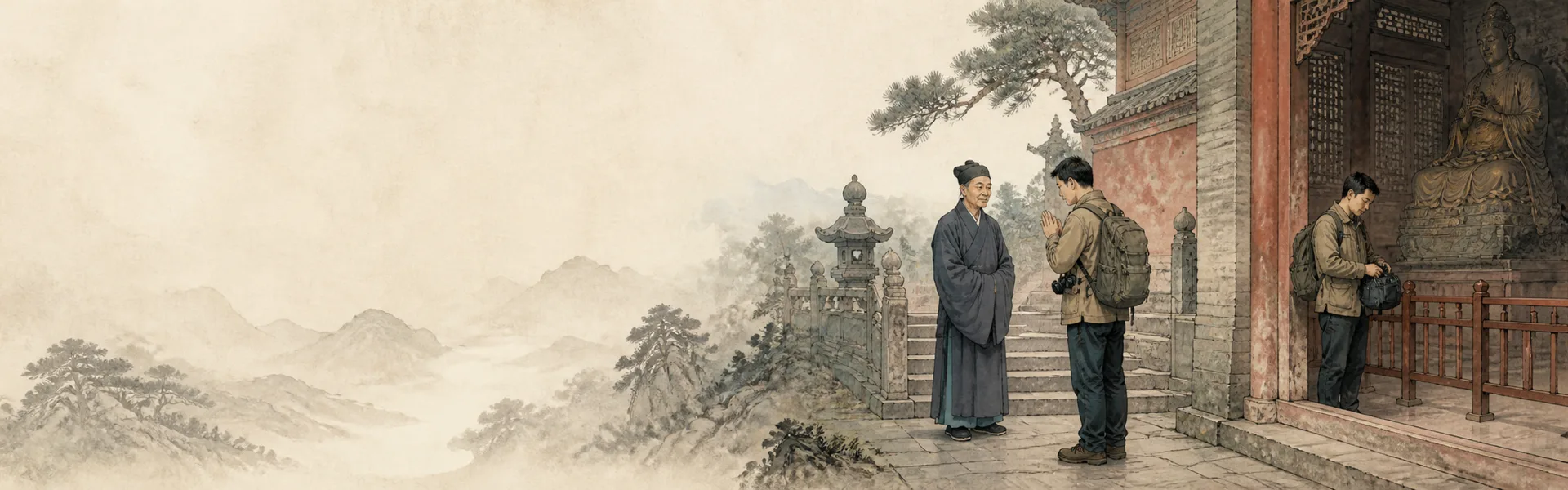
The general position
Photography is normal at Wudang. The site is a major visitor destination, cameras are everywhere, and nobody regards a tourist taking pictures as unusual or objectionable. You do not need to be furtive.
What varies is where. Outdoor photography of buildings, courtyards, views and architectural detail is almost always fine. Photography inside halls is sometimes permitted, sometimes restricted, and sometimes prohibited, and the restriction is set locally, hall by hall, with no consistent pattern you can rely on across the mountain.
The reasons for restriction are worth knowing because they make the rules feel less arbitrary. Some are conservation-based, since repeated flash exposure damages pigments and some sculpture and painting is genuinely fragile. Some are about the ritual use of the space, since a hall in active use is not a set. And some are practical crowd management, because a group posing in a doorway stops a hall from functioning.
The working rule is simple: look for a sign before raising a camera in a hall, and if you cannot find one and nobody else is photographing, assume not.
Inside halls
Assume restriction rather than permission indoors, and check.
Where photography is allowed, keep it discreet. No flash, whether or not a sign mentions it, since flash is the main conservation concern and the most intrusive thing you can do in a dim hall. Turn off shutter sounds. Take a few considered photographs rather than many quick ones.
Do not photograph from the centre line directly in front of an altar. This is the position that obstructs, and it is also not the best angle for a sculpture. Standing off to one side gives you a better photograph and inconveniences nobody, which is an unusually easy trade.
Do not move anything to improve a shot. Not a cloth, not a stand, not an offering, not a barrier. This is worth stating explicitly because the impulse to remove a small obstruction from a frame is very strong and it is the point at which photography becomes handling.
Do not walk backwards while framing. It is how visitors collide with altar tables and lamp stands, and it causes most of the actual damage that occurs in halls.
Do not use a tripod inside a hall without asking. It occupies floor space in a working room and reads as a production rather than a visit.
During a service
This is the clearest case and the one where visitors most often misjudge.
Do not photograph a service. Even where photography is otherwise permitted in that hall, a rite in progress is a different situation. It is the working activity of the resident community, not a performance, and a camera turns participants into subjects.
The temptation is considerable, because a service is visually the most striking thing you will see: robes, instruments, movement, incense, low light. Resisting it is the single clearest courtesy available to a visitor, and the memory is not diminished by the absence of a photograph.
If you are unsure whether what you are watching is a service, the absence of a photograph costs you nothing and the presence of one might cost somebody else something. Watch instead. Watching attentively is what the situation actually rewards.
If somebody indicates that you should stop, stop immediately and put the camera away rather than lowering it. Continuing at a reduced level is worse than stopping.
People
Photographing people requires more thought than photographing buildings, and the standard is the same one you would apply at home.
Do not photograph anyone at worship. Somebody kneeling, bowing, offering incense or praying is engaged in a private act in a public place, and a camera pointed at them is intrusive regardless of intention. This is the most common genuine offence committed by visitors at Chinese temples.
Do not photograph clergy without asking. They are working, they are not attractions, and being photographed constantly by strangers is a known irritation for anyone in visible religious dress. If you ask and they decline, that is the end of it. If you ask and they agree, keep it brief.
Ask before photographing individuals generally, and accept refusal gracefully. A gesture toward the camera and a questioning look communicates perfectly well without language.
Be careful with children, and be more careful than you would be at home. Photographing other people's children without a parent's clear agreement is unwelcome in China as elsewhere.
Crowds and general scenes are a different matter and are ordinarily fine. The distinction is whether an identifiable person is the subject.
Yourself in the photograph
Photographs of yourself are entirely normal, and a small number of positions are worth avoiding.
Do not pose with your back to a principal figure. It is the standard instinct, it is the position that blocks the axis, and it reads badly in a way that is easy to avoid by turning slightly and standing to one side.
Do not pose on, over or beside ritual equipment: the kneeling cushion, the altar table, incense burners, bells. Do not sit on anything you are not sure about.
Do not photograph yourself performing a devotional act. Bowing, kneeling or offering incense while a companion photographs you converts the gesture into a picture of a gesture, which is the one thing that genuinely does look disrespectful to onlookers.
Do not use a selfie stick in a crowded hall or on narrow stairs. This is a practical point as much as a courtesy: the routes at Wudang include long flights of steps with drops beside them.
Group photographs are fine in courtyards and best arranged out of the flow of people rather than in a gateway.
Drones
Assume you cannot fly a drone, and verify before considering otherwise.
Wudang is a protected heritage and scenic area, and unmanned aircraft are subject to national regulation in China as well as to local rules that may restrict or prohibit flight over the area entirely. Rules on registration, permitted airspace and operation change, and enforcement at managed sites is real.
Beyond legality, a drone over a working temple during a service or over crowded stairs is intrusive and hazardous in obvious ways. Even where flight is permissible, the site is often busy, mountainous, subject to sudden cloud and wind, and full of buildings that must not be struck.
If you intend to fly, that requires checking current national regulations and obtaining any local permission in advance, which is a process rather than a question you can resolve on arrival. This site cannot tell you the current position and does not attempt to.
Physical respect beyond the camera
Photography is one form of contact with a place, and the same principle governs the others: look as much as you like, handle nothing.
Do not touch sculpture, carvings, inscriptions, altar objects or painted surfaces. Skin oils accumulate, and a surface touched by a thousand visitors a year deteriorates measurably. This applies to the things that appear robust as much as the obviously delicate ones.
Do not lean on altar tables, railings, columns or door frames, and do not put a bag down on anything that is not a floor.
Do not take rubbings of stelae or carved boards, and do not run a hand over an inscription to read it.
Do not remove anything, including a fallen leaf from a courtyard tree, a fragment of tile, or a stick of incense from a bundle. The impulse to take a small physical memory is understandable and the aggregate effect of it is not small.
Do not climb on anything: platforms, bases, walls, railings, or architectural features. This is both a conservation matter and a safety one, since much of what looks climbable at Wudang has a considerable drop on the other side.
Why the local sign always wins
Every page in this section defers to local notices, and it is worth explaining why rather than simply repeating it.
Conditions change. A hall may be photographable one year and not the next because conservation assessment changed, or because a particular object was moved, or because visitor numbers rose. A section may be closed for repair, a service may be scheduled, or a temporary arrangement may be in force. None of that reaches a website.
Authority is also divided. The mountain is administered by secular authorities and the temples by a Taoist organisation, and the notices you see may come from either. Both are current and specific, and this page is neither.
So the hierarchy is straightforward: a sign, or an instruction from someone on site, outranks anything written here. If they conflict, follow the sign, and do not ask for an explanation. Compliance without argument is the entire expectation, and it is a very low one.
Sources and limits: rules on photography, drones, access and conduct are set locally and by national regulation, vary between halls and sites, and change without notice. Nothing here is a statement of current regulation, and drone operation in particular requires verification of current national and local rules in advance. Notices and instructions at any specific site always take precedence over this page.
Key points
- Photography is normal outdoors and variable indoors. Look for a sign before raising a camera in a hall, and if there is none and nobody else is shooting, assume not.
- No flash, no shutter sounds, no tripods without asking, and never move anything to improve a shot.
- Do not photograph from the centre line in front of an altar; standing to one side gives a better image and blocks nobody.
- Never photograph a service, even where the hall otherwise permits photography.
- Never photograph anyone at worship, and ask before photographing clergy or individuals. Accept refusal without argument.
- Do not pose with your back to a principal figure, on ritual equipment, or while performing a devotional act.
- Assume drones are not permitted; flight would require verifying current national and local rules in advance.
- Touch nothing: sculpture, carvings, inscriptions, altar objects and painted surfaces all degrade from accumulated contact.
- Take nothing away, and climb on nothing. Much of what looks climbable here has a drop behind it.
- A local sign or an instruction on site outranks this page. Follow it without needing a reason.