Incense, Bowing and Offerings at Wudang Temples
武当宫观的上香、叩拜与供品
This page describes how incense, bowing and offerings are actually done, for the benefit of anyone who wants to take part. It is written as description rather than instruction, and the most important thing on it is the opening section: none of this is required of you, and choosing to do none of it is entirely normal.
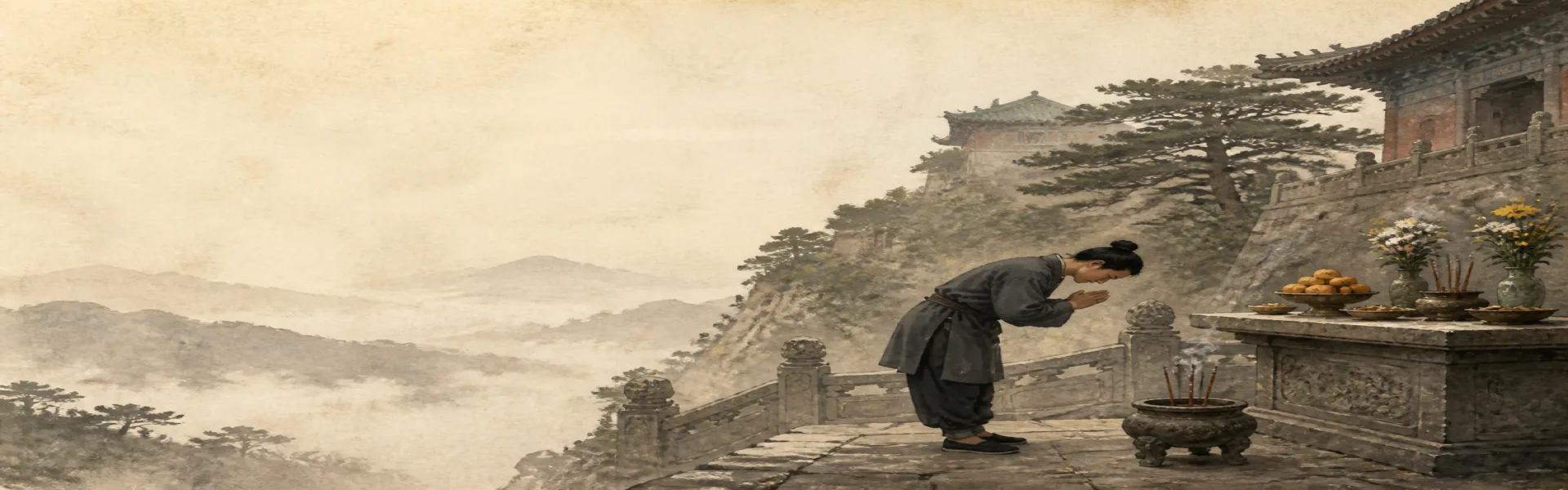
None of this is required
Nobody at a Wudang temple expects a visitor to bow, kneel, light incense or make an offering. You will not be invited to, nobody will notice that you did not, and there is no minimum contribution or gesture that entitles you to be there.
This is worth stating clearly because visitors often feel a vague obligation to do something, and then perform a half-remembered gesture out of politeness. That is the one approach worth avoiding. A gesture performed without meaning it is not more respectful than standing quietly; if anything it is less, because it treats a religious act as a courtesy owed to onlookers.
Standing still and looking is a complete and sufficient way to visit. A great many Chinese visitors do exactly that, and no distinction is drawn between them and anyone else.
The reason for describing the practices anyway is twofold. Some visitors genuinely want to participate and would rather not do it clumsily. And even if you never intend to, knowing what people are doing makes the hall considerably more interesting to watch.
The hand gesture
The gesture you will see most often is a hand position held in front of the chest, and it is worth understanding because it is the one thing visitors most often copy incorrectly.
In Taoist practice the hands are not placed palm to palm in the way common in Buddhist contexts. A frequent form has one hand loosely enclosing or covering the other fist, held at chest height, sometimes with a slight bow of the head. The details vary between traditions and between occasions, and clergy use more specific forms in ritual that a visitor has no reason to attempt.
The practical point is the distinction. Pressing your palms together is the gesture of a different tradition, and while nobody will object, it does signal that you are reproducing a general idea of piety rather than the local one. If you want to make a gesture, the loose enclosing form with a slight nod is closer, and if you are not sure, a simple small bow of the head with your hands at your sides is unambiguous and always acceptable.
Do not attempt the more elaborate ritual hand forms used by clergy during a service. They carry specific meanings within the rite and imitating them from the visitor's floor is not participation.
Incense, and what it is for
Incense is the most visible act of devotion at a Chinese temple, and knowing roughly what it does makes the practice legible rather than merely picturesque.
Offering incense is an act of respect and communication directed at a specific figure. It marks that you have come, it accompanies a request or a thanksgiving, and it functions as the ordinary currency of interaction between a person and a deity. The smoke rising is the plain image behind it: something sent upward from where you are to where the figure is.
Quantity is not devotion. There is a widespread assumption among visitors that more incense means more sincerity, which produces enormous bundles burnt at once. Local practice is generally modest, usually three sticks, and modesty reads better than volume. Conservation concerns have also made large-scale burning increasingly unwelcome inside halls.
Incense is not required in order to bow, to make a request, or to visit. It is one available form, not a ticket.
How it is done
If you want to offer incense, the sequence is simple and there is no need to be precise about it.
Buy incense locally, near the temple where you intend to use it. Take a small number of sticks rather than a bundle. Light them at the designated flame, which is normally provided; do not light them from a candle on the altar or from another person's sticks unless that is obviously local practice.
Hold them together in both hands at about chest height, with the burning ends away from you and away from other people. Face the figure, and bow the head or bend slightly from the waist. If you have something to say, say it silently. Then place the sticks upright in the burner, which is usually in a designated brazier outside the hall or at a specified place rather than inside.
Two practical cautions. Lit incense in a crowded hall burns other visitors' clothing regularly, so keep the burning ends pointing away and down at your side while walking. And follow the local arrangements about where burning is permitted, which increasingly restrict it inside halls for the sake of the buildings.
If you get the order of any of this wrong, nothing happens. There is no invalidating error available to a visitor.
Where to buy incense
Incense is sold at and near the temples, and this is where to buy it rather than bringing it from home or from the town below.
Buying it on site is simpler, means you get an appropriate kind and quantity, and directs the small amount of money to the place you are visiting. There is no need to seek out anything special; the ordinary bundles sold at the stalls are what everyone uses.
One thing worth being alert to. Around busy sites anywhere in China, you may encounter someone offering incense, a blessing, an amulet or a service with an unclear price, followed by pressure to pay a large amount. This is a straightforward commercial tactic and it is not connected to the temple. Buy from a normal stall or from a temple counter, establish the price before taking anything, and decline anything unsolicited. Clergy do not approach visitors to sell things.
If you would rather contribute money than burn anything, a donation box serves the purpose, and it is discussed in more detail on the page about money and donations.
Bowing and kneeling
Bowing runs from a small nod to a full prostration, and every point on that range is normal. Nothing obliges you to any particular depth.
The simplest form is a standing bow: face the figure, hands together in front of the chest in the loose enclosing form, and bend the head or the upper body slightly. This is what most casual visitors do and it is entirely sufficient.
The fuller form uses the cushion in front of the altar. A person kneels on it, bows forward with the hands to the floor, and may repeat this a number of times before standing. This is the ordinary devotional act and it is done by a large proportion of Chinese visitors without ceremony or self-consciousness.
Three practical notes. The cushion is for kneeling, which bears repeating because sitting on it is the most common visitor error in Chinese temples generally. If somebody is waiting to use it, step away rather than pausing in front of it. And if you kneel, do not photograph yourself doing it, which converts the act into something else.
If you have knee or back trouble, a standing bow is not a lesser version of anything. Nobody is assessing form.
Offerings
Physical offerings are common and modest, and the range is narrower than visitors expect.
Typical offerings are fruit, flowers, oil for lamps, and money placed in a box. Food offerings are usually simple and are placed on the altar table by temple staff or by the person offering where that is the local arrangement. Nothing extravagant is expected and extravagance is not a virtue here.
Do not place anything on an altar yourself unless you have seen others doing it or been shown where. When unsure, hand it to staff or use the designated place; if there is no obvious way to do it, a donation box is always available and always acceptable.
Do not offer meat or alcohol at a Taoist temple of this kind unless you know it is appropriate to a specific practice. Monastic Quanzhen communities are vegetarian, and this is one of the few offerings that would be genuinely out of place.
Do not bring offerings from your own country as souvenirs to leave. The impulse is generous and the result is clutter that somebody has to remove.
Drawing lots and making vows
Two further practices are visible at Wudang and are worth explaining, since they are frequently misread.
Divination lots are a common temple practice: a person kneels, asks a question, and draws a numbered stick from a container, or uses paired blocks to obtain a yes or no. The number corresponds to a written verse, which is interpreted, often with help. This is ordinary devotional activity rather than fortune-telling entertainment, and it is not something to try casually with somebody else's equipment. If it is offered as a service to visitors at a counter, that is a different matter and the price should be clear before you begin.
Making a vow is the other. A person asks for something and undertakes to do something in return, commonly returning to give thanks, making a contribution, or performing a specific act if the request is granted. Much of the traffic at a mountain like this over the centuries has consisted of people fulfilling such undertakings. It explains a great deal about why people climb a very large number of steps.
Neither practice is aimed at visitors, and neither requires anything of you. Knowing what they are simply means you can recognise what is happening in front of you rather than seeing a queue.
If you would rather do none of it
This is the ordinary case and deserves its own closing note, because the whole page can otherwise read as a set of options you ought to choose from.
You can visit a Wudang temple, spend an hour there, look at everything, watch a service from the side, and leave without making a single gesture or giving anything. That is a complete visit. The building was built to be entered, and entering it attentively is the whole of what is asked.
If you want to mark the visit somehow without performing a religious act, the available options are unremarkable and real: put something in a donation box, buy something from the temple's own counter if there is one, be unhurried, and be quiet. None of these implies belief and all of them are useful to the place.
Sources and limits: this page describes practices as commonly observed at working Taoist temples, in general terms. Forms of gesture, incense use and offering vary between traditions, regions and individual temples, and local arrangements govern where burning and offering are permitted. Notices and instructions at any specific site always take precedence. This page describes practice and does not set out doctrine or prescribe religious observance.
Key points
None of this is required. Standing quietly and looking is a complete visit, and a gesture performed without meaning it is not respect.
The Taoist hand form loosely encloses one hand with the other at chest height, rather than pressing palms together.
Do not attempt the elaborate ritual hand forms used by clergy during a service.
Incense is an act of respect and communication. Quantity is not devotion, and three sticks is ordinary.
Light at the designated flame, hold burning ends away from people, and place sticks where local arrangements indicate, usually outside the hall.
Buy incense on site, agree a price first, and decline anything unsolicited. Clergy do not approach visitors to sell things.
Bowing ranges from a nod to a full prostration and all of it is normal. The cushion is for kneeling, not sitting.
Usual offerings are fruit, flowers, lamp oil and money. Do not offer meat or alcohol, and do not place things on altars yourself.
Drawing lots and making vows are ordinary devotional practices, not entertainment, and explain much of the traffic on the mountain.
If you want to mark a visit without a religious act: use a donation box, buy from the temple counter, and be unhurried and quiet.