Entering and Moving Around a Wudang Temple Hall
进入武当宫观殿堂与殿内走动
This page covers the mechanics of being inside a hall: which door to use, what to do at the threshold, where to stand, and what to keep your hands off. None of it is difficult, and all of it follows from one feature of the building, so the fastest way to learn it is to understand that feature rather than memorise the consequences.
The axis, and why it explains everything
A hall of this kind is symmetrical about a central line that runs from the door, across the floor, to the altar and the principal figure behind it. That line is not decoration. It is the working part of the room.
Everything happens in relation to it. A person who comes to worship stands on it, faces along it, and bows or kneels on it. The cushion sits on it. The incense burner sits on it. The figure sits at the end of it, facing back down it toward the door. If you understand that a line runs through the room and is in constant use, you can derive nearly every convention on this page without being told.
The practical rule that follows is a single sentence: stay off the centre line, and you will be right about doors, standing positions, photography angles and how to cross the room. That one habit does more work than a list of twenty prohibitions.
It also explains why the conventions are not fussy. They are not about ritual purity or hierarchy of persons; they are about not standing in a corridor that somebody else is using.
The doors
Larger halls typically have three doorways on the front elevation: a central one and one on either side. The central one belongs to the axis.
Use a side door. This is the ordinary habit rather than a prohibition, and it is what most Chinese visitors do without thinking about it. If the hall has only one door, use it, and the question does not arise.
There is a widely repeated convention about entering by one side and leaving by the other, sometimes explained in terms of directions or the movement of qi. It varies between places and traditions and is not worth worrying about. Any side door is fine, and consistency matters more than which side you chose.
Do not stop in a doorway. Doorways in these halls are narrow, often raised, and frequently the only way in and out, and standing in one to take a photograph or check a map blocks the whole hall. Step through, then stop.
The threshold
Chinese buildings of this type have a raised wooden or stone threshold in the doorway, and it is treated as part of the structure rather than as floor.
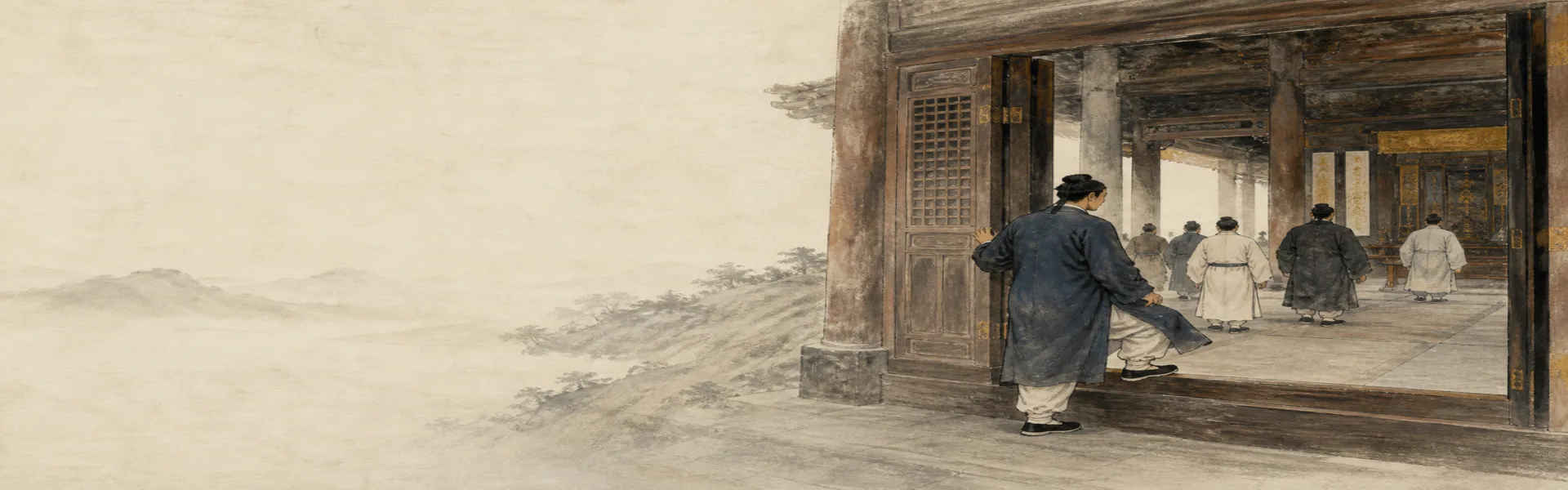
Step over it rather than on it. This is a general Chinese architectural convention, not specific to temples or to Taoism, and it applies in old houses and city gates as much as here. Nobody will stop you if you tread on it, and it is a small courtesy that is easy to keep.
Watch your footing while you do. Thresholds at Wudang are often high, the light changes sharply as you enter, and the step down on the far side is not always the height you expect. More visitors come to grief on thresholds than on anything else inside a hall.
Some halls or particular inner spaces may ask you to remove shoes. This is not general practice at Wudang, but where it is indicated, do it, and this is one reason to wear shoes you can take off without sitting down.
Moving around inside
Once inside, the geometry does the work again.
Move around the edges. Walk along the sides of the room rather than through the middle, and if you must cross the centre, cross it and keep going rather than pausing there.
Stand to one side to look. You will see a sculpture better from an angle than head-on, so this costs you nothing. The centre position directly in front of an altar is the one place where you will inconvenience somebody without noticing.
Give way immediately and without ceremony to anyone who appears to be worshipping. Step aside, wait, carry on. Do not make an event of it, and do not apologise at length; the person is concentrating on something else.
Keep your voice low. Stone and timber halls carry sound extremely well, and a normal conversational volume that seems fine near the door is audible throughout. Whispering carries too, which surprises people; the answer is fewer words, not quieter ones.
Turn your phone to silent before you go in, not when it rings.
Do not walk backwards to frame a photograph. It is how people collide with altar tables, lamp stands and other visitors, and it is the single most reliable way to cause actual damage in a hall.
What not to touch
Handling is the category that produces real problems, and the rule is broader than most visitors assume.
Do not touch anything on or near the altar. Incense burners, candles, lamps, bells, wooden implements, cloth covers, offerings of fruit or flowers, boxes, sticks, and anything that looks decorative or discarded. If it is in the altar area it has a function, including the things that look like they do not.
Do not touch the figures. Not the sculpture, not its clothing, not its hands, not the platform it stands on. In some traditions touching a particular image is a devotional act; assume it is not here unless local practice is obviously otherwise.
Do not sit on ritual furniture. The cushion in front of the altar is for kneeling. Low benches and stools inside halls generally belong to the clergy or to the service. If you need to sit down, do it in the courtyard, on a step, or on something obviously provided for resting.
Do not lean on anything. Altar tables, railings around sculpture, columns with carved or painted surfaces, and painted timber generally. Leaning transfers hand oils and body weight to surfaces that are old and were not designed for it.
Do not handle inscriptions or take rubbings. Stelae and carved boards are among the most valuable things on the site and among the most easily damaged by repeated contact.
And do not move anything to see it better, or to photograph it without something in the way. This includes small items, cloths, and stands.
Pointing, and other small gestures
A few habits of gesture are worth adjusting, and they are minor but easy.
Do not point at figures with a single finger. In Chinese social usage pointing directly at a person with one finger is rude, and the convention extends to images of gods. Indicate with an open hand instead, which is the ordinary alternative and looks entirely natural.
Do not stand with your back to the principal figure to be photographed. This is worth stating because it is such a common instinct, and because the resulting position is exactly the one that blocks the axis.
Do not put your hands on your hips or fold your arms while standing in front of an altar, particularly during a service. This is a small thing, and it reads as it would anywhere.
Do not eat or drink inside a hall. Water in a courtyard is fine; eating is not, and this includes finishing something you started outside.
Do not smoke anywhere on a temple site. Beyond courtesy, these are timber buildings on a mountain and fire is the standing threat to them.
Incense, if you offer it
Incense is entirely optional, and this page covers only the practical points relevant to moving around a hall. If you do offer it, three things are worth knowing.
Buy it locally rather than bringing it, and buy it near the temple where you intend to use it. Braziers are usually outside or in a designated place rather than inside the hall.
Where incense is lit and where it is placed are both governed by local arrangements, which increasingly restrict burning inside halls for conservation reasons. Follow the signs and follow what other people are doing.
Do not light incense from a candle on the altar or from someone else's sticks unless that is obviously the local practice. There is normally a designated flame.
And carry lit incense pointing away from other people and away from anything hanging. Crowded halls plus lit sticks is how visitors burn each other's clothing.
If a service is happening
The rules for moving around become simpler rather than harder, because the correct behaviour is to stop moving.
Take a position at the side or the back and stay in it. Do not circulate, do not change position for a better view, and do not move to the other side of the hall. Presence is unobtrusive; movement is not.
Never pass between the clergy and the altar, and never cross the centre of the floor.
Maintain actual silence, and do not attempt to join the chanting or copy the movements. Standing still is the correct form of attention and is what most Chinese visitors do.
If you want to leave, leave quietly by the side, without crossing in front of anyone. You are free to go at any time; the only requirement is that you do it without becoming the thing people notice.
Sources and limits: this page describes common practice at working Taoist temples and general conventions of Chinese temple architecture. Individual halls differ, conventions vary between regions and traditions, and rules on shoes, incense and access are set locally and change. Notices and instructions at any specific site always take precedence over anything written here.
Key points
- A hall is symmetrical about a working centre line running from door to figure. Stay off it and most conventions follow automatically.
- Use a side door where there are three, and never stop in a doorway.
- Step over the raised threshold rather than on it, and watch your footing while doing so.
- Move around the edges, look from an angle, and cross the centre briskly if at all.
- Give way to anyone worshipping immediately and without ceremony.
- Keep voices low, phones silent, and never walk backwards to frame a photograph.
- Touch nothing on or near the altar, do not touch figures or inscriptions, do not sit on ritual furniture, and do not lean on anything.
- Indicate with an open hand rather than pointing, and do not eat, drink or smoke on site.
- If you offer incense, buy it locally, use the designated flame and place, and carry lit sticks away from people.
- During a service, take one position at the side or back, stay silent and still, do not join in, and leave by the side if you go.