Mozhen Well and Taizipo at Wudang Mountain
武当山磨针井与太子坡
These are the first two sites of consequence on the ascent, and they belong together because both concern the beginning of Zhenwu's story rather than his attainment. One is small and matters entirely for its story; the other is one of the most ingenious pieces of architecture on the mountain. Together they set up the narrative that the rest of the climb completes.
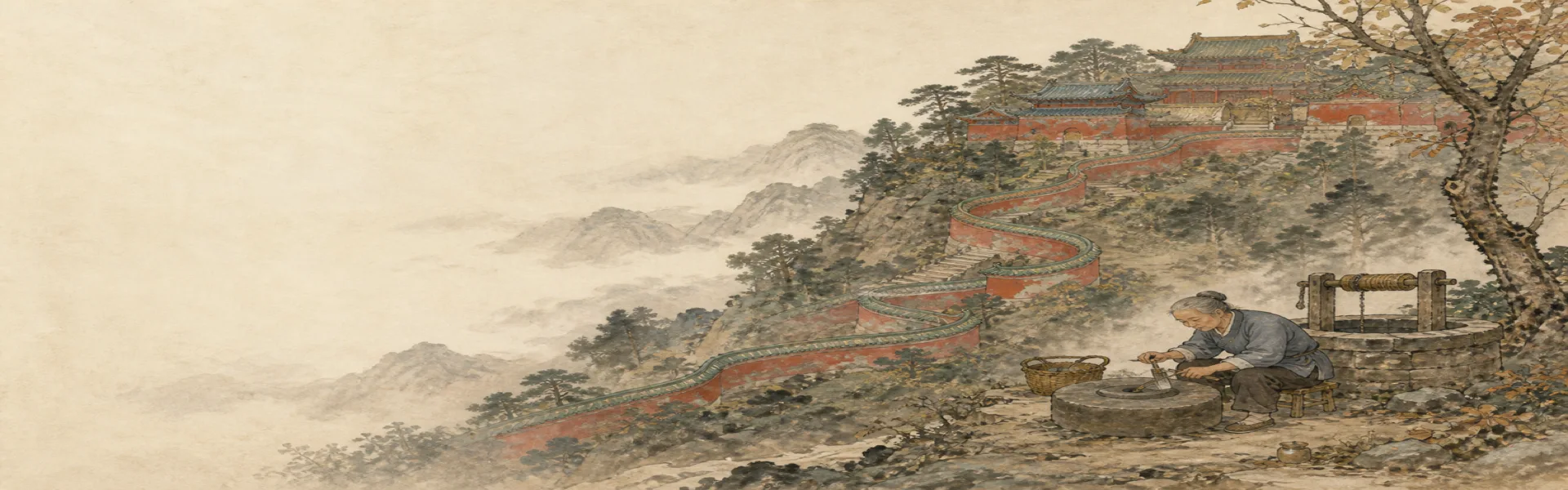
Mozhen Well
Mozhen Well, the Needle-Grinding Well, is a modest walled complex low on the mountain, also known by a second name honouring a famous immortal. It is quickly seen and easily dismissed, and it should not be, because it is where the whole sequence starts.
Inside there is a small hall, a well, and — the point of the place — two iron bars set up for visitors to see, together with an image of an old woman at a grindstone. The buildings are not architecturally important and are largely later work. What is here is a story rendered in objects, which is a very Chinese way of using a site: the narrative is the exhibit.
The story and what it means
The young prince, having left his palace to cultivate on this mountain, grew discouraged and started back down. On the way he met an old woman grinding an iron bar on a stone. He asked what she was doing. She said she was making a needle. He objected that this was absurd, that an iron bar could never become a needle. She answered, in the version everyone remembers, that if she ground long enough it certainly would — and that his own case was no different. He understood, turned around, and went back up.
The woman is not an ordinary villager. In the tradition she is a deity in disguise, sent to test and redirect him, and she is honoured in the hall accordingly. This detail matters: the story is not about folk wisdom encountered by chance but about the celestial administration intervening in a candidate's training, which is exactly how that administration is imagined to work throughout Chinese religion.
The story is late, belonging to the literary elaboration of the hagiography from the Song onward rather than to any early stratum, and the site was named for the story rather than the story arising from the site. Knowing that does not diminish it. It tells you that the mountain and the biography were built to fit each other, and it explains why the lowest significant site on the ascent is about perseverance: the designers put the lesson about not giving up at the point where a climber has just begun and is not yet tired.
Taizipo: Fuzhen Temple
Higher up is Taizipo, the Prince's Slope, whose formal name means something close to the Temple of Returning to Perfection — a reference to the prince turning back to his practice. It was built in the Ming programme in 1412 and substantially repaired under the Qing in the later seventeenth century, and it is the first place on the ascent where the ambition of the whole project becomes obvious.
The site is a steep hillside with essentially no level ground, which for a Chinese courtyard building is close to a contradiction in terms. Chinese religious architecture is organised around courtyards on a flat axis; here the builders had to produce that experience on a gradient. Their solution was to terrace the slope and stack the courtyards up it, so that you climb from one enclosure to the next and the axis rises with you. The result is a building complex that behaves like a normal temple in plan and like a staircase in section.
The four wonders
Local tradition summarises the site with a list of four features, and it is a genuinely useful summary rather than tourist patter.
The nine-bend wall, a long undulating enclosure wall along the approach. One pillar carrying twelve beams, a structural tour de force inside the upper building. Four gateways within a short distance, punctuating the ascent through the complex. And the scent of osmanthus said to carry for a great distance, which is the one item on the list that is seasonal and atmospheric rather than architectural.
Lists of this kind attach to many Chinese sites and are worth taking seriously as evidence of what visitors historically noticed. Three of these four are about how the building handles the slope, which confirms that the difficulty of the site was recognised as its distinction.
The Nine-Bend Yellow River Wall
The approach runs beside a high wall that curves back and forth as it climbs, red-plastered and tile-capped, named for the great river's meanders.
It is doing several things at once. Structurally it retains the hillside and manages water on a slope where uncontrolled runoff would undermine everything. Practically it eases the gradient, because a path that traverses is easier than one that goes straight up. And experientially it withholds the destination: because the wall bends, you cannot see where you are going, and the complex is revealed only in stages. That is precisely what a sequence of courtyards does on flat ground, achieved here with a single wall on a hillside. It is the clearest lesson on the mountain in how the designers converted difficulty into effect.
One pillar carrying twelve beams
Inside the tall building at the upper part of the complex is the feature everyone comes for: a single central timber column into which twelve beams are framed, carrying the floor structure above.
The reason for it is the same as the reason for everything else here. There was not enough level ground for a normal grid of columns, so the load had to be gathered onto one point where the ground could take it. Chinese timber framing, which joins members by carpentry rather than fasteners, made this possible, but it is nonetheless an extreme solution and it is admired precisely because it is extreme.
Look at it as engineering rather than as a curiosity. The interest is in how the joints are cut so that twelve members can meet at one column without destroying it, and in the fact that this was done in a building that has stood on an unstable slope for centuries.
Walking through the complex
The sequence inside is worth following deliberately rather than wandering, because the order was designed.
You enter past a screen wall and through a gateway into the lowest courtyard, where a guardian hall holds the martial protectors who belong at the threshold of a Taoist temple. From there the axis climbs. Successive gateways mark stages, each one a threshold that in a flat temple would be a courtyard wall, and each one narrowing the view ahead. The tall multi-storey building higher up is where the famous framing is, and it is also where you get the clearest sense of how much vertical distance the complex covers. Above that are the halls dedicated to Zhenwu in his princely aspect and to scripture, at the top of the composition.
Two things repay attention as you go. First, look back down, not just up: the views across the courtyards from above are how the composition was meant to be appreciated on the descent. Second, notice how small the individual courtyards are compared with a flat-site temple of similar rank. The builders kept the sequence of enclosures at the cost of their size, which tells you which of the two mattered more.
What is original
Be careful here, as everywhere on the mountain. The site's layout, its terraces, its retaining and enclosure walls, and its stone are substantially historic, and the essential structural achievement is real. The timber buildings have been repaired and partly rebuilt repeatedly, notably in the Qing, and paintwork, tiling, fittings and most images are modern renewals.
So what you are looking at is an authentic Ming site plan with an authentic response to the slope, carrying buildings of mixed date. That is the normal condition of Chinese religious architecture and it is not a disappointment once you know how to read it.
Practical information
Both sites sit on the main ascending route below the mid-mountain palace and are normally taken in order on the way up. Mozhen Well needs very little time; Taizipo needs more than most people give it, and the upper part of the complex is where the interest is, so do not stop at the first courtyard.
The approach involves stairs, and the interior circulation involves more, so it is not a level site. Interiors are dark, which matters if you want to see the framing; photography rules vary and are sometimes restricted inside halls, so look for notices and ask rather than assume. Because this is a working religious site as well as a monument, keep your voice down and give way to anyone at worship. Provisioning is limited, and the site is quietest early.
Sources and limits. Descriptions follow published architectural and conservation material on the site together with the mountain's gazetteers. Construction and repair dates are as generally reported; the extent of Qing and later rebuilding varies building by building and is not always documented in detail. The needle-grinding story is reported as a late element of the hagiography. The traditional list of four features is local tradition. No opening arrangements, fees or photography rules are stated here, since all change.
Key points
These are the first significant sites on the ascent and both concern the beginning of Zhenwu's story, not his attainment.
Mozhen Well is architecturally minor and matters entirely for the story preserved there in objects.
The old woman grinding an iron bar into a needle is a deity in disguise, not a chance encounter with folk wisdom.
The story is a late literary element, and the site was named for it rather than the reverse.
Taizipo, formally the Temple of Returning to Perfection, was built in 1412 and heavily repaired under the Qing.
Its achievement is producing courtyard architecture on a slope with no level ground, by terracing and stacking enclosures.
The nine-bend wall retains the hill, eases the gradient and withholds the view, doing the work of a courtyard sequence.
One pillar carrying twelve beams gathers the load onto a single point because the ground allowed nothing else.