Feng Shui Compass School: How the Luopan Is Used
风水理气派:罗盘如何用于方位判断
Where the Form School reads the visible shapes of the land, the Compass School reads direction. It holds that the orientation of a building—which way it faces, and how its parts align with the points of the compass—determines how it meets the flow of qi, and that the auspicious or inauspicious character of each direction can be calculated from the trigrams, the Stems and Branches, the Five Phases, and often the dimension of time. Its signature instrument is the luopan, the geomantic compass, and its methods are the most technical and calculation-heavy part of Feng Shui. This page describes the compass, the main directional systems, and how the school works in practice.
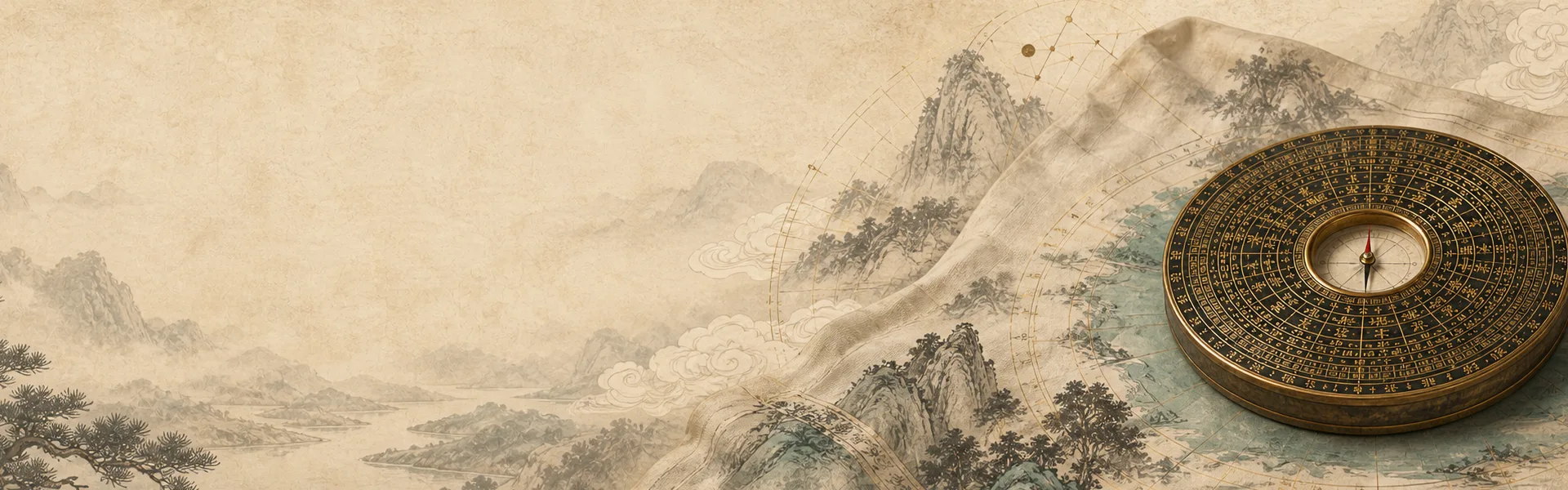
The luopan
The luopan (罗盘) is a magnetic compass elaborated far beyond the simple needle. At its center sits the magnetic needle in a small well, the “heaven pool,” and around it are arranged concentric rings, each carrying a system of correspondence. The number of rings varies with the compass and the school; a full professional luopan may carry dozens. The innermost rings usually give the eight trigrams and the basic directions; further rings give the twenty-four directions or “mountains,” made by dividing the circle into twenty-four sectors of fifteen degrees each and naming them with the eight trigrams‘ associated characters, the Stems, and the Branches. Still further rings carry the sixty jiazi, phase attributions, degree markings, and the special data required by particular directional systems.
The twenty-four mountains
The twenty-four directions, or twenty-four mountains, are the working grid of the Compass School. Because the twelve Earthly Branches alone would give only twelve sectors, the system adds eight of the Heavenly Stems and four of the trigrams to reach twenty-four, so that each fifteen-degree sector has a name drawn from the shared vocabulary of Chinese cosmology. A practitioner takes a bearing on a building’s facing or sitting direction, reads which of the twenty-four mountains it falls in, and then interprets that direction through the rings of the luopan. The precision of the instrument—dividing the horizon into twenty-four named sectors—is what allows the fine directional judgments the school is known for.
Competing directional systems
Several distinct directional systems developed within the Compass School, and they can give different and even conflicting advice, which is one reason the tradition is complex. One widely used system assigns each person a personal trigram based on their year of birth and sex, sorting people into an “east group” and a “west group,” each with four auspicious and four inauspicious directions; a dwelling and its key features are then judged by how they align with the occupant’s favorable directions. Another major family of methods, sometimes called the Flying Star system, adds time to space: it assigns numbers to the nine directions of a building according to its construction period and facing, and tracks how these “stars” move through cycles of years, so that a building’s fortune is read as changing over time.
The trigrams behind the calculations
The eight trigrams and the two arrangements associated with them lie behind much of this. The trigrams are placed around the eight directions in a fixed scheme, and each direction thereby acquires the qualities of its trigram along with the phase, family member, and other correspondences the trigram carries. The south, for example, is associated with the trigram Li, with fire, and with the middle daughter; the north with Kan, with water, and with the middle son. When a Compass School practitioner judges a direction, these trigram correspondences supply much of the meaning, and the relationships of generation and control among the phases of the directions are used to decide what supports and what harms.
The Eight Mansions method
Of the many compass systems, two account for most of what you will actually meet, and the simpler is Eight Mansions (八宅). It works from the occupant rather than from the calendar. A person’s birth year yields a personal trigram, the ming gua (命卦), and each trigram sorts the eight directions of a house into four favourable and four unfavourable ones.
The four favourable directions carry names that indicate what they are supposed to supply: sheng qi (生气), generating breath, for vigour and advancement; tian yi (天医), heavenly doctor, for health; yan nian (延年), lengthened years, for stable relationships; and fu wei (伏位), the crouching position, for steadiness. The four unfavourable ones are jue ming (绝命), severed fate; wu gui (五鬼), five ghosts; liu sha (六煞), six killings; and huo hai (祸害), misfortune and harm. In practice the method is used to decide which rooms a person should sleep and work in, and which way a bed or desk should face.
Eight Mansions is popular because it is easy: one number per person, one table, and clear answers. Its weaknesses are equally easy to see. Because it keys on the individual, a house good for a husband can be bad for a wife, and a family of five generates five conflicting sets of instructions with no principled way to resolve them. It also ignores the landscape entirely and takes no account of when the house was built. Practitioners who work in other systems often treat it as a beginner’s method for this reason, while those who use it point out, fairly enough, that a method giving usable answers has some advantage over one giving none.
Flying Stars and the problem of time
The other system you will meet constantly is Flying Stars, xuan kong fei xing (玄空飞星), and it is considerably more elaborate. It assigns nine numbers to the nine cells of a three-by-three grid derived from the Luo Shu diagram, then moves them through the cells according to fixed rules. A building gets a chart of its own, calculated from its facing direction and the twenty-year period in which it was completed.
The periods are the distinctive feature. Time is divided into nine of them, each twenty years, cycling in a hundred-and-eighty-year round; the eighth ran from 2004 to 2024 and the ninth from 2024 to 2044. Further layers of annual and monthly stars are laid over the building’s own chart. The consequence is that judgements have expiry dates: a bearing that was favourable under one period becomes ordinary or harmful when the period turns, and a house may need reassessment rather than merely re-inspection.
Two things are worth saying plainly about it. The first is that the arithmetic is real arithmetic — the rules are definite, the charts are reproducible, and two practitioners working the same method on the same building should get the same chart. The second is that this internal consistency is often mistaken for evidence. A system can be perfectly rule-governed and still have no connection to what it claims to predict, and Flying Stars supplies no argument for why a number moving through a notional grid should affect a household. There are also genuine unresolved disputes within the tradition, notably over bearings that fall on the boundary between two of the twenty-four mountains, where different lineages substitute different values and reach opposite conclusions.
How a reading is actually done
In practice the Compass School proceeds by measurement and calculation rather than by the intuitive reading of scenery. The practitioner establishes the building’s exact orientation with the luopan, identifies its facing and sitting directions among the twenty-four mountains, determines the occupant’s personal directions or the building’s star chart, and then judges the placement of doors, bedrooms, stoves, and other key features against these systems. Remedies—the placement of objects associated with a phase, or the activation or suppression of particular directions—are prescribed to adjust the balance. The whole procedure has the character of a calculation applied to a floor plan, quite unlike the landscape reading of the Form School.
Why it looks so technical
Because the systems are numerical and the rings of the luopan so many, the Compass School can appear forbiddingly technical, and its various methods do not always agree. This internal complexity and disagreement is honestly part of the tradition: different lineages emphasize different systems, and a direction favorable under one method may be unfavorable under another. Skilled practitioners navigate this by training within a particular lineage and by combining directional calculation with landform sense. The complexity should be understood as the accumulation of many centuries of elaboration rather than as a single coherent science.
What the claims amount to
As with the rest of Feng Shui, the Compass School’s claims about the effect of directions on fortune are interpretations internal to the tradition, not results confirmed by modern investigation. Its genuine interest lies in the sophistication of its systems, its integration of the whole apparatus of Chinese correlative cosmology into a practical instrument, and its remarkable place in the history of the magnetic compass itself, which Chinese geomancers were using for orientation long before it was applied to navigation. The luopan is a compact encyclopedia of Chinese cosmology, and learning to read it is learning to see space through that cosmology.
The essentials
For the reader, the key ideas are these. The Compass School judges a place by direction rather than by landform, using the luopan, a magnetic compass ringed with the trigrams, the twenty-four directions, the Stems and Branches, and the phases. It works by measurement and calculation, applying systems such as the east–west group of personal directions and the time-based Flying Star method. Its methods are elaborate, sometimes conflicting, and best learned within a lineage—but at their heart is a single idea, that orientation governs how a building meets the flow of qi.
Key points
The Compass School judges a site by direction rather than by the shape of the land.
The luopan is a magnetic compass surrounded by concentric rings, each carrying a different system.
The twenty-four mountains, built from the Branches and other markers, form the working grid.
Several directional systems developed and can give conflicting answers.
The eight trigrams and their two arrangements underlie much of the calculation.
Practice proceeds by measurement and calculation rather than by reading scenery.
The number of rings and systems makes the school look forbidding, but each ring is one scheme.
Claims about direction affecting fortune are interpretative, not demonstrated.
Sources drawn on for this article include: Joseph Needham’s Science and Civilisation in China (volume 4, on the magnetic compass and its geomantic origins, and volume 2, on the trigrams and correlative cosmology); Stephan Feuchtwang’s An Anthropological Analysis of Chinese Geomancy, on the compass and its rings; Ole Bruun’s An Introduction to Feng Shui; and standard scholarly treatments of the luopan, the twenty-four directions, and the compass-school systems.