Feng Shui Today: Homes, Cities, Design and Cultural Practice
今日风水:住宅、城市、设计与文化实践
Feng Shui remains a living tradition because it has continued to adapt while retaining a recognisable concern with place, orientation, movement and the relationship between people and their surroundings. During the modern period it travelled through Hong Kong, Taiwan, Singapore and Chinese communities around the world, entered new professional and domestic settings, and became familiar far beyond the culture in which it first developed.
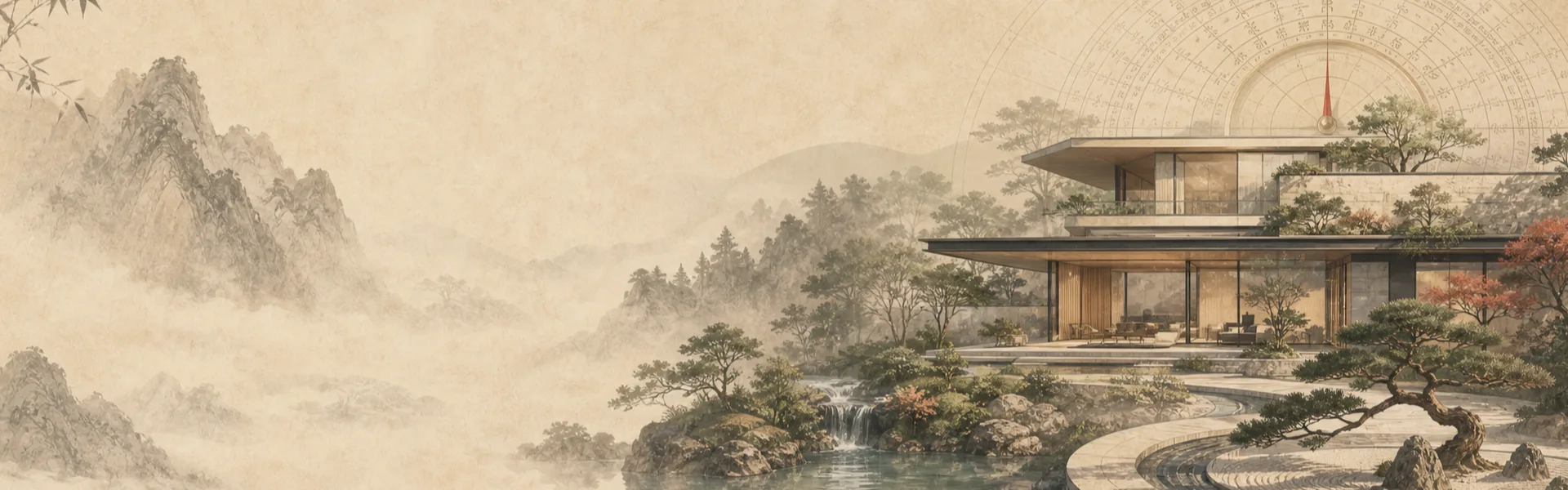
To understand Feng Shui today, it helps to see both continuity and change. Classical approaches remain part of lineage teaching, while new interpretations respond to apartments, offices, cities and international audiences. These forms do not need to be treated as identical. Each can be understood through its sources, methods and cultural setting.
A tradition carried through change
The nineteenth and twentieth centuries brought major political, social and architectural change across China. In different periods, inherited practices were restricted, recast or moved outside formal institutions. Feng Shui nevertheless continued through family custom, local specialists, building practice and the transmission of texts.
Hong Kong, Taiwan and Southeast Asian Chinese communities became especially important centres of continuity. Practitioners taught established methods, publishers kept manuals in circulation, and households continued to consider orientation, timing and spatial arrangement when building, moving or renovating. In Singapore and elsewhere in the region, Feng Shui also became part of a wider conversation about heritage, identity and modern urban life.
Global journeys and local adaptations
From the late twentieth century, Feng Shui reached a broad international audience through books, design media, courses and consultation. As it entered new languages and markets, it was often adapted to local homes and expectations.
Some contemporary approaches emphasise decluttering, furniture placement, light and the emotional quality of a room. Classical systems usually draw on a wider technical vocabulary, including landform, direction, the luopan, time cycles and a practitioner’s transmitted method. Both may shape how people experience a place, but they represent different stages and styles of development.
Recognising adaptation is more useful than searching for one uniform modern version. A reader can ask which features come from classical landform or compass traditions, which developed in a particular lineage, and which are contemporary design interpretations.
Feng Shui in homes, workplaces and communities
Modern Feng Shui appears in many settings. Families may consider the orientation of a home, the position of an entrance, the arrangement of important rooms or the timing of a move. Businesses may seek advice on circulation, entrances and the relationship between a building and its surroundings. Communities may also preserve landscape features, burial traditions or local stories connected with the siting of settlements.
The same method is not used everywhere. Form-based approaches give particular attention to terrain, water, shelter and the visual character of a site. Compass-based approaches work with direction, time and calculated patterns. Many practitioners combine several strands, while others remain closely identified with one school.
This variety is part of the tradition’s history. It is therefore helpful for an article, course or consultation to name the method being presented instead of describing one school’s interpretation as the whole of Feng Shui.
Architecture, environment and cultural memory
Feng Shui has influenced the ways places have been imagined, discussed and remembered. Its vocabulary appears in accounts of villages, graves, temples, gardens, houses and cities. Ideas such as shelter, orientation, water, approach and spatial balance helped communities connect the form of a site with family continuity and social life.
Many of these concerns also invite practical observation. Sunlight, ventilation, noise, movement, topography and drainage affect how a place is used and experienced. Feng Shui brings such observations into a broader cultural language of relationship, timing and resonance.
The practical and interpretive layers should be explained with care. Environmental observations can be examined directly; traditional readings of qi, fortune and correspondence belong to the inherited framework of the art. Keeping these layers visible allows readers to appreciate the full tradition without reducing it to either interior decoration or a single set of claims.
Learning with a practitioner
A thoughtful practitioner should be able to identify the school or combination of methods being used, explain the reasoning behind a recommendation, and distinguish observation from interpretation. The scope of the consultation, the fee and any follow-up should be clear from the beginning.
Good guidance also respects the client’s judgement. It offers workable options, recognises practical constraints and avoids promising a fixed result. Questions that belong to medicine, law, finance, engineering or mental health should remain with qualified professionals in those fields.
For a learner, the same principles apply. Begin with the history and vocabulary, study Form and Compass approaches in their own context, compare more than one teacher, and notice where schools agree or differ. This produces a deeper understanding than collecting isolated rules.
Traditional frameworks and present-day knowledge
Feng Shui is a traditional interpretive system shaped by Chinese cosmology, ritual life, architecture and the experience of landscape. Its concepts have meaning within that historical and cultural framework, and they continue to guide practitioners and communities today.
Clear presentation does not require either dismissal or overstatement. Historical claims should be supported by texts, objects and scholarship. Environmental observations can be discussed in practical terms. Interpretive claims should be identified as part of the tradition and should not be presented as scientifically established certainty.
This approach keeps the subject open to serious cultural study while allowing readers to understand what a practitioner is doing, what sources inform the method and where personal judgement remains important.
Why Feng Shui continues
Feng Shui continues because it offers a language for paying attention to place. For some people, that attention is connected with lineage and family custom. For others, it supports architectural thinking, cultural identity or a more deliberate relationship with home and landscape.
Its modern forms show how traditions travel: some preserve detailed calculations, some emphasise visual and environmental qualities, and some translate inherited ideas into new design settings. Studied in context, these forms reveal an active conversation between history and contemporary life.
Key points
Feng Shui continued through family practice, specialist teaching and printed texts during periods of rapid modern change.
Hong Kong, Taiwan, Singapore and overseas Chinese communities have been important centres of transmission.
International forms range from classical lineage methods to contemporary design adaptations.
Form and Compass approaches should be identified clearly rather than blended into one undifferentiated system.
Practical observations and traditional interpretations can be discussed together while remaining distinct.
Responsible guidance explains its method, scope and limits and does not promise a fixed outcome.
Feng Shui should be presented as a traditional interpretive system with significant historical, cultural and architectural importance.