Origins and History of Chinese Feng Shui
中国风水的起源与历史
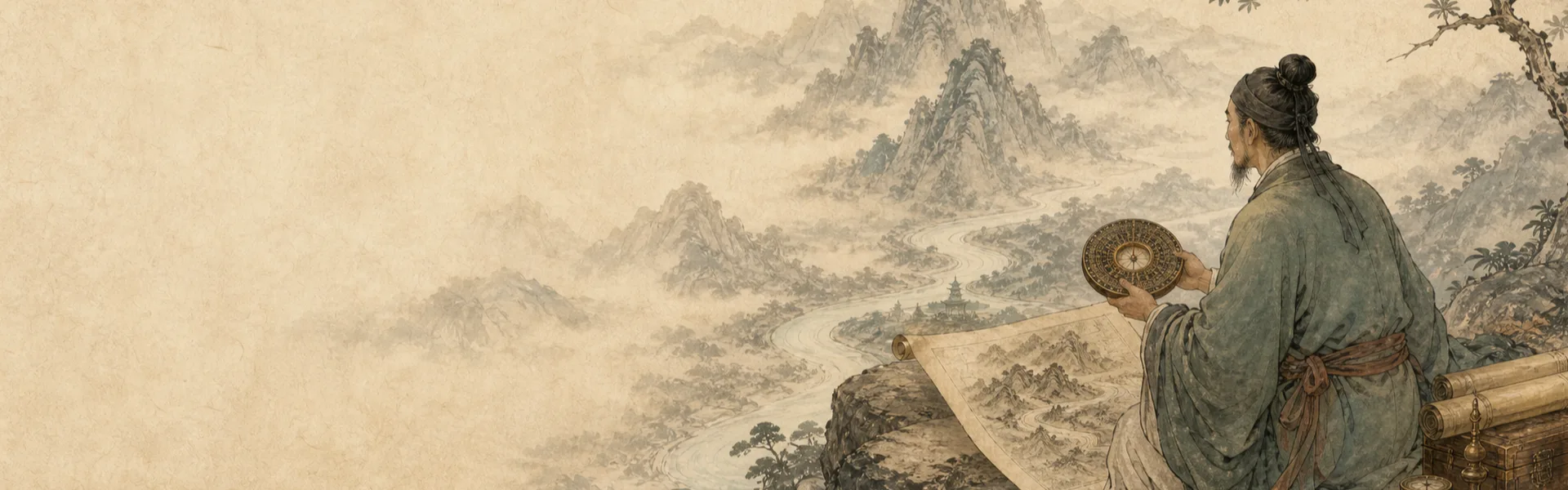
The impulse behind Feng Shui is very old: the wish to build in the right place, sheltered from harsh winds, near good water, facing the sun, and set against protecting high ground. Long before the word “Feng Shui” was used, Chinese communities were siting settlements and graves with evident care for the surrounding terrain. Neolithic villages were often placed on south-facing slopes above rivers, and the oracle-bone inscriptions of the Shang record divinations about where to found cities and lay out capitals. The art that later crystallized as Feng Shui grew out of this ancient and practical concern with choosing auspicious ground.
Siting before there was a theory
People chose where to live long before anyone wrote down a reason. Neolithic villages in the Yellow River basin sit, with striking regularity, on river terraces above the flood line, on the sunny side of a slope, with higher ground to the north. Banpo near Xi‘an is the standard example: raised ground, water close but not level with the settlement, dwellings clustered away from the prevailing winter wind.
It is tempting to call this early feng shui, and popular books often do. The claim needs care. What the sites show is that people made sensible decisions about drainage, sun, and shelter — decisions that any farming population in that climate would converge on by trial, and that hunter-gatherers make too. There is no evidence of a doctrine, no vocabulary, and no specialist. The continuity worth asserting is that later feng shui inherited a body of practical siting preferences already thousands of years old, and then supplied theoretical reasons for them. The preferences came first and the theory afterwards, which is the opposite of how the tradition tells its own story.
Divining a dwelling: Shang and Zhou practice
The first documentary evidence is about divination rather than landscape reading. Shang oracle bones record enquiries about whether to build a settlement at a particular place, and about the siting of tombs. The method was to put the question to the ancestors by cracking a bone or shell and reading the crack, not to survey the terrain. The decision was referred upward for approval; it was not calculated from the ground.
Zhou texts show the same pattern with more procedure attached. The Book of Documents describes divining for the site of a new capital, and the Book of Poetry has passages on inspecting ground before founding a settlement. The ritual literature includes a specialist office concerned with tombs and with the layout of ceremonial space, and there are references to bu zhai (卜宅), divining a dwelling, as a recognised undertaking. This is the immediate ancestor of feng shui, and the important thing about it is what it lacks: no qi, no dragon veins, no compass, no five phases. It is an omen practice concerned with obtaining sanction, and the transition to a calculating art still lay ahead.
The Han synthesis
The intellectual materials from which the classical art was built came together during the Han dynasty. It was in the Han that yin-yang cosmology, the theory of the Five Phases, the trigrams of the Yijing, and the Stems and Branches of the calendar were woven into a single correlative system, and it was natural that this system should be applied to space as well as time. Han tomb-building and the elaborate concern with orienting graves toward auspicious directions show the emerging art at work. The famous diviner‘s boards and early compass-like instruments of the Han, which model the heavens above and the earth below, are among the ancestors of the later Feng Shui compass.
The foundational texts
The tradition attributes its foundational texts to this early period, though the attributions are not always secure. A key early work, the Book of Burial, concerned with the siting of graves, is traditionally ascribed to Guo Pu, a scholar of the Jin dynasty in the fourth century. It is in this text that the classic formulation appears: qi rides the wind and scatters, but is held when it meets water—the saying from which the name “wind and water” is drawn. Whether Guo Pu wrote it or it was compiled later, the Book of Burial became one of the anchors of the tradition, and its emphasis on burying the dead where qi gathers shaped the whole later art of grave siting.
How reliable are the traditional attributions?
The tradition credits its classics to named early figures, and almost none of those credits survives scrutiny. The Zangshu, the burial classic that everything later builds on, is attributed to Guo Pu, a fourth-century scholar genuinely known for divination and commentary. But the text is not mentioned in any bibliography for centuries after his death, its vocabulary belongs to a later period, and the received version was edited in the Song and again in the Ming. Most scholars now treat the attribution as honorific: the book collects material of uncertain date under a respectable name.
The same holds elsewhere. Works are assigned to Yellow Emperor ministers, to Han dynasty officials, and to Tang masters on no better evidence than a title page. This matters for reading the history, because a tradition that presents itself as a single transmission from antiquity was in fact assembled over many centuries by many hands, with later material regularly backdated to acquire authority. The practice was not dishonest by the standards of the time — attaching a text to a founder was a normal way of signalling which lineage it belonged to — but it means dates in feng shui bibliographies cannot be taken at face value, and any account of the art‘s development has to be built from datable references and archaeology rather than from the claims the manuals make about themselves.
Two schools emerge
Over the Tang and Song dynasties the art matured and divided into the recognizable schools that still organize it. The Form School, associated with masters working in the mountainous region of Jiangxi, read the shapes of the land—the “dragon veins” of the mountain ranges, the flow of water, and the configuration of a site‘s surroundings. The Compass School, associated with Fujian, worked more with the compass, the trigrams, the Stems and Branches, and calculation. These were not rigidly separate; most accomplished practitioners used both landform reading and compass work, but the two emphases gave the tradition its enduring structure.
Yang Yunsong and the Form School
A famous name from this formative period is Yang Yunsong, a Tang-dynasty master traditionally regarded as a founder of the Form School and honored in the tradition as a great teacher who used his knowledge to help ordinary people rather than only the powerful. As with Guo Pu, the historical details are uncertain and much of what is told of him is legend, but his name marks the point at which landform Feng Shui became a self-conscious body of teaching passed from master to disciple. The texts attributed to him and his lineage became core classics of the Form School.
Feng Shui and the imperial state
Feng Shui was woven deeply into imperial life. The siting and orientation of capitals, palaces, and imperial tombs were matters of state, and specialists were employed to ensure that the emperor‘s dwellings and the dynasty’s ancestral graves were correctly placed. The layout of Beijing, with its central north-south axis, its careful orientation, and its relationship to surrounding hills and water, reflects such concerns. At the level of ordinary life, families consulted Feng Shui practitioners about the siting of houses and the placement of ancestral graves, in the belief that a well-placed grave would benefit descendants. The art thus operated at every level of society, from the imperial court to the village.
The late imperial technical literature
During the late imperial period an enormous technical literature accumulated, and the Compass School in particular developed increasingly elaborate methods, adding ring after ring to the luopan and devising systems that combined direction, time, and the trigrams to judge the changing fortune of a site. Some of these later systems, such as the methods that track a building‘s fortune through cycles of time, are intricate calculations layered over the older landform reading. This growth in complexity is characteristic of the mature tradition and is one reason Feng Shui can appear bewildering to newcomers.
The twentieth century
In the twentieth century Feng Shui underwent sharp changes. It was criticized as superstition by reformers and, for a period, discouraged in mainland China, while continuing in Hong Kong, Taiwan, and overseas Chinese communities. From the late twentieth century it spread worldwide, often in simplified and commercialized forms quite far from the classical tradition. The history of Feng Shui is therefore a long one: an ancient practical concern with good ground, systematized through Han cosmology, codified in the classical texts and schools of the Tang and Song, elaborated across the late empire, and transformed again in the modern age.
What the history shows
Seen as a whole, this history shows Feng Shui to be neither a timeless secret nor a modern invention, but a tradition with a documented development. Its practical core—build in sheltered, well-watered, sunlit places—is ancient and sensible. Its cosmological framework was assembled in the Han. Its schools and classic texts took shape in the medieval period. And its many elaborate systems accumulated over the centuries that followed. Understanding this layering is the first step toward reading the art clearly.
Key points
Feng Shui began in the practical wish to build in sheltered, well-watered, sunlit and protected places.
Its intellectual apparatus — yin–yang, Five Phases, trigrams, Stems and Branches — came together in the Han.
Foundational texts are attributed to this early period, though the attributions are not always secure.
The art matured under the Tang and Song and divided into the Form and Compass schools.
Yang Yunsong of the Tang is traditionally regarded as a founder of the Form School.
Siting of capitals, palaces and imperial tombs was a matter of state concern.
A large technical literature accumulated in the late imperial period, especially for the Compass School.
It was attacked as superstition by twentieth-century reformers before later reviving.
It is neither a timeless secret nor a modern invention, but a tradition with a traceable history.
Sources drawn on for this article include: Joseph Needham‘s Science and Civilisation in China (volume 2, on the pseudo-sciences and the background of Feng Shui); Richard J. Smith’s Fortune-tellers and Philosophers; Stephan Feuchtwang‘s An Anthropological Analysis of Chinese Geomancy; Ole Bruun’s Fengshui in China and An Introduction to Feng Shui; and the traditional classics associated with Guo Pu and Yang Yunsong in scholarly translation and study.