Feng Shui Form School: How Landscapes Are Read
风水形势派:如何观察山水与地形
The Form School, or landform school, is the older and more visual branch of Feng Shui. It reads a site by the shapes of the land around it—the mountains and hills, the flow of water, and the way these features enclose or expose a place. Its central conviction is that the contours of the earth channel qi much as a riverbed channels water, and that a practiced eye can read from those contours where qi gathers and where it disperses. This page sets out the main ideas of the Form School: the dragon veins, the ideal enclosed site, and the model of the four celestial animals.
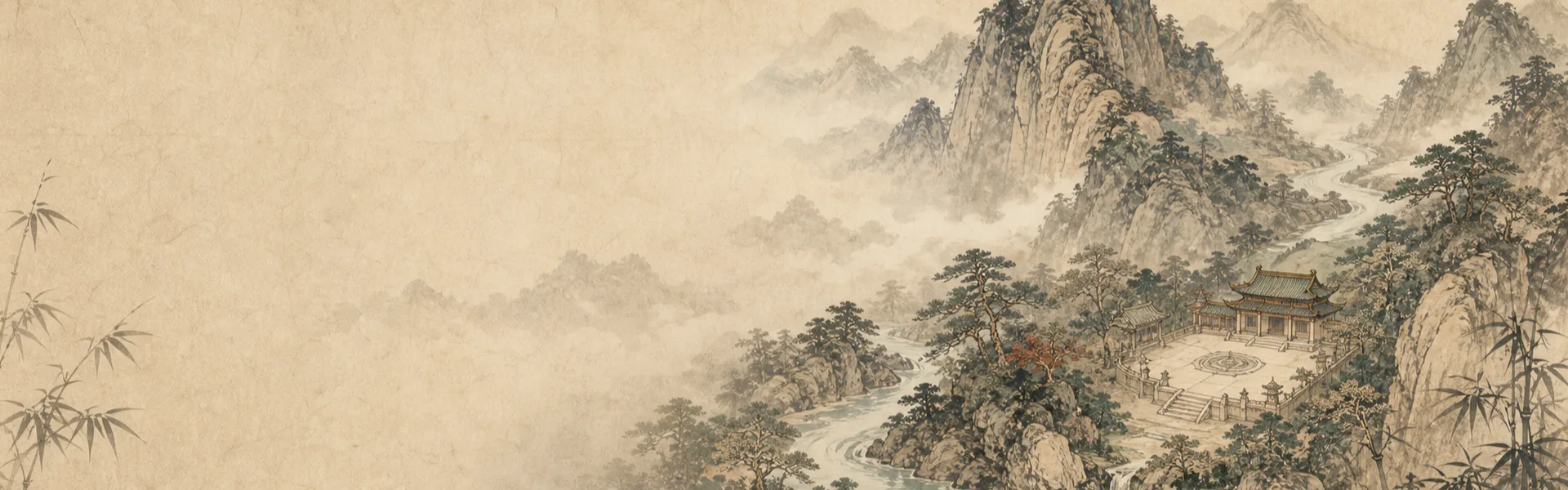
Mountains as dragons
The governing image of the Form School is the dragon. Mountain ranges are seen as dragons—long, sinuous bodies of living earth through which qi flows—and the ridgelines along which this energy travels are called dragon veins, longmai (龙脉). A Form School master traces these veins across the landscape, following a range from its distant, high origin down through its twists and branches to the point where it settles. The place where a vigorous dragon vein comes to rest, gathering its qi, is the prized site, called the “dragon’s lair” or xue (穴), a word that also means an acupuncture point on the body—the same image of a place where vital energy concentrates. Finding the lair is the essential skill of the landform master.
The five things a reading looks at
Form school practice is usually summarised as five operations, and having them in mind turns a vague impression of landscape-reading into a checklist you can actually follow. The classical formula runs: seek the dragon, examine the flanking hills, observe the water, fix the point, set the facing — mi long, cha sha, guan shui, dian xue, li xiang.
The dragon (龙) is the ridgeline: where the high ground comes from, how it branches, whether it arrives at the site with substance or peters out. The flanking hills (砂) are the ground on the left and right, which should enclose without crowding. Water (水) means streams, ponds, and in modern practice roads, judged by whether it approaches visibly and leaves out of sight rather than running straight past. The point (穴) is the precise spot, and locating it is treated as the hardest part of the art — a site can be right to within a hundred metres and still wrong by ten. The facing (向) is the direction the building looks, which the form school derives from the terrain rather than from a compass table.
These five are sequential, and the order is the substance of the method. You do not begin with the spot and look for reasons; you begin with the largest features and narrow down. A practitioner who arrives, glances around, and immediately indicates a point is not doing form school work, whatever they call it.
The embrace of land and water
Around the ideal lair the land should form a protective embrace. Water is the second great element the Form School reads, and its role is expressed in the classic maxim that mountains govern people while water governs wealth. Flowing water is thought to guide and hold qi; a site embraced by a gently curving watercourse, with the water arriving and departing in a slow, winding fashion rather than rushing straight through, is favored. Water that curves lovingly around a site, like a belt, is auspicious; water that cuts away from it, or rushes at it in a straight line, is not. The interplay of embracing mountains and embracing water defines the good site.
The four celestial animals
The most famous Form School model is the configuration of the four celestial animals, which describes the ideal surroundings of a site in terms of four guardian features. Behind the site should rise a higher elevation, the Black Tortoise, giving support and shelter at the back—ideally to the north, so the site faces the warm south. To the left, as one looks out from the site, should be a somewhat higher ridge, the Azure Dragon; to the right, a somewhat lower one, the White Tiger; these embrace the site on either side. In front, at a distance, should lie lower ground and ideally water, with a small hill beyond, the Vermilion Bird, closing the view. A site so enclosed—supported behind, embraced on both flanks, and open but protected in front—is the classic armchair or horseshoe shape that gathers qi and shelters the dwelling.
Why those four animals
The four animals are more than a checklist of hills; they are also the four directional emblems of classical Chinese cosmology, each tied to a direction, a season, a phase, and a color. The Black Tortoise governs the north, winter, and water; the Vermilion Bird the south, summer, and fire; the Azure Dragon the east, spring, and wood; the White Tiger the west, autumn, and metal. In the ideal orientation, with the tortoise-hill to the north and the bird-hill to the south, the animals of the landscape align with the animals of the heavens, and the site sits in harmony with the cosmic order. This is why the model is at once a practical guide to good terrain and a symbolic statement about a place’s alignment with the cosmos.
Reading mountain shapes through the Five Phases
The Form School also reads the shapes of individual mountains through the Five Phases, since a peak’s form is thought to express a phase and so a quality of qi. A tall, straight peak is wood; a sharp, pointed one is fire; a broad, flat-topped one is earth; a rounded, dome-like one is metal; and a wavy or irregular one is water. The phases of the surrounding peaks, and whether they generate or control one another and the site, add another layer to the reading. A landscape can thus be assessed not only for its enclosure but for the character and harmony of the energies its mountains express.
The practical sense behind it
Much of the Form School’s guidance has an evident practical wisdom, which is part of why it endured. A site backed by high ground to the north is sheltered from cold winter winds; one open to the south receives sunlight; one near gently flowing water has access to that essential resource without the danger of a torrent; one enclosed by surrounding hills is protected from wind and from view. Stripped of its cosmological language, the ideal Form School site is simply a well-sheltered, sunny, well-watered spot—which is why such sites were, and are, genuinely pleasant and practical places to live. The tradition wraps this sound siting sense in a rich symbolic vocabulary.
Where the claims go beyond the practical
At the same time, the specifically metaphysical claims of the Form School—that a particular lair concentrates beneficial qi, that a well-placed grave will bring fortune to descendants, that the phase of a distant peak affects a family’s luck—are interpretations within the tradition, not findings established by modern methods. The Form School is best appreciated as a sophisticated and often beautiful way of reading landscape, combining genuine environmental sense with a symbolic cosmology. Its influence on Chinese settlement, garden design, and the siting of temples and villages is real and visible in the landscape to this day.
Reading an old settlement
The best way to see whether any of this is real is to test it on ground that was chosen long ago. Take an old village or walled town in hilly country in central or southern China and work through the five operations. You will very often find the pattern: the settlement on a terrace above the flood line, higher ground behind to the north, a stream arriving from one side and curving away, the approach road entering at an angle rather than head-on, and the principal hall or ancestral temple placed at the point the ground gathers.
Finding the pattern feels like confirmation, and it is worth being careful about why. Three quite different things are contributing. Some of the fit is genuine practical selection: any settlement in that climate that survived floods and winter wind was on ground of roughly that description, whether or not anyone consulted a specialist. Some is deliberate design, because from the Song onward many villages really were laid out with siting advice, so the theory is partly describing its own handiwork. And some is survivorship — badly placed settlements were abandoned or washed away and are not there for you to look at, so the surviving sample is filtered in favour of the theory.
There is also the ordinary problem that a flexible system explains whatever it meets. The vocabulary is rich enough that an absent hill can be read as an open direction, a straight road as a spear of harmful qi or as a beneficial channel depending on what else is present. If you catch yourself finding an explanation for every feature, you are no longer testing anything. The useful discipline is to decide in advance what would count as a badly sited settlement, then see whether the old ones actually avoid it. Done that way the exercise is genuinely informative, and what it tends to show is that the practical layer of feng shui holds up well and the resonance layer is untouched by the evidence either way.
The essentials
For the reader, the Form School comes down to a few vivid ideas: mountains are dragons and their ridgelines are veins of qi; the best site is the lair where a vein settles; water gathers and holds qi and should embrace rather than assault a site; and the ideal surroundings form the armchair of the four celestial animals, supported behind and embraced on both sides, facing open, protected ground. These images, at once practical and poetic, are the heart of landform Feng Shui.
Key points
The Form School is the older, visual branch of Feng Shui, reading a site by the shapes around it.
Mountain ranges are read as dragons, with ridgelines as the veins along which qi travels.
The ideal site sits in a protective embrace of land, with water as the second element read.
The four celestial animals describe the ideal surroundings — support behind, openness in front, flanking hills.
Those animals are also the directional emblems of classical Chinese cosmology.
Individual peaks are classified by Five Phase shapes.
Much of the guidance has obvious practical value: shelter, drainage, aspect and outlook.
That practical sense is part of why the school endured.
Claims that a particular site concentrates beneficial qi go beyond what the practical reasoning supports.
Sources drawn on for this article include: Stephan Feuchtwang’s An Anthropological Analysis of Chinese Geomancy; Ole Bruun’s An Introduction to Feng Shui and Fengshui in China; Joseph Needham’s Science and Civilisation in China (volume 2); and standard scholarly treatments of the Form School, the dragon veins, and the four celestial animals in the study of Chinese geomancy.