Feng Shui for Homes and Graves: Yangzhai and Yinzhai
阳宅与阴宅风水:住宅和墓葬有何不同
Feng Shui divides its subject into two great domains: the dwellings of the living and the resting places of the dead. In the tradition‘s own language these are the yang house, yangzhai (阳宅), and the yin house, yinzhai (阴宅). The same principles of qi, landform, and direction apply to both, but the aims and the emphases differ, and the two domains have somewhat separate bodies of technique. This page describes each, and the belief in ancestral influence that gave grave Feng Shui its extraordinary importance in traditional China.
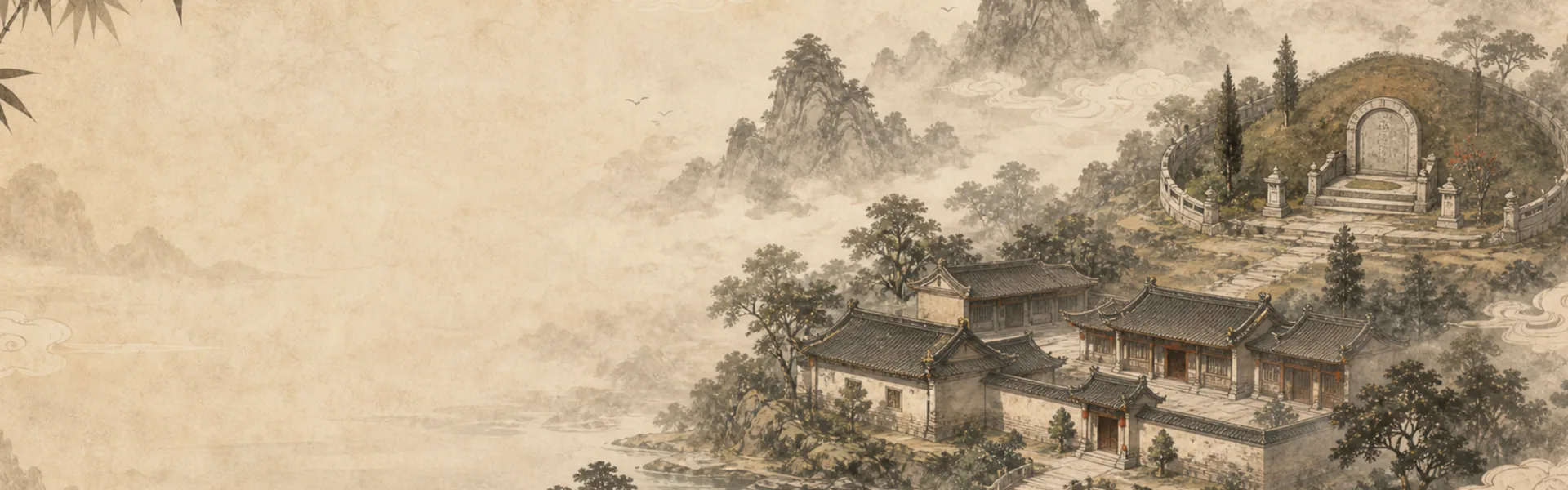
Two domains, one vocabulary
Houses and graves are handled by the same art, with the same terms, and the same practitioner is usually competent at both. Qi, dragon veins, the gathering point, the four animals, the compass rings and the twenty-four mountains all appear in both bodies of literature. What differs is who is supposed to benefit and over what span of time.
A dwelling acts on the people currently living in it, and its effects are expected to show up within a lifetime and to change if the household moves. A grave acts on the descendants of the person buried in it, and its effects are expected to unfold over generations. That difference in timescale has a consequence worth noticing at once: grave claims are almost impossible to disconfirm, because any outcome can be attributed to a placement made decades earlier, whereas house claims at least invite the question of what happened after the family moved in.
The direction of borrowing also matters. The theory was developed first for graves and then applied to houses, not the other way round. This is why some standard household advice reads slightly oddly when you examine it: rules about the direction a structure should sit, about being backed by higher ground and open to the front, were worked out for a tomb in open country and then transferred to a dwelling in a village, and later to an apartment on the eleventh floor of a tower. Each transfer required reinterpretation, and the disagreements among modern practitioners about how to apply classical rules to flats are the latest stage of a very old process of adaptation.
The yang house
The yang house is the home of living people, and its Feng Shui concerns how a dwelling gathers beneficial qi for those who live in it. The assessment begins with the site—its landform and surroundings, judged by the Form School—and proceeds to the building‘s orientation, judged by the Compass School. Within the house, attention falls on the placement of the features through which qi is thought to enter and move: above all the main door, through which qi comes in, but also the stove or kitchen, the bedrooms, and the flow of movement through the rooms. A good yang house sits on a well-chosen site, faces an auspicious direction for its occupants, and arranges its key rooms so that beneficial qi reaches the people and harmful qi is deflected.
The practical core of household advice
Much everyday Feng Shui advice concerns the yang house, and a good deal of it has a practical core. Guidance to avoid a house at the end of a long straight road, or a bed positioned directly in line with a door, or a stairway aimed straight at the entrance, corresponds to a sense of comfort, safety, and calm that most people recognize. The tradition expresses these judgments in terms of qi and sha, but many overlap with ordinary good sense about light, air, movement, and repose. This practical dimension is part of why yang-house Feng Shui remains popular and is the form most often encountered outside China today.
The yin house
The yin house is the grave, and here the tradition made its most distinctive and consequential claim. It held that the qi of a well-sited ancestral grave benefits the descendants of the person buried there. A grave placed at a true dragon‘s lair, where beneficial qi gathers, was believed to bring prosperity, official success, and healthy progeny to the family, while a badly placed grave could bring decline and misfortune. Because Chinese kinship placed such weight on the ancestral line and the fortunes of the family across generations, the siting of graves became a matter of the greatest seriousness, and Form School expertise was brought to bear above all on finding auspicious burial ground.
The reasoning behind grave siting
The reasoning behind this belief drew on the idea that ancestors and descendants share the same qi, being of one bodily substance passed down the generations. If the buried remains of an ancestor rest in ground rich with beneficial qi, that qi was thought to resonate with the shared qi of the living descendants and to nourish their fortunes, much as two strings tuned alike will sound together. This notion of resonance between ancestor and descendant is the theoretical heart of yin-house Feng Shui. It also explains why families would go to great lengths, and sometimes great expense, to secure and protect an auspicious grave site, and why disputes over burial ground could be so bitter.
Why graves belong to the Form School
Grave Feng Shui was overwhelmingly the domain of the Form School, because a burial site is chosen from open land where the configuration of mountains and water can be read directly. The master traces the dragon veins, identifies the lair where qi settles, checks the embrace of the surrounding hills and the flow of water, and fixes the orientation of the grave with the compass. The classic texts of the tradition, beginning with the Book of Burial attributed to Guo Pu, are largely concerned with this art. For much of Chinese history, the placement of a family‘s graves was considered as important to its long-term fortunes as any decision it could make.
How the two domains interact
The two domains interact in the life of a family. The yang house shapes the fortunes of those living in it now; the yin house, through the ancestors, shapes the fortunes of the whole descent line over time. A prosperous family might attribute its success to well-placed ancestral graves as much as to a well-sited home, and a family in decline might seek the cause in a grave disturbed or poorly located. The care of graves, already central to Chinese ancestral practice for reasons of filial piety and ritual, thus carried an additional weight of belief about its effect on the living.
What feng shui actually did in society
Whatever one concludes about its theory, feng shui performed real social work, and understanding that explains its persistence better than any argument about qi.
It supplied a neutral language for disputes about land. A lineage that objected to a neighbour‘s new building could not easily say that it wanted the light, the view, or the water rights for itself, but it could say the building damaged the qi of an ancestral grave, and that was a respectable public complaint which magistrates were willing to hear. Court records are full of such cases. Feng shui thus functioned as a kind of customary planning law, giving people a way to contest changes to shared space in terms nobody had to admit were self-interested.
It also protected trees. Groves standing behind villages and around graves were classed as feng shui woods, and cutting them was a serious offence against the whole community. In parts of south China these are now among the few remaining patches of old lowland forest, and ecologists study them precisely because the belief preserved them when nothing else did. Whether or not the reason was sound, the effect was conservation.
Less happily, it offered an explanation for misfortune that placed no blame on anyone living, and a remedy — reburial, rebuilding, a screen wall — that could be acted on. That is a genuine comfort, and it is part of why the practice was valued. But the same features made it an instrument of harm. Burials were sometimes delayed for years, occasionally decades, while a family sought an acceptable site or the money to buy one, with a coffin kept in a temple in the meantime. Families ruined themselves paying for tombs. Accusations of grave damage were used to extort neighbours, and practitioners were in a position to demand a great deal from anxious clients. Reformers who attacked feng shui in the nineteenth and twentieth centuries were usually attacking these consequences rather than its cosmology, and their complaints were not unfounded.
What can and cannot be supported
It must be said plainly that the central claim of yin-house Feng Shui—that the siting of a grave affects the fortune of descendants—is not supported by any evidence outside the tradition‘s own framework, and belongs to the domain of belief rather than demonstrated fact. The same holds for the more specific promises of yang-house Feng Shui regarding wealth or success. What can be said without qualification is that these beliefs were sincerely held, socially powerful, and deeply woven into Chinese family life, and that the practical siting wisdom bound up with them—shelter, sunlight, water, calm—has a real basis. The honest approach is to present the practical and the metaphysical layers distinctly, respecting the tradition while not endorsing its predictive claims.
The essentials
For the reader, the distinction is straightforward. Feng Shui treats two kinds of “house”: the yang house of the living, where the concern is a comfortable, well-oriented dwelling that gathers good qi for its occupants; and the yin house of the dead, the grave, where the concern is a site whose qi is believed to benefit descendants through the resonance of shared ancestral qi. The first blends practical sense with cosmology and remains widely practiced; the second rests on a belief about ancestral influence that was central to traditional China and shaped the landscape of its graves.
Key points
Feng Shui divides into the yang house of the living and the yin house of the dead.
Yang-house practice asks how a dwelling gathers beneficial qi for the people in it.
Assessment begins with the site and surroundings, then moves inside to layout and orientation.
Much everyday household advice has a practical core about light, airflow, noise and movement.
Yin-house Feng Shui concerns graves, and makes the tradition’s most consequential claim.
The reasoning is that ancestors and descendants share the same qi, so a well-sited grave benefits the family.
Grave siting belongs to the Form School, since burial sites are chosen from open landscape.
The claim that a grave’s siting affects descendants’ fortunes is not supported by evidence.
Sources drawn on for this article include: the Book of Burial (Zangshu) attributed to Guo Pu, in scholarly translation and study; Stephan Feuchtwang‘s An Anthropological Analysis of Chinese Geomancy, on the yin and yang house and ancestral resonance; Ole Bruun’s Fengshui in China, on the social role of grave and house siting; and standard scholarly treatments of Chinese ancestral practice and geomancy.