Qi, the Feng Shui Compass and the Two Schools
风水中的气、罗盘与形势理气之分
Beneath the many methods of Feng Shui lie a small number of central ideas. Grasp these, and the whole art becomes intelligible; miss them, and its techniques seem arbitrary. The most important are the concept of qi, the instrument of the compass, and the division of practice into the Form and Compass schools. This page sets out these organizing concepts, on which the more detailed pages that follow depend.
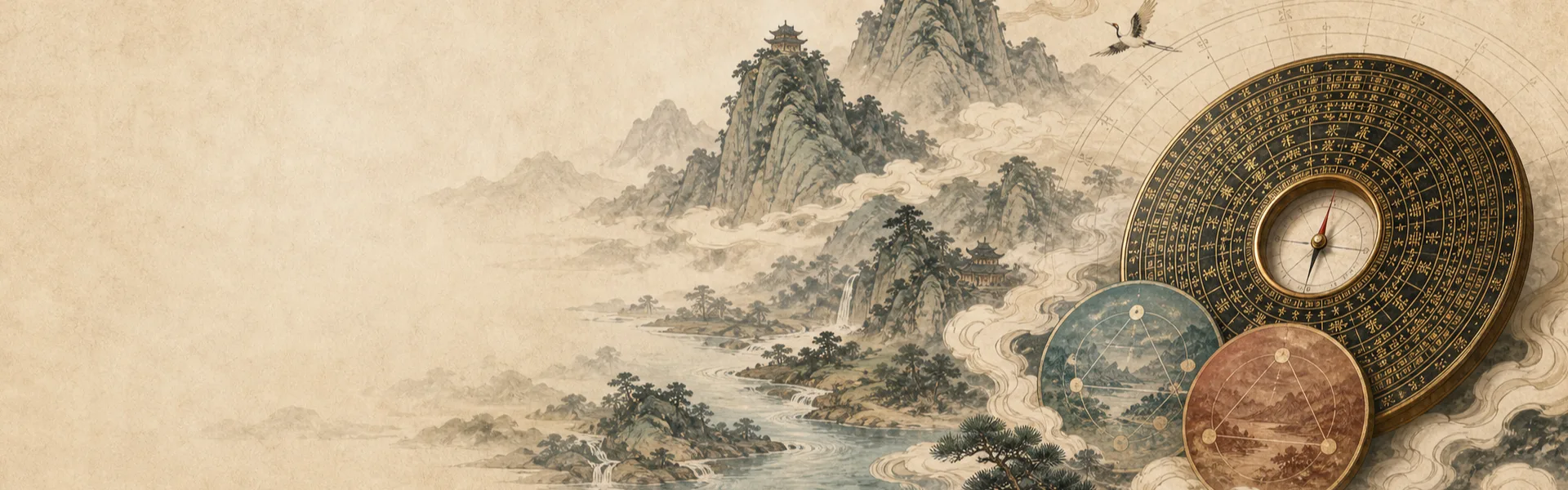
Qi, and how it is imagined to move
The foundational idea is qi (气), the vital energy that Chinese thought holds to animate all things. In Feng Shui, qi is imagined as flowing through the landscape much as blood flows through a body or water flows across the land. Good Feng Shui is a matter of situating a dwelling where beneficial qi gathers and lingers, and of avoiding places where it rushes past, stagnates, or turns harsh. The classic saying preserved in the Book of Burial captures the aim: qi is scattered by the wind and halted by water, so the ideal site is one sheltered from strong winds and embraced by gently flowing water, where qi can collect. Every technique in Feng Shui is ultimately a way of judging how qi moves through a place and how a building can be positioned to benefit from it.
Living qi and harmful qi
Two kinds of qi are distinguished in an ideal site. Sheng qi, “living” or vital qi, is the beneficial energy that a good site gathers; sha qi, “killing” or harmful qi, is the destructive energy carried by sharp, fast, or hostile features. A straight road or river rushing directly at a house, a sharp ridge or roof-edge pointing at a door, or a narrow gap channeling wind are read as sources of sha qi, sometimes called “secret arrows.” Much practical Feng Shui consists of identifying such threats and either avoiding them in siting or deflecting them with screens, walls, plantings, or mirrors. The distinction between nourishing and harmful energy runs through the whole art.
Direction, orientation and the compass
Direction and orientation are the second great concern, and here the compass enters. The Chinese magnetic compass, whose use for orientation is itself an important part of the history of science, was developed into the specialized Feng Shui instrument called the luopan (罗盘). Where an ordinary compass shows only the cardinal directions, the luopan carries many concentric rings inscribed with the eight trigrams, the twenty-four directions, the Stems and Branches, the Five Phases, and other systems of correspondence. Reading a site with the luopan means taking a precise bearing and then consulting these rings to judge which directions are auspicious for a given building and occupant. The compass translates the abstract cosmology of directions into a practical measuring tool.
Where the compass came from
The magnetic needle enters siting earlier than it enters navigation, which is one of the more interesting facts about the instrument. Before the needle there was a lodestone spoon turning on a polished bronze board, described in Han sources, used for orientation in divination rather than for travel. By the eleventh century the suspended or floating needle was in use, and the earliest clear description of magnetic declination anywhere in the world comes from Shen Kuo’s notebook of about 1088, where he observes that the needle points slightly east of true south.
That observation matters because it was made by people doing exactly this kind of work. Siting requires an accurate bearing, and a practitioner comparing the needle’s direction against the position of the pole star or the noon shadow would notice a discrepancy. The tradition then did something quite sophisticated with the discovery: rather than discard either reading, it built both into the instrument, which is why a luopan carries more than one set of direction marks. The mariner’s compass and the siting compass share the needle and diverge completely thereafter, since the rings on a luopan encode calendar and trigram data of no use whatever at sea.
The luopan itself
A luopan (罗盘) is a disc, usually of lacquered wood or brass, with a magnetic needle at the centre in a small well called the heaven pool (天池), surrounded by concentric rings of characters. The rings are called ceng (层), layers, and their number varies from four on a simple field instrument to forty or more on an elaborate one. There is no standard luopan; the layers a maker includes announce which lineage the instrument serves.
Several rings appear on almost every example. The twenty-four mountains (二十四山) divide the circle into twenty-four sectors of fifteen degrees each, named with a mixture of the eight trigrams, the twelve earthly branches, and four of the heavenly stems; this is the working scale on which a bearing is read, and it is the layer a beginner should learn first. Rings of the eight trigrams appear in both their early and later arrangements. Others carry the sixty-four hexagrams, the sixty stem-and-branch combinations, the twenty-eight lunar lodges, and a fine subdivision called fenjin (分金) used for very precise placements.
Most striking is that a full luopan carries three separate needle scales, a consequence of the declination problem. The correct needle (正针) aligns with magnetic north. The seam needle (缝针) and the middle needle (中针) are offset from it, and are used respectively for water and for the surrounding hills in some traditions. The offsets originally recorded the difference between magnetic and astronomical bearings at particular times and places. Because declination changes over centuries and by location, these offsets became historical fossils rather than live corrections, and practitioners now disagree about what the three needles are for — a real technical problem inside the art which the manuals tend to pass over.
The Form School
These two concerns—the shape of the land and the reading of directions—correspond to the two great schools of Feng Shui. The Form School, or landform school, judges a site chiefly by the configuration of its surroundings: the mountains, hills, water, and open space around it, and the way these gather or scatter qi. It is visual and topographic, and its ideal site is described through a famous model of four surrounding features, treated in detail on a later page. The Form School dominates where the land is dramatic, as in the mountainous south, and it is the older and more intuitive of the two approaches.
The Compass School
The Compass School, or directional school, judges a site chiefly by orientation and calculation. Using the luopan, it determines the exact facing of a building and applies systems that combine direction, the trigrams, the Stems and Branches, and often time, to decide what is auspicious. Its methods are numerical and can be highly elaborate, including systems that assign each person a favorable set of directions and systems that track how a building’s fortune shifts through cycles of time. The Compass School flourishes where the land is flat and offers few landforms to read, as on plains and in cities.
What the two schools actually disagree about
The dispute is not merely one of emphasis; three substantive questions separate them. The first is what decides. For the form school the ground decides, and a bearing is a refinement applied to a site already judged good by eye. For the compass school the bearing decides, and a site with acceptable terrain can still be ruled unusable by calculation.
The second is whether the occupant matters. Form school judgements are about the place and hold for whoever lives there. Compass school judgements often incorporate the birth data of the specific person or family, so the same house can be good for one household and bad for another. This is a large difference in the kind of claim being made, and it is why compass work shades into fate calculation while form work does not.
The third is whether time matters. Several compass systems attach a site’s quality to moving cycles — most familiar is the scheme of nine periods of twenty years each, under which a bearing that was favourable becomes unfavourable when the period turns. Form school reading has no such clock; a hill that shelters a site shelters it in every generation. Anyone comparing advice from two practitioners will find that most contradictions trace back to one of these three questions rather than to incompetence.
How the two are used together
In actual practice the two schools are complementary rather than opposed. A skilled practitioner typically begins with the landform—choosing or assessing a site by its surroundings—and then refines the judgment with the compass, fixing the orientation and checking the directions. The distinction is one of emphasis and of technical toolkit, not a fundamental disagreement about the nature of the art. Both schools share the same underlying aim of gathering beneficial qi and avoiding harmful qi, and both rest on the same cosmology of yin-yang, the Five Phases, and the trigrams.
The shared web of correspondences
Underlying both is the network of correspondences that Feng Shui shares with the rest of Chinese metaphysics. Each direction is associated with a trigram, a phase, a season, a color, and much else; a mountain has a phase according to its shape, a pointed peak being fire and a rounded one metal or earth; water is yin and mountains are yang. Reading a site means seeing it through this web of correspondence, so that its physical features become legible as a pattern of energies. The concepts of qi, direction, and correspondence are thus not separate techniques but aspects of a single way of seeing the landscape.
The essentials
For the reader, the essential points are these. Feng Shui is about qi—gathering the beneficial kind and avoiding the harmful kind. It judges a place in two complementary ways: by the shape of the land, which is the Form School, and by direction and calculation, which is the Compass School. And it reads both through the shared cosmological correspondences of Chinese thought. With these concepts in hand, the detailed methods on the following pages fall into a clear order.
Key points
A few central ideas make the whole art intelligible: qi, the compass, and the two schools.
Qi is imagined flowing through a landscape as blood flows through a body or water across land.
Good siting gathers beneficial sheng qi and avoids the harmful kind.
The second concern is direction, which is where the compass comes in.
The Form School reads the shape of the land — hills, watercourses, protection and exposure.
The Compass School judges a site by orientation and calculation using the luopan.
In practice the two are complementary, and a skilled practitioner uses both.
Both rest on the same network of correspondences used throughout Chinese metaphysics.
Sources drawn on for this article include: Joseph Needham’s Science and Civilisation in China (volume 2, on the concept of qi and correlative cosmology, and volume 4, on the magnetic compass); Stephan Feuchtwang’s An Anthropological Analysis of Chinese Geomancy; Ole Bruun’s An Introduction to Feng Shui; and standard reference treatments of the Form and Compass schools and the luopan in the scholarly literature.