
A TAOIST VIEW OF LIFE · 道家人生观

Honour, Disgrace and Freedom from External Approval 宠辱若惊与虚己游世:不把外在毁誉当成自己

Why Laozi says both praise and blame startle us—and how Zhuangzi’s “Empty Boat” parable dissolves needless resentment.

A still mountain pool ringed by mossy rocks, ferns and pines, reflecting the sky.

Everyone understands why public criticism or disgrace hurts. What makes Chapter 13 of the Tao Te Ching so psychologically acute is that Laozi warns us that praise and favour can be just as unsettling as disgrace: “Favour and disgrace both feel like a shock… When you receive favour, you are startled; when you lose it, you are startled” (宠辱若惊……得之若惊,失之若惊).

1. Why Praise Can Make You as Anxious as Blame

When our sense of self depends on external applause, being praised does not bring lasting peace—it immediately creates the anxiety of defending that image and the fear that the applause may be withdrawn tomorrow. As Chapter 70 puts it, the sage “wears coarse cloth outside while holding jade within” (被褐怀玉): inner integrity is carried quietly inside rather than hung outside for strangers to grade.

2. Zhuangzi’s Parable of the Empty Boat (虚舟之喻)

In the Mountain Tree (山木) chapter of the Zhuangzi, Zhuangzi shows how ego-identification also magnifies conflict with others:

“Suppose you are crossing a river and an empty boat drifts into yours. Even if you have an irritable temper, you will not fly into a rage. But if there is a person in that other boat, you will shout at them to steer clear; if they do not hear the first time, you shout again; by the third time, a torrent of curses follows. Earlier you were not angry, and now you are—because earlier the boat was empty (虚), and now it is occupied by a self (实). If a person can empty the self while moving through the world, who can harm them?”

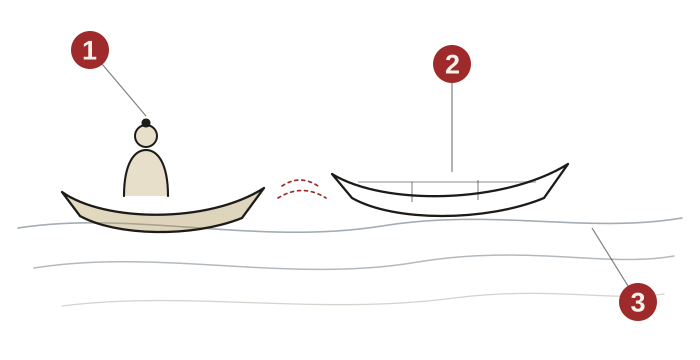
Diagram of Zhuangzi’s Empty Boat parable showing a traveler’s skiff meeting an unsteered empty boat on flowing river currents

Zhuangzi’s Empty Boat parable (Shan Mu): when we stop projecting hostile intent onto every collision, reactive anger dissolves.

  1. Your skiff crossing the river amid everyday encounters
  2. An unsteered empty boat (虚舟): friction without an attacking ego sparks no rage
  3. The shared current of life through which an unburdened heart moves freely

3. Practising “The Empty Boat” in Daily Life

  • Separate Useful Feedback from Identity: Listen carefully to factual corrections that improve your work or practice, while letting flattering or hostile labels pass through without sticking.
  • Do Not Assume Every Bump Is Personal: When someone is brusque in traffic, at work, or at home, treat it first like an unsteered boat—driven by their own fatigue or distraction rather than a personal plot against you.

Seeker’s Q&A · Frequently Asked Questions

What is the lesson of Zhuangzi’s Empty Boat parable (虚舟之喻)?

When an empty boat bumps into ours, we do not get angry because we see no ego attacking our ego. By loosening rigid self-importance (“emptying the self”), we can handle friction and criticism without reactive anger.


