Taoist meditation is usually called jingzuo (静坐), quiet sitting, or simply dazuo (打坐), sitting. The words are plain, and so is the outward form: a person sits still, upright and unhurried, and lets the body, the breath and the mind settle. What makes it Taoist is not the posture, which it shares with many traditions, but the texts that describe what stillness is for and the communities that have kept the practice alive, among them the temples of Wudang Mountain.
This page is a map. It sets out the methods the classics name, how sitting fits into Taoist life at Wudang, how to arrange the posture, and a short first practice. For internal cultivation as a whole, including standing and moving practice, see Wudang Internal Cultivation.
Stillness before there was a Taoist religion
The idea that a still body and a quiet mind open onto something larger is older than organised Taoism. The Tao Te Ching (Dao De Jing) asks whether one can "embrace the One" and soften the breath like an infant (chapter 10), and urges the reader to reach the limit of emptiness and hold fast to stillness (chapter 16). Neither passage gives instructions, but later practitioners read both as descriptions of sitting.
The Zhuangzi goes further. In one dialogue Confucius teaches his student Yan Hui the "fasting of the heart-mind" (心斋): stop listening with the ears, then stop listening with the heart, and listen with qi, until what remains is an open emptiness. In another, Yan Hui reports that he has learned to "sit and forget" (坐忘), letting go of the body and of clever knowing until he is joined with the great flow of things. These two short scenes, discussed on our page on the core themes of the Zhuangzi, became the classical foundation for Taoist sitting.
Five methods the tradition names
Over two thousand years, teachers gave the practice many names. Five recur often enough to serve as a map. They overlap, and a single teacher may use several of them.
Fasting of the heart-mind (心斋). Attention moves from the senses to something quieter than thought. In practice it often begins as simply listening to the breath without steering it.
Sitting and forgetting (坐忘). The practice of letting go: of tension, of commentary, of the effort to achieve anything. In the Tang dynasty, Sima Chengzhen (司马承祯, 647–735) wrote the Zuowang lun, a treatise that sets out sitting and forgetting as a series of stages.
Guarding the One (守一). Gathering attention and holding it, gently and steadily, on one point or one quality. The phrase appears in the Han-period Taiping jing, and Ge Hong discusses it at length in the fourth-century Baopuzi.
Visualisation (存思). Holding images in the mind: deities, lights or palaces located within the body. It is central to the Shangqing school and to the Yellow Court Classic, and it is usually taught within a lineage rather than from books.
Inner observation (内观). Turning attention inward to watch thoughts and feelings arise and pass without being carried off by them. A Tang-period scripture, the Neiguan jing, is devoted to it.
Later internal alchemy (neidan) builds on these foundations with its own maps of breath and energy, including the "small heavenly circuit" described in the Wu-Liu school. Those methods are traditionally taught step by step by a teacher, and nothing on this page depends on them.
How Wudang's Taoists sit
Most of the Taoists who live in Wudang's temples today belong to the Quanzhen order, which from its founding in the twelfth century made seated practice part of monastic life. Historically, Quanzhen communities timed their sitting with a bowl pierced by a small hole and floated on water: when it filled and sank, the period was over. The discipline was communal and regular rather than heroic.
At Wudang, sitting takes its place beside morning and evening liturgy, scripture recitation, work, and movement arts such as taijiquan and qigong. Visitors sometimes expect long silent retreats; more often what they meet is sitting as one ordinary part of a disciplined day. Our page on what Wudang schools actually teach describes what a student can realistically expect.
Setting up the posture
The posture serves one aim: to be upright without strain, so that you can forget the body rather than fight it.
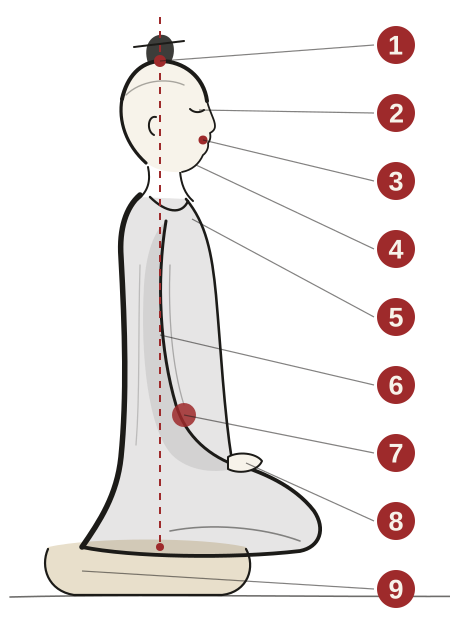
The main points of a steady sitting posture. A schematic drawing; lineages differ in the details, especially the position of the hands.
- Crown lifted, as if by a thread
- Eyes lowered, half-closed (“lowering the curtain”)
- Tongue resting on the upper palate
- Chin slightly tucked
- Shoulders dropped, chest soft
- Spine upright, not rigid, on one vertical line from crown to base
- Lower dantian, below the navel
- Hands folded in the lap, often in the ziwu jue (子午诀)
- Cushion high enough that the hips sit above the knees
Seat. Sit on a firm cushion so that your hips are a little higher than your knees. Cross the legs loosely, or use half or full lotus if your knees allow it without pain. A chair is entirely acceptable: sit forward, feet flat, back free of the backrest.
Spine and head. Let the spine rise naturally, as if the crown of the head were lifted by a thread. Tuck the chin slightly so the back of the neck lengthens. Drop the shoulders and let the chest soften.
Face. Lower the eyes until they are half-closed, resting on the floor in front of you; Taoist teachers call this "lowering the curtain" (垂帘). Let the tip of the tongue rest lightly on the upper palate behind the front teeth.
Hands. Fold the hands loosely in the lap, near the lower dantian below the navel. Many Taoist lineages use a particular clasp. The best known is the ziwu jue (子午诀), sometimes called the taiji hand seal: in a common form, the thumb of the left hand rests at the base of its ring finger and the right hand closes around the left, so that the two hands make a closed ring. The details differ between lineages; if you learn a clasp from a teacher, use theirs. If not, a simple resting fold is enough.
These points apply the same principle as the three regulations of body, breath and mind: settle the body first, and the breath and mind follow more easily.
A first ten minutes: listening to the breath
This short practice follows the spirit of the fasting of the heart-mind. Use a timer so you are not checking the clock.
- Settle (2 minutes). Arrange the posture, then let the body grow still. Notice the points of contact: cushion, floor, hands.
- Listen (5 minutes). Bring attention to the breath at the nostrils or the belly and simply listen to it, without lengthening or deepening it. When thoughts come, note them and return to listening.
- Let even the listening go (2 minutes). Stop directing attention. Remain sitting, quiet and open.
- Close (1 minute). Rub the palms together until they are warm, rest them over the eyes, then massage the face and knees before standing up slowly.
Ten minutes a day is a sound beginning. Regularity matters far more than length.
What to expect, and where it goes wrong
Most early sittings are ordinary: restlessness, sleepiness, an itch, a busy mind. That is not failure; noticing it is the practice. Warmth, tingling or a sense of spaciousness may come and go. Taoist teachers advise treating such sensations with indifference, neither chasing nor fearing them.
The tradition also has a name for practice that goes badly wrong, zouhuo rumo (走火入魔), and its warnings are worth taking seriously. Do not force or hold the breath, do not jump to long sittings, and do not try to steer energy along paths from books. Modern research agrees that meditation is not risk-free for everyone: a 2017 study of experienced meditators (Lindahl and colleagues, PLOS ONE) recorded challenging and sometimes lasting difficulties. If you have a history of psychosis, severe depression or trauma, talk to your doctor and an experienced teacher before beginning, and stop if practice leaves you distressed rather than steadier.
Further on the site
- Wudang Internal Cultivation: the wider practice of posture, breath, attention and conduct.
- Standing Practice: stillness on your feet, the natural partner to sitting.
- Neigong: internal training in the martial arts.
- Incense, Meditation and Taoist Practice: how incense frames a sitting.
Chapters & Study Guides in Taoist Meditation: Sitting Practice from the Zhuangzi to Wudang (4)
How two sentences about Yan Hui became a seven-stage Taoist method, and what it asks of a practitioner today
What the One is, where the texts place it, and how to rest attention without forcing it
The Scripture of Inner Observation, the three observations of the Classic of Purity and Stillness, and how to watch the mind without following it
The internal alchemy map behind the “microcosmic orbit”, the claims made for it today, and why this page gives no method